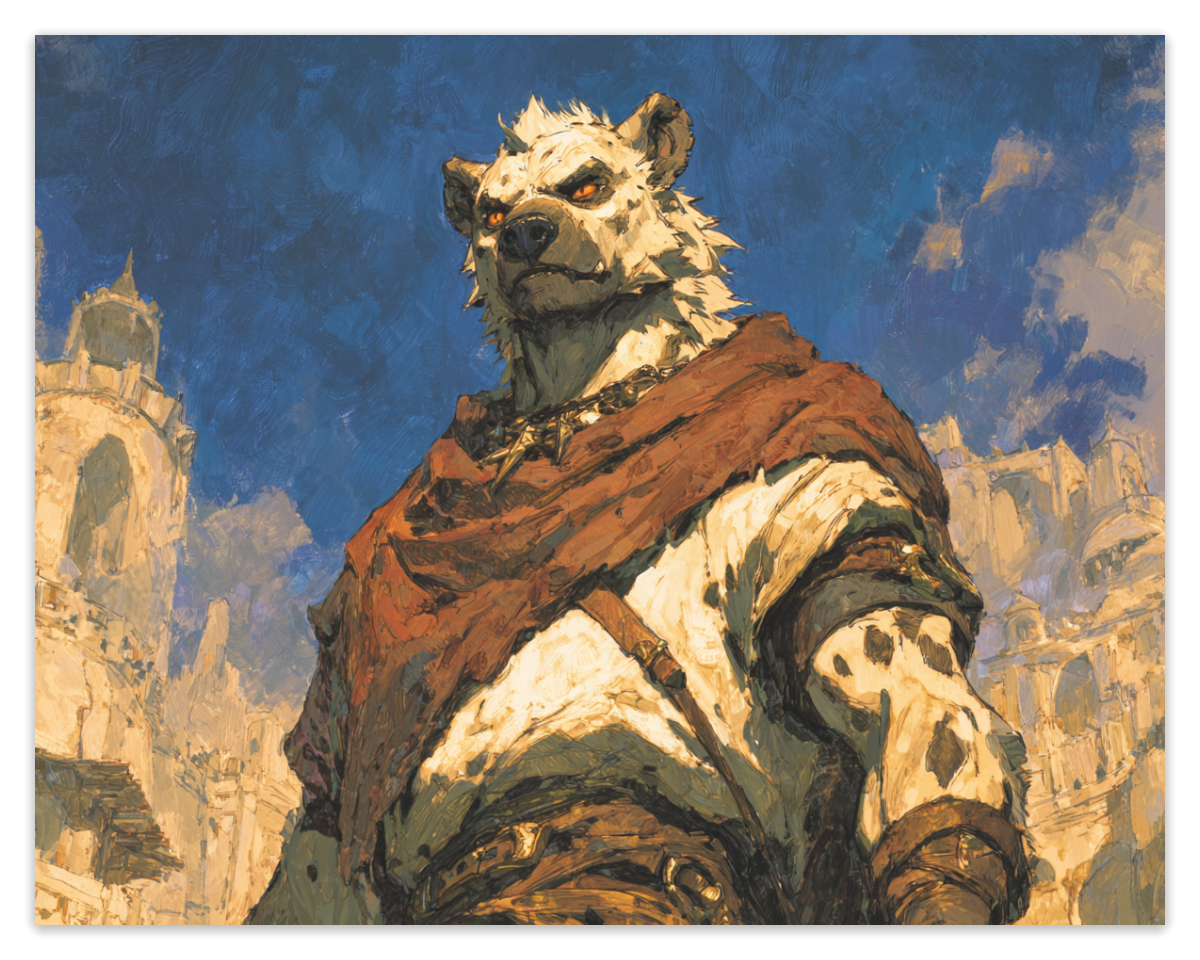
Ancestry · Iphexar · Old Midralis / Vasterien
Zalakiri
“The Zalakiri are not a people I can place on the Watch List in good conscience, not because they are harmless, but because the instrument of the Watch List was not designed for a people whose danger is not in what they might do, but in what they already are. The laughter you hear from a Zalakiri encampment at night is not celebration and it is not threat. It is a conversation in a language older than their words, in a register that was old before the Great Barrier was raised. I spent three weeks in a Velhari border settlement. I left knowing more about the infernal than the Conservatory has in its sealed archive, not because anyone told me anything, but because I learned to hear what the laughter was carrying.”
— Eonlogos, Celestian Archivist
Overview
The Zalakiri are a hyena-humanoid people of Vasterien — ancient in the region, shaped by the specific convergence of Old Midralis’s great basin ecology and the infernal energy that bled through the Great Barrier during the Elemental Cataclysm. They are called Gnolls by most of the outside world, a term they tolerate with the specific patience of people who have more pressing concerns than correcting strangers. Their own name, Zalakiri, carries a meaning in their oldest Daebaal register that outsiders consistently translate as “the laughing kind” and that Zalakiri linguists will tell you means something considerably more specific about what laughter is and what carrying it means.
They are the other significant people of Vasterien, and their history in the region is inseparable from the Felarian history that runs alongside it. In Old Midralis, both peoples were numerous in the great basin. The Cataclysm that remade Neo Midralis remade their relationship too: the slow desertification that replaced the green basin with the arid terrain of present-day Vasterien produced a competition for the remaining viable resources that neither people fully remembers starting and neither people has fully stopped prosecuting. What holds the current truce is not goodwill. It is the specific economic leverage of a border city that needs both peoples stable enough to trade.
What distinguishes the Zalakiri from the outside world’s mental category of “gnolls” is the thing that Eonlogos spent three weeks failing to fully decode: the laugh-register. Zalakiri laughter is not an emotional expression that bleeds into their communication. It is a communication system that operates in parallel with verbal speech, encoding pack hierarchy, territorial claims, ritual acknowledgment, and the specific registers of the N’zalak divide in a channel that Diplomata-acquired Daebaal does not carry and that most outsiders experience as atmospheric menace rather than structured language.
Origin & History
The Breach and the Becoming — Year 0
The Elemental Cataclysm’s effects on the Great Barrier were not uniform. The concentrated force of four Elemental Lords’ simultaneous defeat stressed the barrier’s architecture at specific points where elemental and infernal cosmological geometries overlapped — places where the barrier thinned and tore briefly, allowing direct energy bleed-through. The Vasterien breach point was one of these: a location in what was then the deep interior of the great basin where the barrier tore, allowing infernal energy to bleed through for hours and days until the barrier restabilized.
The proto-hyena packs that occupied the breach site absorbed this energy across the breach’s duration. When the barrier restabilized, the absorption was complete and permanent. Their descendants, over the following generations, completed the change — bipedal stance, enlarged cranium, and the specific cognitive architecture that infernal-saturated biology produces: intelligence organized around hierarchy reading, threat assessment, and the social mapping of obligation and debt.
Zalakiri oral tradition does not describe this event directly. The oldest layer of the Daebaal oral archive describes a period called the Tearing Laughter: a time when the world itself laughed, and the ancestors heard it and laughed back, and were never the same afterward.
The Great Basin — Old Midralis
Before the Cataclysm, the terrain that would become Vasterien was the great basin: a vast expanse of savannah, open woodland, and dense river-fed greenery that supported large populations of both Felarians and Zalakiri. The two peoples coexisted with the specific texture of coexistence that large predator populations achieve when territory is abundant enough to make conflict more expensive than avoidance. Zalakiri pack territories were organized around the water source networks that the basin’s Prisma Current-sustained climate system maintained. The laugh-register’s territorial nuance encoding, the specific laugh-patterns that communicate “this is mine,” “this is contested,” “this is yours but I am watching” — developed in this period, refined across millennia of precise resource negotiation.
The Desertification and the Feud — 1st Age
The Cataclysm’s disruption of Vasterien’s Prisma Current architecture did not produce an instant desert. It produced a slow failure: a progressive drying over centuries as the Current systems that had sustained the basin’s water table degraded without maintenance. Felarian oral tradition encodes this as “the long diminishment.” Zalakiri oral tradition encodes it differently: as a period when the laughter changed, when the pack-territories defined by reliable sources became defined instead by the absence of sources, when the laugh-pattern for “this is mine” began to be used in registers that previously meant “I am afraid.”
The feud that developed in this period was not declared. It accumulated. Resource competition escalated from disputed margins to actively contested core territories as the water sources failed. By the time Giris intervened in the 3rd Age, the feud had been running long enough that neither side could reliably identify the precipitating event. They were fighting because they had been fighting.
The Giris Truce — 3rd Age
The city of Giris — then as now the primary border settlement at Vasterien’s northern edge — brokered the truce between Felarians and Zalakiri with the specific motivation of a city that needs stable trade routes and finds sustained frontier warfare expensive. The Zalakiri position on the Giris truce is, in the 4th Age, one of the clearest expressions of the Ashketh-Velhari divide: Ashketh communities regard it as a Velhari concession to outside pressure that produced territorial boundaries the Ashketh did not ratify; Velhari communities regard it as a pragmatic arrangement that stopped a war both sides were losing.
The truce holds technically. The underlying conflict is entirely intact. Deniable skirmishes occur in the interior. Giris continues to apply the same economic pressure that produced the original truce, continues to be the primary reason it holds, and continues to have a more detailed intelligence picture of the Vasterien interior than any other outside institution.
The N’zalak Divide
The most significant internal division in Zalakiri culture is not geographic, not sub-type-based, and not organized around any formal institutional split. It is the question of N’zalak — what the connection means, what obligation it creates, and whether the answer to that question is veneration, rejection, or something more complicated that neither tradition has fully articulated. Both traditions agree on one thing: the Tearing Laughter happened. The ancestors were changed by something. What changed them is the point of fracture.
The Venerating Tradition
Communities in the venerating tradition hold that the energy that changed the ancestors was not an accident of cosmological proximity but a gift — that the proto-hyenas at the breach site were specifically chosen for their capacity, that the Tearing Laughter was an act of recognition rather than an act of spillage. The power the Zalakiri carry — their Prismal depth, their infernal-adjacent Echo, the laugh-register itself which in venerating theology is understood as N’zalak’s own voice finding expression in mortal throats — is sacred inheritance. This does not mean pledging loyalty to the infernal. The theology is more specific: a debt is acknowledged. The obligation is to be worthy of what was given, not to return it.
The venerating tradition’s ritual practice centers on specific laugh-register patterns used in ceremonial contexts. The most sacred of these patterns is called the Tearing-Echo: a laugh-sequence that the venerating tradition holds is the closest mortal approximation of what the Tearing Laughter sounded like. Practitioners who have performed the Tearing-Echo in full report experiences that they describe, in the Daebaal register, as “being heard from far away.”
The Rejecting Tradition
Communities in the rejecting tradition hold that the Tearing Laughter was exactly what it appears to be: an accident of cosmological proximity that contaminated the ancestors with energy that was never meant for them. The power the Zalakiri carry is real, but it is infernal in origin and infernal in character, and treating it as a gift naturalizes something that should be understood as a wound. The rejecting tradition does not argue that the Zalakiri should be ashamed of their origin — shame is not a useful framework for a people who need to eat and survive. It argues that venerating the source of the contamination is the specific form of self-betrayal that keeps the wound open.
The rejecting tradition’s practice involves working with the infernal-adjacent Spiritual Expressions deliberately — Fire most prominently, channeled through frameworks of purification and controlled burn rather than darkness and consumption. The laugh-register is used fully in the rejecting tradition, including territorial and hierarchy registers, but the specifically infernal ceremonial patterns are stripped out. Rejecting-tradition practitioners describe the stripped version as feeling “lighter.” Venerating-tradition practitioners describe it as “diminished.”
Where the Divide Lives
The divide maps onto the Ashketh-Velhari sub-type split in the way of a correlation that is real but not deterministic. Ashketh communities in the deep desert interior, where the original breach point’s energy saturation was most concentrated and isolation from outside cultural influence is greatest, trend strongly toward the venerating tradition. Velhari communities on the savannah margins, where sustained contact with other peoples has produced awareness of how the infernal association affects outside perception, trend toward the rejecting tradition. But the correlation is not absolute.
The divide is the source of the most significant internal Zalakiri political tensions in the 4th Age — more structurally significant than the Felarian conflict, which both traditions agree on opposing, and more emotionally charged than the Giris truce question, which both traditions find pragmatically navigable. Inter-tradition Zalakiri encounters are not violent by default. They are careful.
Culture & Society
The Laugh-Register
Daebaal is a language with a documented pack-social register and territorial nuance that outsiders who acquire it through Diplomata develop genuine functional fluency in. What they do not acquire is the laugh-register: the parallel communication system the Zalakiri operate simultaneously with speech, encoding information in vocalization patterns that range from barely-audible breath-based sounds to the full carrying laugh that outsiders hear as threatening and Zalakiri hear as a complex sentence.
The laugh-register has four primary layers, each with its own grammar. The hierarchy layer is the most continuously active — every Zalakiri in a social setting is producing and reading hierarchy signals in the laugh-register simultaneously with whatever verbal conversation is happening. The territorial layer activates in range-relevant contexts, encoding “mine,” “contested,” “acknowledged yours,” and more complex territorial relationships that Daebaal’s verbal register encodes only clumsily. The ritual layer is used in ceremonial contexts and is the layer most divided between venerating and rejecting traditions. The grief layer is the most private and least accessible to outsiders — it operates at frequencies that most non-Zalakiri cannot consciously hear, which is why most Midralis scholarship has not documented it.
The Eonlogos quote is not exaggerating. An outsider who spends sustained time in Zalakiri company and pays attention will begin to acquire fragments of the laugh-register without formal instruction, not through Diplomata’s acquisition mechanism, but through pattern-recognition that any sufficiently attentive person develops in sustained contact with a communication system they cannot initially decode. What they acquire will be imprecise, missing the cosmological dimensions that formal Zalakiri instruction provides. It will also be considerably more than they realize they have acquired.
Pack Structure and Short Lives
Zalakiri society is pack-organized, not in the loose metaphorical sense that some outsiders apply to any tribal structure, but in the specific sense of small, tight, multi-generational units whose internal governance is the primary political reality of each member’s life. The pack’s decisions are the decisions that matter. Inter-pack relationships are negotiated through specific formal channels that the laugh-register’s territorial layer encodes, and the results of those negotiations are as binding as any written treaty in a culture where written treaties are not the primary binding mechanism.
The ★☆☆☆☆ Celestrian Span shapes everything about pack culture. Knowledge transmission across short generational gaps is the most pressing institutional problem Zalakiri society faces: how to carry complex information across a forty-year life and into the next generation before the carrier dies. The laugh-register is part of the solution: it can encode compressed information in patterns that transmit faster than verbal instruction. The specific social role of elder-pack-members, those who have survived into their fifties, is another: elders are the repositories of inter-pack history, territorial negotiation precedent, and the ritual layers of the laugh-register, and the specific cultural weight given to their pronouncements reflects the community’s understanding that this knowledge will not exist in another twenty years if it is not transmitted now.
Sub-Types
The Ashketh and Velhari represent the two primary Zalakiri adaptations to Vasterien’s post-Cataclysm landscape. They are not rigidly distinct populations — inter-sub-type pack formation is common, and the children of mixed packs may belong to either sub-type. What distinguishes them is not genetics but the specific relationship each has developed with the terrain they occupy, the outside world they contact, and the N’zalak question they live inside.


Physical Features
- Stature: 6’–7’ tall, muscular and imposing; Velhari run toward the upper range; Ashketh tend leaner and more efficient; both sub-types carry the dense musculature of beings built for sustained physical effort in demanding terrain.
- Fur & Coloration: Full-body coverage in hyena-adjacent patterns. Ashketh run toward muted desert colors (dust gray, pale ochre, washed-out brown); Velhari toward richer savannah tones (tawny, burnt orange, streaked brown). Spots, stripes, and irregular markings are common across both sub-types.
- Face: Elongated hyena-adjacent muzzle with pronounced teeth. The muzzle and jaw musculature that supports the laugh-register’s range is visible in the specific development of the lower facial structure — Zalakiri faces are built around the vocal apparatus in a way that outsiders consistently describe as predatory but that functions as much as a precision instrument as a weapon.
- Eyes: Golden-amber across both sub-types, with the specific low-light visual adaptation that predator-origin peoples consistently develop. The eyes carry an intensity of focus that outsiders read as threatening and that is more accurately described as evaluative, a Zalakiri looking at something is assessing it, and the assessment is visible.
- Laugh-register anatomy: The specific vocal apparatus that produces the laugh-register’s range is visible as a subtle difference in the hyoid bone structure and laryngeal cartilage. No outside scholar has published a full anatomical account of this structure, because the Zalakiri who have interacted with outside anatomical scholarship have consistently declined to provide sufficient access for one.
- Infernal marking: Some Zalakiri, disproportionately from venerating tradition communities, carry faint bioluminescent markings that become visible in complete darkness. These markings develop in adolescence and intensify with age. They are understood in the venerating tradition as the infernal inheritance becoming visible, and in the rejecting tradition as an infernal contamination marker that is managed but not eliminated.
Alignment
Zalakiri are primarily chaotic in nature, driven by pack loyalty over abstract law and by the specific ethical framework of a people whose lives are short enough that deferring ethical decisions to future generations is not a viable strategy. What is right for the pack now is the primary moral question; what outside institutions consider right is a secondary consideration weighted by how much power those institutions have to enforce their position.
Individual Zalakiri vary considerably by tradition and sub-type. Venerating-tradition practitioners develop an ethical framework organized around acknowledgment and obligation that produces a kind of reliability outsiders sometimes mistake for lawfulness — if a venerating Zalakiri tells you they will do something, they will do it, because the framework of acknowledged debt makes breaking stated obligations cosmologically significant rather than merely socially inconvenient. Rejecting-tradition practitioners develop a different kind of reliability: they will tell you when they will not do something rather than pretending the constraint does not exist.
Affinity Disposition
Zalakiri Spiritual Expression distribution reflects the specific infernal saturation of their origin. Darkness at 14.0 is the dominant expression — consistent with their infernal origin, with the deep desert interior’s residual saturation, and with a people whose most sacred communication register operates in a channel that most other ancestries cannot consciously perceive. Fire at 12.0 is the second dominant expression, reflecting both infernal origin and the character of Vasterien’s desert ecology and the rejecting tradition’s channeling of infernal energy through purification frameworks. Light at 3.0 is the most notably suppressed expression — a predictable consequence of an infernal-origin population whose dominant cosmological association is with the opposite register.
| Spiritual Expression | Distribution (%) |
|---|---|
| Nature | 9.0 |
| Wind | 8.0 |
| Anima | 8.0 |
| Mind | 7.0 |
| Fire | 12.0 |
| Metal | 5.5 |
| Earth | 7.0 |
| Aqua | 5.0 |
| Electricity | 5.0 |
| Ice | 4.0 |
| Thunder | 7.0 |
| Darkness | 14.0 |
| Light | 3.0 |
| Empyreal | 0.5 |
Conflicts & Connections
With the Felarians — The Interrupted Feud
The Zalakiri-Felarian relationship is the defining inter-people dynamic of Vasterien. The feud predates both peoples’ living memory, which means it predates the specific individuals and communities who prosecute it and has acquired the specific inertia of conflicts that are older than the people fighting them. Neither people knows what started it. Both peoples know what has happened since, in considerable and deeply felt detail.
The Zalakiri perspective on the Felarians carries a specific asymmetry: Zalakiri communities at terrain margins are simultaneously conducting the verbal contact that both sides acknowledge and the laugh-register communication that the Felarians cannot fully decode. Felarian communities with their extraordinary sensory acuity are aware that something is happening in a channel they cannot read. This asymmetry: the Zalakiri knowing what both sides are saying, the Felarians knowing that something is being said they cannot access — is the specific texture of the current truce’s frontier: functional, adversarial, and watched very carefully from both directions.
With Giris — The Economic Leash
Giris brokered the truce and Giris maintains the truce and Giris is under no illusions about what it is doing. The city’s leverage over both Zalakiri and Felarian communities is economic — access to trade goods, markets, and the specific material dependencies that both peoples have developed over centuries of controlled border-city contact. The Velhari sub-type is most directly within this leverage because they are the Zalakiri most integrated into the trade relationships Giris manages. The Zalakiri position on Giris is pragmatic without being warm. The city is useful. The city is also the primary mechanism by which outside institutional attention reaches the Vasterien interior, and that is a function that Velhari community leaders think about with considerable sophistication.
With the Concordiax — Institutional Irrelevance
The Concordiax has largely written off the Zalakiri as a regulatory priority: a conclusion that the Zalakiri have noticed and find more useful than any alternative relationship with that institution would be. The Concordiax’s files on Zalakiri Prismal capacity are inaccurate in the direction of underestimation, the files on Zalakiri population distribution are incomplete, and the files on the laugh-register contain a single entry from a 3rd Age survey that reads “Gnoll vocalization patterns appear threatening but carry no structured content” and has not been revised since.
Language Notes
Daebaal (racial language) carries a pack-social register and territorial nuance that outsiders who acquire it through Diplomata develop genuine functional fluency in. What they do not acquire, what the Diplomata mechanism cannot produce, is the laugh-register: the parallel communication system the Zalakiri operate simultaneously with speech. Outsiders who have learned conversational Daebaal typically have functional access to the verbal register. The laugh-register, and the specific cosmological dimensions it encodes in its deeper layers, are not accessible without long-term community immersion and formal Zalakiri instruction.
The laugh-register’s complexity reflects millennia of development: its territorial layer predates the N’zalak influence by enough generations that linguists studying the oldest layer of Daebaal treat it as evidence of pre-infernal Zalakiri social complexity that the “gnolls are simple” framing consistently underestimates. Its ritual and grief layers are the most restricted, the least documented, and the most consequential for understanding what the Zalakiri actually are versus what outside institutions believe them to be.
Systems & Campaigns
- Pathfinder 2e Gnoll › Zalakiri
- D&D 5e+ Gnoll › Zalakiri
- Draw Steel TBD
- Daggerheart TBD
- Realmfall Saga Active
- Ultimus Concluded