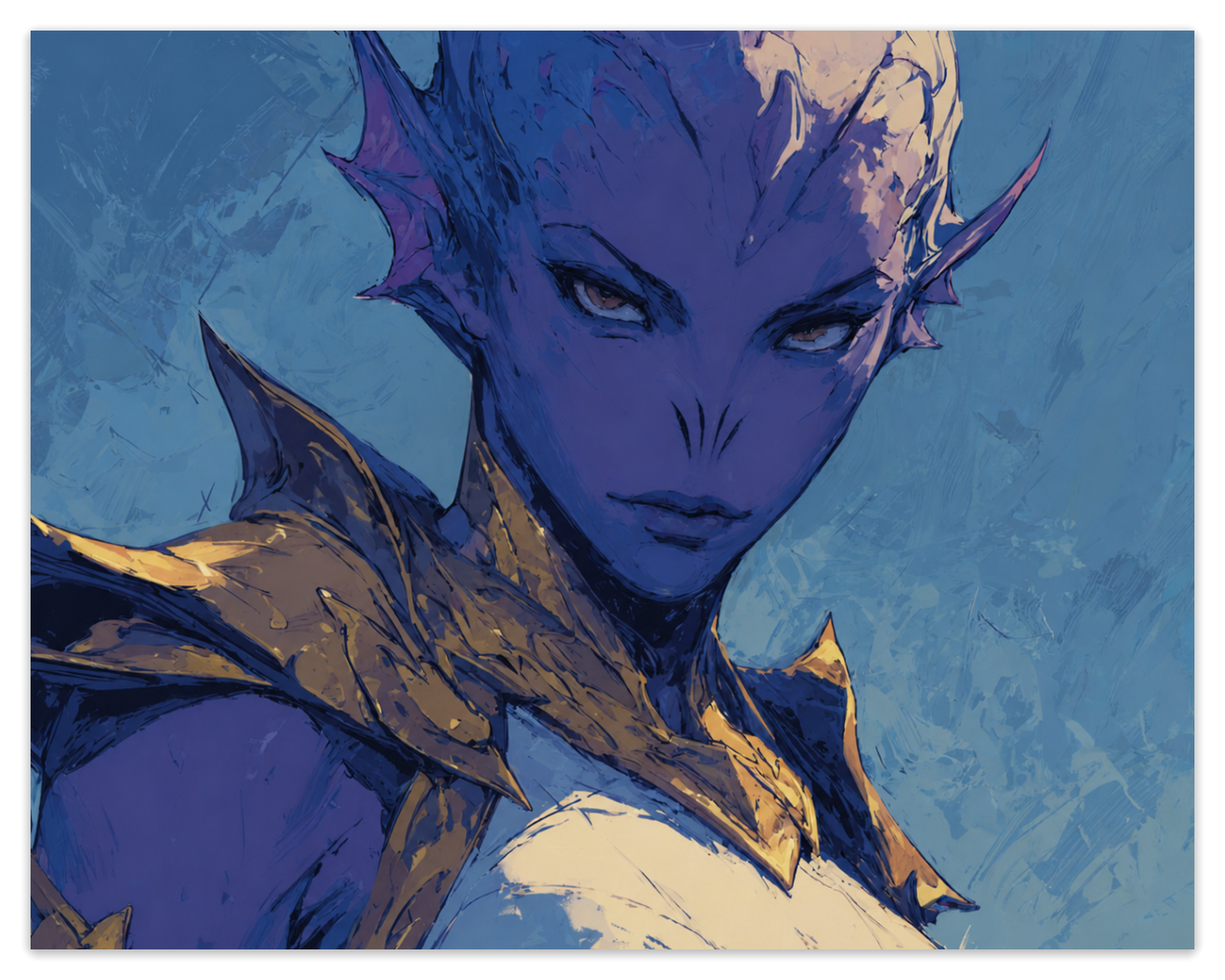
Ancestry · Iphexar · Midralis
Hydroling
 Common
“They grieve for something they have not been told they lost. I have watched enough peoples carry history to recognize the posture. The Hydrolings carry it in their relationship to the current ocean: the particular attention of someone who is not quite in the place they call home, tending it with a care that goes beyond what ecology requires.”
— Eonlogos, Celosian ArchivistOverview
Hydrolings are one of the oldest mortal races in Midralis, here before the world became what it now is. Their ancestors swam seas that no longer exist, and what the Elemental Cataclysm left behind was a different ocean. Hydrolings adapted. They speak of it as purpose.
In practice, this means that a Hydroling who greets you on a coastal dock has already made assessments you cannot see. They have read the tide’s position relative to the nearest Ebb Council session. They have noted whether you are someone their community’s oral tradition contains. They have calibrated, without appearing to, how much of what they know is appropriate for someone at your level of trust. This is the ordinary social texture of a people who have organized their interior life around the principle that knowledge travels at the right depth, not the highest speed.
They are amphibious, equally functional on land and underwater, though their presence on land has always been conditional the way a tide’s is: they come and go according to rhythms that land races read as diplomatic timing and Hydrolings understand as ecology. Hydroling neutrality is the form that survival has taken across millennia of navigating a world that has never been reliably interested in the ocean's politics.
Physical Features
Three Features Outsiders Consistently Misread
Three physical features of Hydrolings carry social and functional meaning that non-Hydrolings reliably miss.
- Hair – Where present, fine and silky, running along the hairline and sometimes down the back of the neck. On land, hair that should be reading water current is reading air instead, which produces what outsiders describe as unusual attentiveness and Hydrolings experience as having one sense running mostly on noise. It is not decorative.
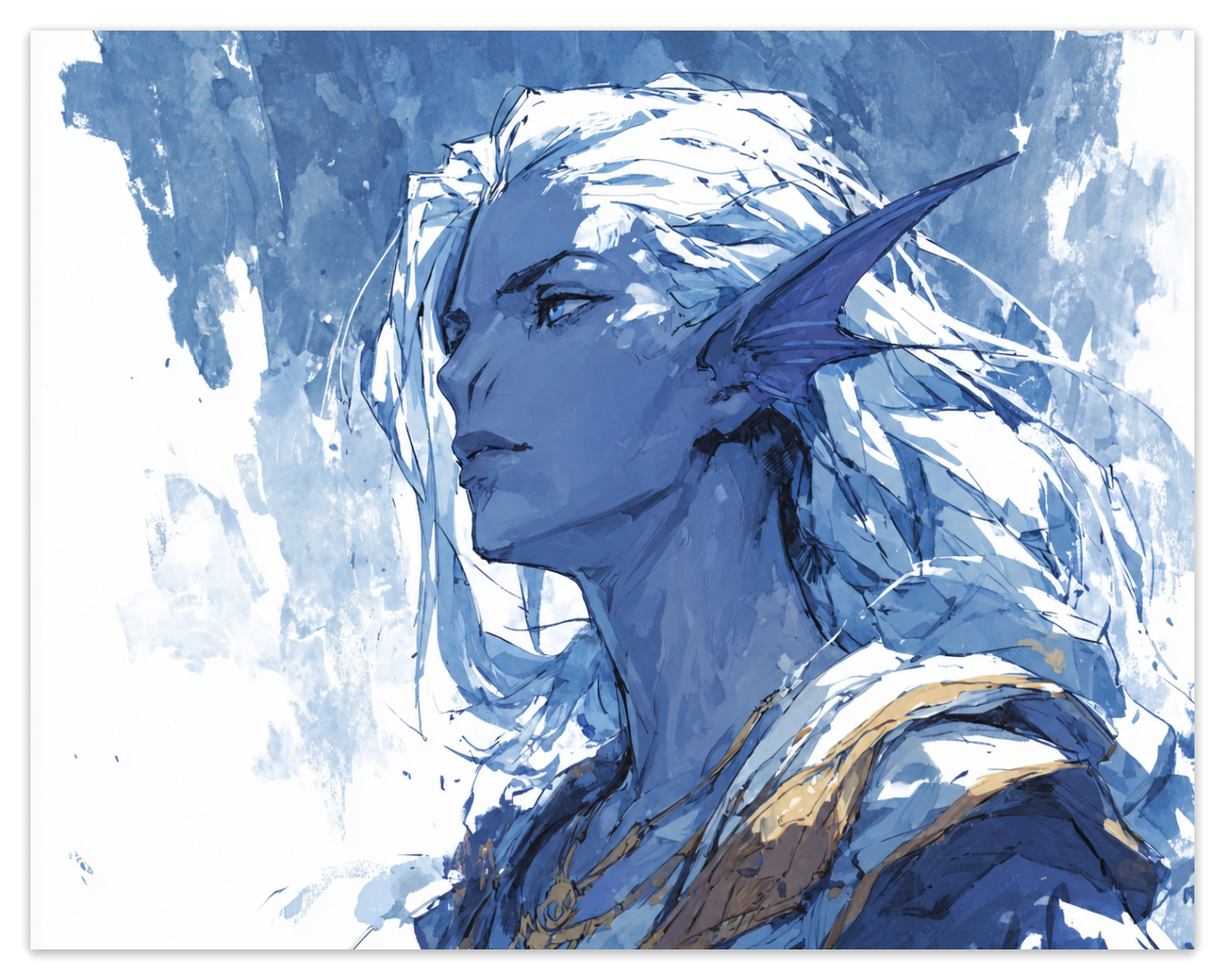
- Ear fins – Position and movement are precise emotional signals: stress, calm, attention, skepticism, and the specific fin-set that means “I am listening at depth to something you cannot hear.” Non-Hydrolings read ear-fin movement as decorative or involuntary. Hydrolings in prolonged diplomatic contact with land races sometimes develop a conscious habit of stilling the fins to reduce information leakage. Other Hydrolings in the room recognize the effort immediately.
- The gloves – Hydroling hands are webbed; the webbing retractable but present. Gloves worn on land are sometimes functional. More often they are social: the practical reduction of the pause that happens when a land interlocutor notices webbed hands and loses the thread of the conversation. A Hydroling who removes their gloves in a social context is not making a statement about comfort. They are making a statement about trust.
A Hydroling who notices another stilling their fins in conversation, or keeping their gloves on in a context where gloves are unusual, is receiving precise social information. They will not acknowledge having received it. They will adjust their own behavior accordingly. Acknowledging it directly would be intrusive.
- Height 5’8”–6’5”; muscular and lean, built for sustained movement through water and on land in equal measure
- Skin smooth; deep oceanic blues through mid-range teals to lighter coastal hues, darker in those who work the deep water
- Gill nares in place of a protruding nose: two to four narrow gill-like slits that assist with aquatic respiration and scent detection underwater; large eyes adapted for low-light at depth with a slight reflective quality in darkness
- Lifespan 150–200 years standard; exceptional individuals reach 220
Origin & History
The Tears of the Ocean Goddess
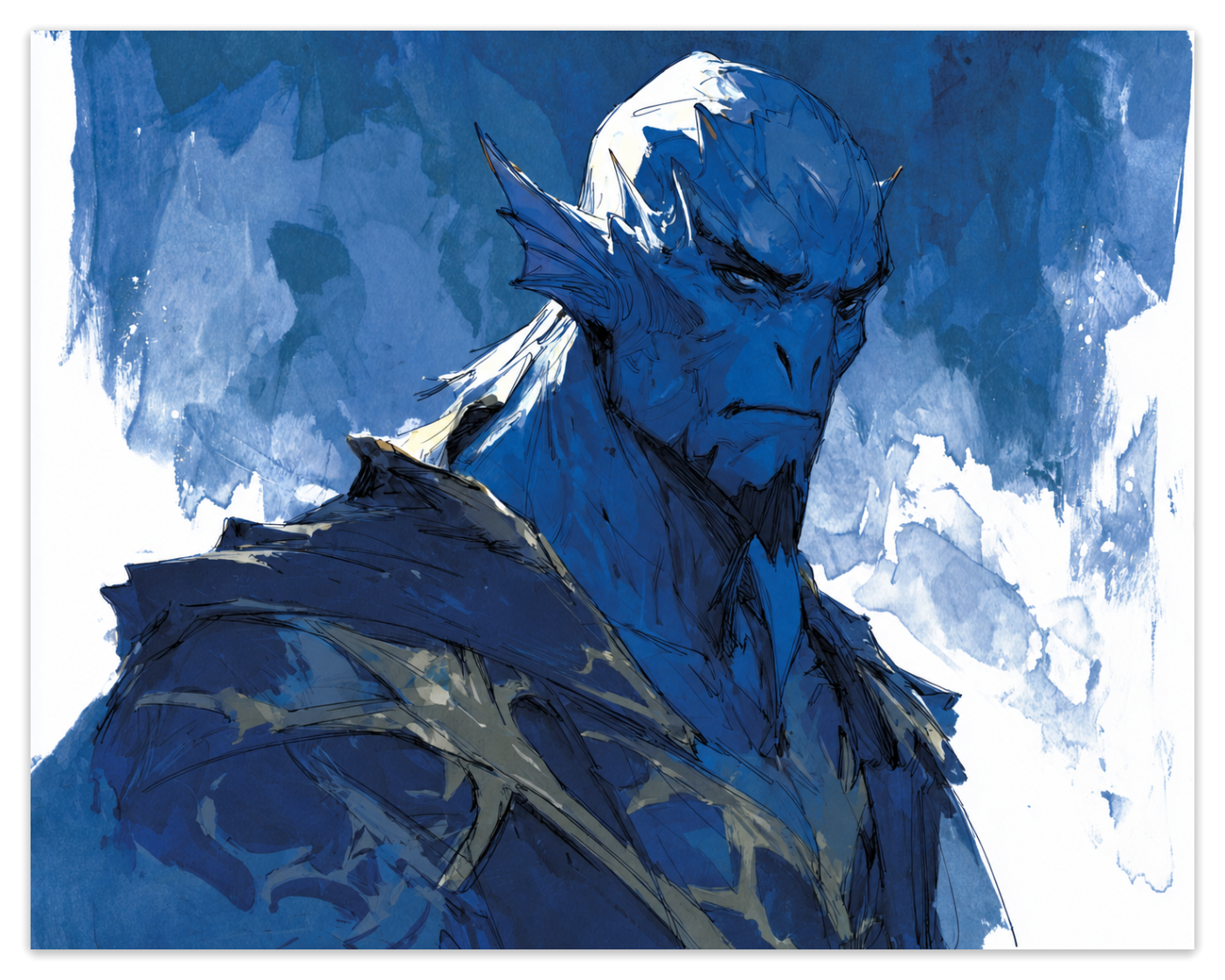
Hydroling origin mythology describes their creation as the tears of a grieving ocean goddess: a divine being who wept for the suffering and imbalance in Old Midralis, whose tears mingled with the waters and gave rise to the first Hydrolings, entrusted with the stewardship of the seas. Hydroling scholarship takes the account seriously: poetically accurate with a precision that exceeds what myths usually achieve, framed as befits something that happened before anyone was present to record it, but carrying real weight.
What this deity was precisely, and what became of her, are questions that elder tradition holds with care. The answers, to the extent they exist at all, are held within the tradition. What the Concordiax knows is that Hydrolings predate the New Age, that their spiritual profile carries markers their ancestry alone cannot explain, and that they decline to elaborate on this with the particular quality of politeness that signals the subject is closed.
When the Ocean Changed
The Elemental Cataclysm at Year 0 N.A. reshaped Midralis at a geological level. For Hydrolings, the Cataclysm was more than a catastrophe: the seas they had evolved in ceased to exist. The Oreshi Ocean that Hydrolings now navigate is not the body of water their ancestors swam. The current ocean is a post-Cataclysm construction in every detail: the Azure Expanse, the coastal geometries of Auridia and Kyou, the depth profiles of the ocean floor. By Hydroling reckoning, four thousand years is recent.
Hydroling oral tradition preserves fragments of Old Midralis ocean geography: navigational chants and ceremonial passages that encode routes and depth profiles from before the Cataclysm remade the seafloor. Within Hydroling scholarly culture, these fragments are treated as ritual poetry, metaphorical accounts of spiritual journeys rather than literal cartography. The places they describe cannot be located in the current ocean. The scholarly consensus holds that this is because they were never meant to be located. Whether the community believes this is a question the scholarly culture does not ask aloud.
Community Structure
Tidal Governance: The Ebb Council
Hydroling communities are organized around governance that mirrors tidal patterns: periods of concentrated collective decision-making that alternate with periods of distributed individual action, formal sessions at predictable tidal intervals that cannot be convened outside them, and a deep assumption that a decision improves by waiting for the right moment rather than forcing it at the wrong one.
The Ebb Council, the formal deliberative body of a Hydroling community, convenes at fixed tidal intervals. Between sessions, individual Hydrolings act with a degree of autonomy that land races sometimes mistake for decentralization. It is trust in the rhythm. A Hydroling who takes an action between sessions is expected to account for it when the tide comes in. Most can.
This system produces decisions with extraordinary durability: Hydroling diplomatic agreements are among the most reliable in Midralis, treated as binding with a consistency most inter-racial arrangements do not achieve. The inflexibility is the price. A Hydroling diplomat who cannot commit to something “until the Council” is genuinely unable to commit without it. Non-Hydroling negotiators who learn to work with the rhythm rather than against it find the system more reliable than it appears from outside.
The Tide-Breaker
The Ebb Council system has one failure mode that Hydroling communities know well and discuss only privately: the Tide-Breaker. The term describes a Hydroling who acted between sessions in a situation where waiting seemed impossible, or where they convinced themselves it seemed impossible, and whose action could not be fully accounted for when the tide came in.
A Tide-Breaker is not formally exiled. No one announces the change. What happens is subtler and more thorough: the community’s trust reorganizes around their absence. They are still invited to Council. Their contributions are still heard. What changes is the texture of the listening, the slight pause before others respond, the way subsequent speakers acknowledge the previous point without attributing it, the quality of attention that communicates “we heard you, and we are waiting to see.” A senior Tide-Breaker has usually spent enough social capital before the incident to maintain functional standing. A younger one is learning what the rhythm actually costs to break, and that lesson has no formal end date.
The inverse of the Tide-Breaker has no formal name because formal recognition is not how Hydroling communities work. What it looks like in practice: the younger Hydroling whose between-session record is so clean, whose accounting to the Council so precise, that the elders stop auditing the explanations and start consulting them for pattern. The transition happens without announcement. That is how the community signals it.
Ordinary Life
Hydroling social life is organized around what you are allowed to know, not what you can do, not what status you were born into: what you have been trusted with. Knowledge in Hydroling culture is relationship before it is information. When an elder shares something that they have not shared with most of your age cohort, they are not educating you. They are choosing you. The distinction is understood by every Hydroling and never stated directly.
Childhood and Coming of Age
Hydroling children are taught the surface of things with great care and warmth: the ecology of the coastal shallows, the names and habits of marine species whose behavior encodes ecological health, the basic forms of Hydrona, the navigational principles that govern open water travel. All of it is genuine. All of it is also the outermost layer.
Ceremonies exist, but coming of age is not marked by them. It is marked by the first time an elder sits down with a young Hydroling and says something that required having watched them long enough to decide. The young Hydroling who receives this knows what it means. They do not tell their peers what they were told. They note who else among their cohort has changed in a particular way: a new quality of listening, a subtle shift in posture around certain elders. They understand that their cohort is being sorted, slowly, over years, by the calibration of trust.
What this produces in young Hydrolings not yet chosen is patience: the kind outsiders read as passivity, which is its opposite. The young Hydroling who appears simply to be going about their work is building the record that will eventually determine what they are trusted with. Every action between tide-sessions is an audition.
Courtship
Hydroling courtship is conducted in public and understood only partially by those watching. The visible dimension is genuine: shared ocean outings, exchange of small crafted objects, the increasingly deliberate positioning near each other at community gatherings. These are real signals, read correctly by any attentive observer.
What outsiders cannot read is the second dimension: the knowledge exchange. When a Hydroling who is considering a partner begins sharing things they have not shared before, their family’s position in the oral tradition, their personal understanding of community history they were trusted with earlier than most, the texture of what they know and when. That is the more significant offer. Marriage in Hydroling culture is two lineages deciding that what they each know should be able to travel between them. Knowledge compatibility matters as much as personal compatibility, and the two are not always the same thing.
The Hydroling courting someone outside their knowledge tier, who knows things their prospective partner has not been trusted with yet, or whose partner knows things they have not, is in a position that communities discuss only obliquely. The elder who quietly schedules a conversation with that young Hydroling is doing something more precise than forbidding the relationship. They are assessing whether the young Hydroling understands what it will cost in terms of what cannot travel between them.
None of this means the society is cold. One thing that is not organized around knowledge: the attentiveness Hydroling communities give to their very young and their very old. Infants are held with a particular steadiness that has nothing to do with trust calibration, because infants have no trust tier. Elders whose memory has begun to soften are accompanied, not managed: someone swims with them, sits with them at the tidal margin, remains present without agenda. These are the moments in Hydroling life where the knowledge architecture is set aside, and what remains is older than the architecture.
The Shorebound
The Shorebound is the most legible Hydroling failure mode and the least discussed. A Hydroling who has spent too long on land, whether through diplomatic posting, personal attachment to a land community, commercial engagement, or the slow drift that comes from finding land life easier than the tidal rhythm requires, changes. Skin that should be deep ocean blue goes translucent over years. The tidal instincts dull. The ear fins lose some of their responsive precision. The deep tongue becomes effortful. These changes are visible to other Hydrolings and meaningless to land races, which is its own problem.
The Shorebound has violated no formal rule. They are considered, in the social register Hydroling communities use for this, somewhere between pitiable and untrustworthy: pitiable because the drift is understood as loss rather than choice by most who observe it; untrustworthy because a Hydroling whose tidal instincts have dulled is a Hydroling whose judgment about when to act and when to wait, the foundational Hydroling competence, is unreliable. Communities that receive a Shorebound visitor are warm in the surface sense and careful in the deep sense. They do not share with a Shorebound what they would share with a Hydroling living in proper tidal rhythm. The Shorebound, if they have been gone long enough, may not notice the difference.
Humor and Shame
Hydroling humor is organized around timing, because for a people whose social architecture is built on tidal rhythm, a joke placed at the wrong moment is something worse than unfunny. It is slightly rude. The ideal Hydroling joke surfaces at the precise moment when a conversational tide is turning: when what was being said has been fully heard and the shift toward response is beginning. A joke placed there does not interrupt. It surfaces. The funniest Hydroling in a room is usually also the most trusted, because the funniest observations require knowing the most.
Hydroling shame runs in two registers. The first is the shame of acting at the wrong time, the Tide-Breaker shame, the failure of rhythmic judgment. It is visible to other Hydrolings and recoverable: demonstrated good judgment over years can address it, though the addressing takes years. The second is quieter and harder. The Hydroling who discovers that what they believed they held was only an outer layer of something deeper they were never given experiences a structural shame: the shame of having misread their own position in the community’s trust economy. This shame is private, rarely discussed, and leaves no formal record. It is also among the most motivating forces in Hydroling culture.
Private Dissent
The young Hydroling who is intelligent enough to understand the knowledge architecture, and clear-eyed enough to find the withholding unreasonable, exists in every generation. They know that elders hold things they are not being told. They know that “this is not your depth yet” means different things depending on whether it comes from genuine care or strategic positioning. Their community has no formal mechanism for contesting an elder’s judgment about readiness.
Private dissent takes forms that are entirely deniable: questions technically about ecology but structurally about authority, careful attention to the moments when elder behavior does not match elder teaching, or simply the particular quality of conversation two young Hydrolings have when both know they are missing something and want to understand its shape. Neither party refers to what the conversation is actually about. If asked, both would describe it as a discussion of navigational theory. The elders who notice it, and the best elders do notice it, consider it a healthy sign. The young Hydroling who never shows any sign of this conversation is the one the elders watch more carefully. What neither party in the conversation names is that it is also, in the register that predates all of this, simply friendship: the kind that requires no trust tier to establish.
The Abyssalon Rivalry
The Abyssalons are ancient beings dwelling in the deepest reaches of the ocean: the Abissus, as Hydroling tradition names the zone, which maps roughly onto “the depth where light has never reached and pressure has rearranged the rules.” They have been in sustained conflict with Hydroling communities since before the New Age began. The Concordiax classifies the Abyssalon conflict as a territorial dispute. Hydrolings do not correct this classification. When asked, they describe territory and ancient grievance. The description accounts for enough of the observable evidence to be serviceable. That is not the same as sufficient.
The Veteran the Conflict Produces
The Hydrolings who do sustained work at the deep boundary do not come back the same. The term Hydroling communities use is deepened, which functions simultaneously as a compliment and a warning. A deepened Hydroling carries recognizable markers: slower to commit to surface-layer conversation, prone to long pauses that are not hesitation but listening to something others cannot hear, more comfortable in low light than even other Hydrolings. At a community gathering, they are the one near the edge of the room, facing the water, who speaks rarely and is heard carefully when they do.
The household anxiety this produces is specific: not fear that the deepened Hydroling is dangerous, but the particular form of care that watches someone return from a place it knows will eventually be the place they do not return from.
The deepened occupy a social position that communities handle by not naming it. They are not elders in the formal sense. They are something more exact: adults who have been to where the knowledge is hardest and come back still functional. Younger Hydrolings are drawn to them with a curiosity that is partly admiration and partly self-assessment of the sharpest kind. The deepened notice this. They neither encourage it nor refuse it. They wait to see which quality of attention the younger Hydroling brings to the third or fourth conversation, because that is when the self-assessment resolves. Communities rely on the deepened in ways they handle by not acknowledging. When a decision falls outside any deepened individual's formal standing, their opinion tends to arrive through the voices of those who consulted them first. The pretending-not-to is a Hydroling social grace: it keeps the deepened's authority functional without requiring the community to formalize what it cannot explain.
The Lost Ocean
Hydroling culture carries the weight of Old Midralis’s ocean without fully knowing it does. Practices, ritual structures, and navigational traditions encode information about a marine environment that has not existed for four thousand years. The fragments that surface in scholarly analysis are treated as myth, which is the container the culture has found for something it cannot place.
It manifests as a particularly intense investment in the current ocean rather than as grief: an attention to its character, its geography, its Prisma Current patterns, that carries something of the quality of love for a place you arrived at after losing somewhere else. Hydrolings do not know they arrived. They know, at a level prior to analysis, that the ocean they guard is worth guarding, and that what happens to it matters more than the land world currently understands.
The weight distributes into daily life in customs that feel simply correct to those who follow them: a prohibition against disturbing seabed sediment in areas where old ocean floor might still underlie new geology; a mourning practice for Hydrolings lost at sea that involves releasing something personal into the water rather than holding a ceremony on land. The particular discomfort many Hydrolings feel when inland is called homesickness, but it is older and stranger than the word implies.
Affinity Disposition: Strongly Skewed
Aqua is the overwhelming dominant in Hydroling Spiritual Expression: the single highest concentration of any expression in any mortal race’s affinity profile. Ice and Darkness follow, reflecting the deep-water environment that Hydroling Spira has been shaped by since before the Cataclysm.
The elevated Darkness is socially consequential in ways the Conservatory’s aggregate data does not capture. Deep-water practitioners who specialize in Darkness expression are understood within Hydroling communities as workers in the register the Abyssalon boundary requires, suited to the particular depths where the hard work happens. Within communities, a Darkness-specialist occupies a position of quiet prestige that sits outside the formal tier system but is universally understood: invited to gatherings others are not, their opinions on deep-water matters carrying weight their formal seniority alone would not explain. They sit at the edge of rooms. They face the water.
Fire and Metal are the lowest expressions. A Hydroling Fire practitioner is rare enough to attract the quiet scholarly interest that polite cultures express by not asking directly. Within the community, a Fire-expressing individual registers as someone whose Spira is pointing in a direction the ocean does not point: not condemned, not suspect, but noticed as someone whose orientation raises an unspoken question about where it will eventually take them.
The Empyreal baseline (0.5%) is consistent with mortal norms. Hydroling theologians, when asked why proximity to quasi-divine origin leaves this figure unchanged, observe that being shaped by a divine event differs from being connected to the divine. Then they change the subject.
This table reflects population-level Spira tendencies; individual variation applies.
| Spiritual Expression | Distribution (%) |
|---|---|
| Nature | 8.5 |
| Wind | 8.0 |
| Anima | 7.0 |
| Mind | 5.5 |
| Fire | 5.0 |
| Metal | 5.0 |
| Earth | 6.0 |
| Aqua | 13.0 |
| Electricity | 6.0 |
| Ice | 10.0 |
| Thunder | 7.5 |
| Darkness | 9.5 |
| Light | 8.5 |
| Empyreal | 0.5 |
World-Side Relations
With the Concordiax
The relationship is one of studied diplomatic distance. The Concordiax has made repeated efforts to bring Hydroling practitioners within the Verbum licensing framework. Hydrolings have responded with consistent, gracious non-compliance: cooperating on surface-level matters, declining to participate in the regulatory structures that would require making their deep-water practice legible to Conservatory classification, and explaining, with great courtesy, that the framework does not have the depth for what they do. The Concordiax has not found a lever that produces access. The Hydrolings have noted which levers were tried.
With Coastal Myûr States
The relationship is productive and genuinely complex. Coastal Myûr communities depend on marine resources that Hydroling environmental stewardship maintains. This is the closest thing Hydrolings have to a land-side alliance, consistently framed as a partnership of mutual interest rather than an alliance, a distinction that matters to Hydrolings in ways their Myûr partners sometimes find unnecessarily fastidious. The fastidiousness is structural: the moment Hydrolings accept the alliance framing, coastline access becomes contingent on the alliance’s political health, which is not a dependency Hydroling communities are willing to accept.
With the Republic of Jag’dri
Jag’dri holds the most politically integrated Hydroling presence of any land-side state. Its coastal communities, particularly around Ridia, have included Hydroling populations long enough that Hydrona is now spoken alongside Jag’dri Standard in coastal settlements, and Hydroling Ebb Councils hold recognized roles in the republic’s governance structure, seated rather than merely consulted. This integration is real and reflects generations of genuine co-habitation. Something else underlies it: something the Dewan Amara understands without having stated: the republic’s access to the Azure Sea ecology, the river systems, and the Nauvekk depends substantially on Hydroling stewardship cooperation. Both parties understand this. Neither states it as a dependency in formal diplomatic language.
With Azure Expanse Island Communities
Island communities in the Azure Expanse represent the warmest relationships Hydrolings maintain with any land-side people. Those that have coexisted with Hydroling populations for generations tend to develop cultural accommodations that mainland states lack: tidal timing built into governance schedules, Hydroling linguistic patterns partially integrated into local dialects, mutual dependence old enough to have produced genuine cross-cultural integration rather than diplomatic courtesy. These are the communities where Hydrolings are most likely to relax the surface register in mixed company, which those communities understand as the significant signal it is.
Hydrolings Today
In the 4th Age, Hydrolings are present across the Azure Expanse and Oreshi Ocean coastlines: available for trade, environmental consultation, and diplomacy, and more strategically significant than any of that suggests. They have not corrected this impression. The Ebb Councils are deliberating on matters the land world has not been told about. They will deliberate at the right pace.
Demand for Hydroling environmental expertise has grown significantly as coastal communities contend with consequences of their own ocean use. This has produced a generation of Hydroling diplomats more comfortable with extended land posting than any previous generation. The Shorebound problem is more visible than it has ever been, and that is not the full difficulty. Some of the land-posted generation are good at it: effective in land institutional contexts, valued by their partners, genuinely useful to the communities they work within. The elder question, the one that does not get raised in Council, is whether a Hydroling who has become that useful to a land institution is still operating within the architecture, or has quietly become something it cannot contain.
Language Notes
Hydrona is an Old Midralis language with no close relatives among current Midralian tongues. Structurally distinct from all other languages in the Diplomata corpus, it was developed in an environment where sound travels differently, producing tonal and resonant registers that encode depth, current, and underwater spatial orientation as intrinsic elements of meaning. These are grammatical features, not vocabulary items, and non-Hydroling vocal anatomy cannot fully replicate them.
Surface and Deep
The surface register of Hydrona, used in land-side diplomatic contexts, is a modified form that sacrifices precision for accessibility. It is the Hydroling version of speaking slowly and clearly to someone struggling with the language: serviceable, functional, and missing most of what matters. Hydrolings who use the surface register with each other in formal contexts or when non-Hydroling observers are present are understood by other Hydrolings to be deliberately operating in public mode. The fin-position that accompanies sustained surface-register conversation between two Hydrolings who know each other well communicates this precisely: we are performing accessibility; stay with me.
The deep tongue is a different instrument. It was developed in an environment where sound carries spatial and depth information as part of its basic grammar: the direction a current is flowing, the depth of a body of water, the distance between two points at specific tidal phases. A Hydroling using the deep tongue to describe a location is doing something different from describing it. They are locating it within a continuous spatial-acoustic map that all speakers of the deep tongue share. This is what the navigational chants are: not songs about places, but places expressed in the medium that best holds them.
Systems & Campaigns
- Pathfinder 2e TBD
- Draw Steel TBD
- Daggerheart TBD
- D&D 5e+ TBD
- Realmfall Saga Active