Ancestry · Iphexar · Veraldié / Midralis
Veralín
“The Veralín, often called the Keepers of the Canopies, are a prime example of Midralis’s ability to mold life in ways that challenge our understanding of evolution and adaptation. Despite their playful demeanour and seemingly chaotic nature, these beings possess an unparalleled sense of loyalty and wisdom, gained from centuries of living at the intersection of two worlds. Their survival skills, combined with their extraordinary Prismal inheritance, make them formidable guardians of the places they have chosen to call home. There are few who can match their resilience. And fewer still who understand what it costs them to be here rather than there.”
— Eonlogos, Celestian Archivist
Overview
The Veralín — called Feykin by most of the outside world, a name they accept with the specific patience of people who have more important things to correct — are the beings of Veraldié who crossed into Midralis during the Fey Migration of the 3rd Age. They are not a people who chose migration as opportunity. They are a people for whom staying became impossible. The realm that made them — extraordinary in its Prismal beauty, saturated with divine-origin energy, the birthplace of beings who predated the Modern Gods — had been darkening for millennia. What finally pushed the Migration was the combination of Veraldié’s advancing corruption and the Archfey Courts’ response to it: an increasingly exploitative social order that extracted from its communities the specific Prismal depth that Veraldié’s conditions produced.
The name Veralín comes from the Arva root of Veraldié with the suffix -ín, meaning roughly ‘those who carry the nature of.’ The distinction from ‘those who come from’ is meaningful to the Veralín: they are not merely migrants from a place. They are beings whose fundamental character is the uncorrupted divine energy that Veraldié was shaped from.
In Midralis, the Veralín have been building something new for between seven hundred and a thousand years. They have built grove-communities in forest margins and fey-adjacent Places of Power, rebuilt cultural practices around Midralis’s seasonal cycles rather than Veraldié’s, and developed a working relationship with the Concordiax characterized on the institutional side by incomplete assessment and on the Veralín side by careful disclosure of just enough to maintain functional co-existence while protecting what matters. What they have not done is stop being what Veraldié made them.
Origin & History
Veraldié — The World They Carried
Veraldié was not simply a homeland. It was a realm shaped by the purest uncorrupted divine energy released in Auraprima’s shattering, a world of extraordinary Prismal density, beauty, and the specific quality that sustained divine-origin energy produces in an environment: a relationship to time that runs differently, a relationship to change that is not linear, and a relationship to beauty that is not aesthetic preference but cosmological attunement.
The Archfey Courts were the political structure that governed most of Veraldié’s non-Åelvarin population. At their best they were patrons of extraordinary culture — institutions that concentrated Prismal resources and maintained the specific social architecture that Veraldié’s complexity required. At their worst, and increasingly in the centuries before the Fey Migration, they were extractive hierarchies whose primary function was managing access to Prismal depth that Veraldié’s conditions produced in its inhabitants — depth that the Courts found useful and that the people who carried it found themselves unable to retain without Court authorization. The darkening accelerated the extraction.
The Veralín who crossed into Midralis during the Fey Migration include three distinct groups: those who fled the darkening itself, those who fled the Courts specifically, and those who followed family or community across a boundary that others had already opened. Most families contain elements of all three, and they produce meaningfully different relationships to what was left behind.
The Fey Migration — ~2600–2900 N.A.
The breaking of the Umero Seal in the 3rd Age opened passages between Midralis and Veraldié that had been suppressed or blocked. The Veralín who crossed did not come as a unified wave, the Migration extended over three centuries, with different communities crossing at different times for different reasons. The earliest crossers were those with the most acute reasons to leave. The later crossers were often entire communities that had spent decades watching earlier crossers report back before deciding to follow. What they found in Midralis was a world that had been developing for over two thousand years without them, with its own established populations, institutional architecture, and its own relationship to the natural and magical forces that the Veralín had been calibrated to inhabit an entirely different version of.
Building Midralis Homes
The Veralín who settled in Midralis faced a specific challenge: their survival infrastructure in Veraldié was Prismal in a way that did not straightforwardly transfer. Grove-communities in Veraldié were sustained by the realm’s ambient Prisma density. In Midralis, that ambient saturation is absent. The Veralín who settled here had to find locations where the Prisma Current density was high enough to approximate what they needed and develop new practices for sustaining themselves in an environment that is Prisma-present but not Prisma-saturated.
The places they chose are, consistently, places that other peoples find remarkable: ancient forests with unusual Prisma Current configurations, Places of Power where fey-adjacent energies create gradient conditions between Midralis and Veraldié, river confluences where specific Current patterns produce the quality of ambient energy the Veralín associate with home. The Concordiax’s survey records of these locations are more detailed than the Concordiax’s records of the Veralín communities themselves, the institution noticed the unusual Prisma configurations before it fully understood who was living in them.
Culture & Society
Seasonal Governance
Veralín social and governance structures are organized around natural cycles in a way that is not metaphorical — it is the literal structural framework within which decisions are made, obligations are established, and community life is organized. Different seasons carry different governance functions: decisions about territorial boundaries are made at specific seasonal thresholds; ceremonies of commitment and alliance are only valid when conducted at the correct point in the annual cycle; elder councils convene in full only at specific seasonal conjunctions that may occur once every several years.
This produces a governance system that is, from the outside, extraordinarily difficult to engage with institutionally. The Concordiax cannot schedule a treaty negotiation for a convenient administrative date. Within Veralín communities, the seasonal structure is not experienced as constraint — it is experienced as rhythm. A decision made at the wrong seasonal threshold is not merely procedurally invalid. In the Veralín understanding, it is cosmologically incomplete, a commitment made without the specific quality of attentiveness that the right moment carries, and therefore a commitment that will not hold the way it should.
Grove-Courts — Midralis Scale
The Archfey Courts of Veraldié were the political structure the Veralín fled. The grove-courts of Midralis are what the Veralín built in their absence — deliberately smaller, deliberately without the Archfey hierarchy above them, and organized around the principle most violated by the Courts in their final centuries: that the Prismal depth a community produces belongs to the community, not to the institution above it. Each grove functions as a self-governing micro-court with its own traditions, its own seasonal calendar calibrated to the specific Prisma Current patterns of its location, and its own interpretation of the broader Veralín cultural framework. The groves maintain contact with each other through Arva-language communication networks. They do not form a unified political structure. The deliberate absence of a unified structure is itself a political statement about what happened in Veraldié.
The Imprinting Crisis
In the current era of the 4th Age, the accumulated consequences of seven centuries of Prismal Imprinting around established Veralín grove communities have produced a political situation approaching a threshold neither the Concordiax nor the Veralín have formally acknowledged. Agricultural communities across three regions of central Auridia have, over generations, built their entire food production infrastructure around microclimate conditions that Dryad Prismal Imprinting created and sustains. The Concordiax’s regional administrators know this in the way that regional administrators know things that nobody above them has formally acknowledged: through the accumulated pattern of survey anomalies, and through the agricultural crisis reports that consistently correlate spatially with grove boundary changes.
Three months ago, a Concordiax administrator declared a contested grove territory open for settlement during a period when the Veralín seasonal calendar placed the relevant community in a governance-inactive phase. Settlers moved in. The grove’s three resident Dryad elders withdrew rather than contest the entry by force. The settlers are now eight weeks into occupation of territory whose water table has been elevated by two centuries of Dryad Prismal Imprinting. The wells they dug are remarkable. None of them know that these conditions are a function of the beings they displaced, or that the Dryad elders’ withdrawal has already begun the process of reversal. The Veralín seasonal threshold that authorizes territorial response arrives in four months. The response, when it comes, will be in Arva.
Sub-Types — Three Expressions of Veraldié
The Veralín’s three sub-types represent three different expressions of what Veraldié produced in its inhabitants. Mixed-sub-type grove communities are the norm rather than the exception; the three sub-types have coexisted throughout Veralín history. What differentiates them is not mutual incompatibility but genuinely different physical character and the cultural orientations that develop from living in bodies that relate to the world differently.


Physical Features
Veralín physical characteristics span a wider range than any other single ancestry in the compendium, reflecting the three sub-types’ genuinely different biological orientations. What all three share is the specific quality that Veraldié’s Prismal saturation produces in its native inhabitants: a luminous quality, not bioluminescence exactly, but a presence that registers as more vivid than the ambient environment. Outsiders consistently describe encounters with Veralín as leaving the impression that the light was different.
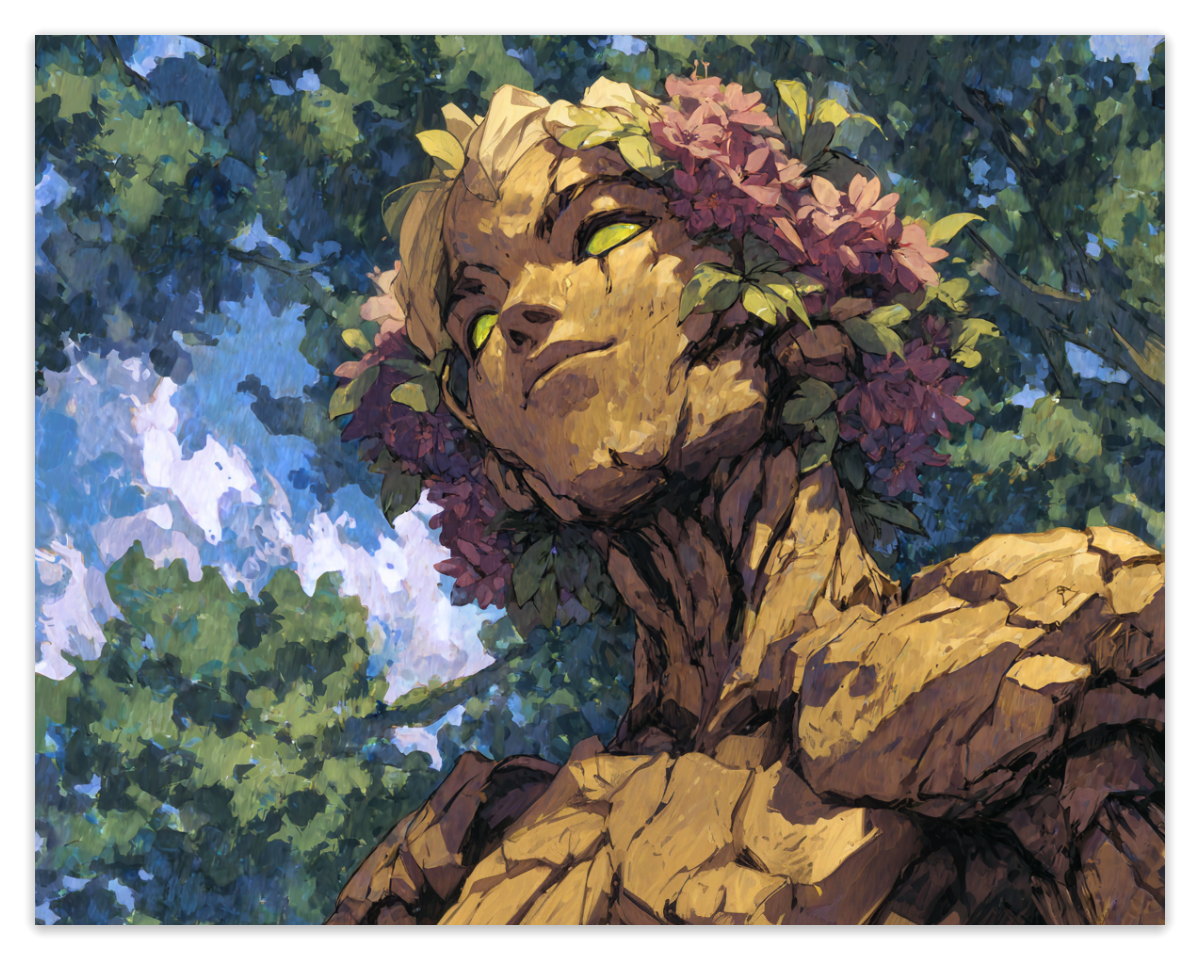
- Dryad: Humanoid, 5’–6’; skin from warm brown to deep green with botanical undertones that intensify seasonally; hair carrying botanical textures (vine, moss, blossom, bark) that change with the seasons; eyes typically amber, gold, or deep green with the luminescent quality all Veralín share.
- Sylvan: The most physically variable sub-type; centaur-adjacent forms range 6’–8’ at the shoulder with fully equine lower bodies and humanoid upper bodies; satyr-adjacent forms are closer to Myûr-scale with goat-adjacent lower limbs and facial features. The shared characteristic is an animal vitality in the movement quality: an alertness and directional spontaneity that reads as feral to outsiders unfamiliar with it.
- Sprite: 2’–3’; fully winged and flight-capable; the most immediately Prisma-visible of the three; in conditions of Prisma Current density, Sprites produce visible ambient light. Their small scale is routinely underestimated as a proxy for limited capability.
- Shared: All three sub-types carry Arva’s relationship to beauty in their physical instincts, a sensitivity to aesthetic environment that manifests as genuine discomfort in settings of ugliness or Prismal poverty, and a specific quality of attention to natural beauty that other ancestries experience as Veralín being unusually present in beautiful places.
Alignment
Veralín alignment tends toward neutral with a strong preference for what their Arva cultural vocabulary calls something that translates approximately as ‘right relationship’ — the alignment between one’s actions and the cycles they participate in. This is not neutrality in the sense of disengagement; it is a specific ethical framework organized around whether a given action is appropriate to the moment and the season it occurs in. The Courts produced Veralín who range toward more complex alignment profiles — those who fled Court exploitation often carry a specific skepticism of hierarchical authority that produces Chaotic Good orientations, while Court-loyal individuals carry Lawful structures organized around a hierarchy most of the community finds abhorrent.
Affinity Disposition
Veralín Spiritual Expression distribution reflects a Veraldié origin above all else. Nature at 14.0 is the dominant expression, not the Nature of Midralis ecology but the specific quality of an intact living network sustained by divine-origin Prismal energy. Wind at 12.5 is the second dominant expression, reflecting the aerial orientation of the Sprite sub-type and the specific quality of fey movement and changeability all three share. Light at 11.5 reflects both Veraldié’s beauty as a cosmological fact and the luminous quality that divine-origin Prismal saturation produces in its inhabitants. Ice at 8.0 reflects the ethereal cold-beauty quality of Veraldié in its uncorrupted state: Ice in the Spiritual Expression framework carries the quality of preserved beauty and crystalline clarity that Veraldié at its best embodied.
| Spiritual Expression | Distribution (%) |
|---|---|
| Nature | 14.0 |
| Wind | 12.5 |
| Anima | 5.0 |
| Mind | 7.0 |
| Fire | 5.0 |
| Metal | 5.0 |
| Earth | 10.0 |
| Aqua | 9.0 |
| Electricity | 4.5 |
| Ice | 8.0 |
| Thunder | 4.0 |
| Darkness | 4.0 |
| Light | 11.5 |
| Empyreal | 0.5 |
Nature at 14.0 is tied with Rabbanar and Zalakiri for the highest single-expression value in any established ancestry table. Empyreal holds at the standard 0.5 baseline — divine-origin heritage does not automatically produce Empyreal attunement in the mortal descendants of a divine-touched realm.
Conflicts & Connections
With the Concordiax
The Concordiax’s relationship with Veralín communities is one of incomplete assessment, structural incompatibility, and the specific frustration of an institution whose administrative calendar cannot negotiate with a governance system organized around seasons. Individual Veralín who leave their groves and interact with Auridian civilization receive the Verbum and participate in Concordiax licensing frameworks — where their Prismal practice is assessed with genuine institutional interest and classified with incomplete accuracy. The Conservatory’s classification framework was not built to accommodate Veraldié-origin Prismal expression, and its practitioners who encounter Veralín produce assessment reports that are consistently flagged as requiring specialist review. The result is a population with some of the highest natural Prismal ceilings in Midralis who are institutionally underdocumented in ways that both the Concordiax and the Veralín find, for entirely different reasons, acceptable.
With the Åel
The Vaenar Åel communities of Midralis maintain threshold connections to Veraldié-adjacent spaces, and they are the non-Veralín beings most aware of what the Veralín carried across from their homeland. The relationship between Vaenar Åel and Veralín grove-communities is warm where it exists, rare in its depth, and carries the specific quality of beings who share a cosmological reference point that nobody around them fully understands. The Veralín communities with the most active Arva communication networks between groves are, according to their seasonal record-keeping, tracking something in the fey-adjacent resonance of their Places of Power that has been changing in recent decades.
Language Notes
Arva (racial language) carries the fey world’s relationship to time, change, and beauty in its grammatical structure. Its temporal grammar encodes gradations of change, cycle-position, and seasonal appropriateness that Diplomata renders as simple past/present/future. Its aesthetic register treats beauty as information rather than opinion: a statement in Arva about a landscape’s quality is not expressing preference but describing a property with the same grammatical structure as describing its elevation. Outsiders who have learned Arva through Diplomata’s acquisition mechanism are technically fluent and missing, by Veralín assessment, approximately a third of what any given Arva statement contains.
One grammatical tense in Arva has no Diplomata equivalent and no compensatory phrase: the tense for beauty that existed and was lost. Not mourning — mourning is a feeling about a fact. This tense is a description of the fact itself, as precise and neutral as a measurement. The Veralín use it continuously in ordinary speech when discussing Veraldié. Diplomata-fluent listeners hear grief. The Veralín are simply being accurate.
Systems & Campaigns
- Pathfinder 2e Leshy / Sprite › Veralín (Dryad); Centaur › Veralín (Sylvan); Sprite › Veralín (Sprite)
- D&D 5e+ Dryad / Satyr / Sprite › Veralín
- Draw Steel TBD
- Daggerheart TBD
- Realmfall Saga Active