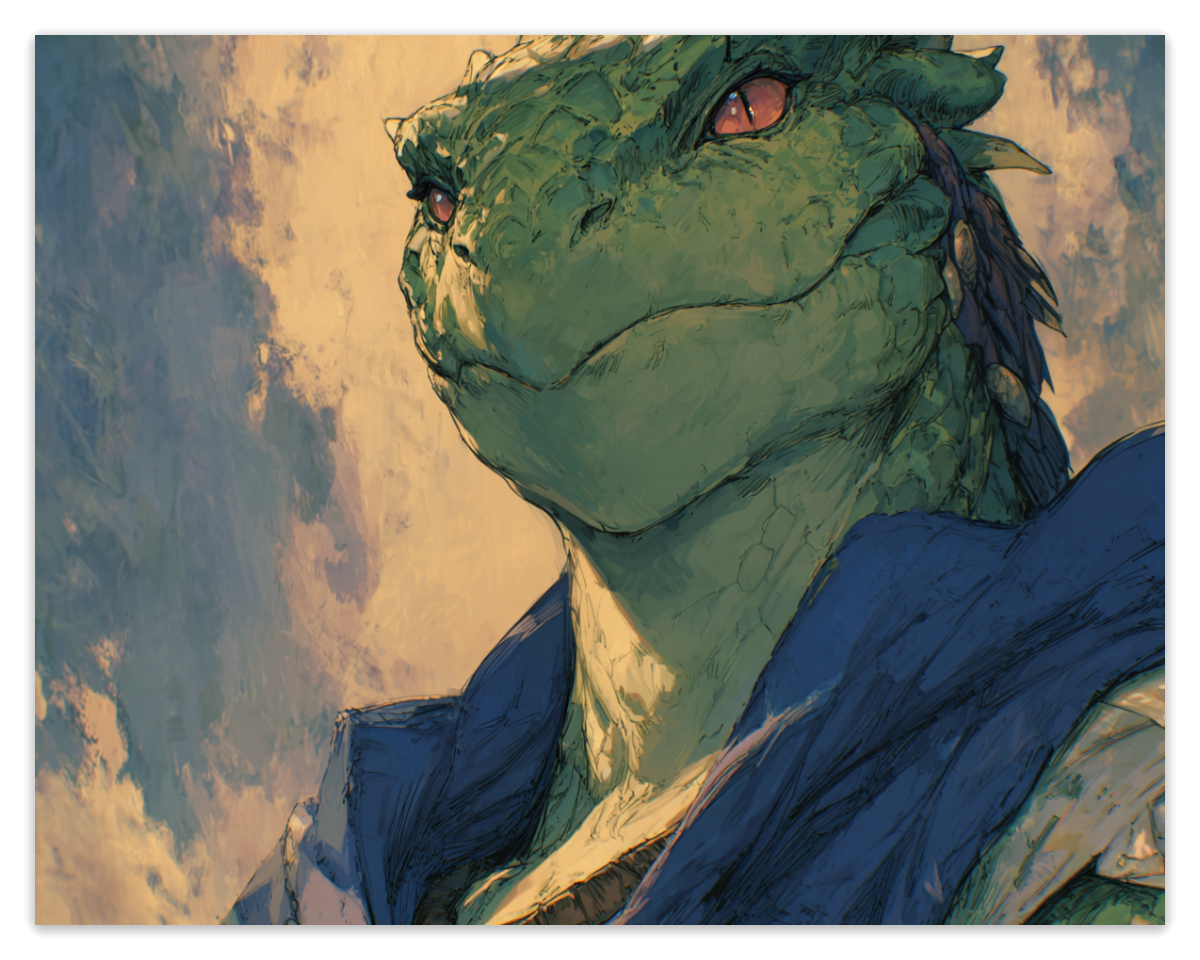
Ancestry · Iphexar · Midralis
Sskar
 Uncommon
“Thassazh is not gone. Thassazh is suspended in the rivers and the deep earth in a condition that has no resolution, guarded by a people whose covenant obligation can neither be confirmed nor released by the object of that covenant. I have never decided whether this is the most tragic arrangement I am aware of, or simply the most honest.”
— Eonlogos, Celosian ArchivistOverview
In a Marshsskar community, a visitor from outside Gondo who asks why the Night-Holes within the territory must be guarded will receive an answer. In a Sunsskar island port three oceans away, the same question receives a different answer. In a Tidesskar flotilla anchored in the Azure Expanse, a third. In a Shadesskar threshold community at the margin between known terrain and something that has no name, a fourth. None of the four answers is identical to any other, and every Sskar who gives one knows, with the awareness of a people who have had this disagreement since before any living Sskar can remember, that the others would not fully accept their reasoning. What is remarkable is not that they cannot explain it to each other in the same terms. What is remarkable is that every subrace guards the Night-Holes regardless: shared obedience without shared interpretation, sustained across an unbroken line of covenantal commitment that has never once produced a common theology.
The Sskar, known to themselves as Kess’karai, children of the coil, are a reptilian people originating from Old Midralis, shaped by the serpent-deity Thassazh in an age before the Elemental Cataclysm remade the world. They are not a unified people. The Cataclysm did not merely reshape their homeland; it killed the god who had become their land, shattering a shared covenant into four interpretations that have never fully reconciled. The Marshsskar hold their ground in Gondo’s unconquerable interior. The Sunsskar are distributed across Midralis more broadly than any other subrace, found in cities, ports, agricultural communities, and mixed populations from the northern reaches of Vasterien to the southern coasts. The Tidesskar move between islands and coasts across two oceans, bearing memory as cargo. The Shadesskar occupy the thresholds: the places between warm and cold, living and not, known and unknown, maintaining a boundary that most people do not know exists.
What they carry at home, alongside the theology, is the weight of people who have been keeping an obligation since before the New Age in conditions whose terms keep changing. The covenantal fracture between subraces is not merely abstract. It plays out in who marries whom, what adulthood requires, what shame looks like, and what the families of Zha’kari practitioners learn to carry. The Sskar who has a clear, settled relationship to the covenant is the fortunate case. The other cases are considerably more common.
Origin & History
Thassazh and the Primordial Covenant
Long before the Elemental Cataclysm, in the age scholars now call Old Midralis, the serpent-deity Thassazh moved through a world whose rivers ran warm and whose deep places held a specific stillness. Thassazh was one of a small number of beings whose nature and intent ran deep enough to bring sapient life into the world through an act of deliberate creation. The method Thassazh chose was not the awakening ritual, not the channeling of a Place of Power. Thassazh dissolved.
The act was transformation of an irreversible kind: the serpent-deity’s body and consciousness redistributed into the river system of what would become the Gondo region, flowing down into the deep earth as a sleeping form too large to comprehend and up through the surface as every waterway that cut through the region’s swamp and jungle. And from the convergence of that distributed divine presence, from the warmth of those waters and the resonance of that buried form, the first Sskar emerged, already carrying in their blood a covenant they had not yet been old enough to choose: protect the balance, or forfeit your scales. It was not a metaphor. The balance Thassazh asked them to protect was Thassazh itself.
The Elemental Cataclysm and the Breaking
The Elemental Cataclysm at Year 0 N.A. did not treat the Sskar as combatants or witnesses. It treated them as terrain. The Cataclysm brought to the Gondo region a violence that the forces driving it could neither anticipate nor control when they met Thassazh’s distributed body. Thassazh’s distributed body absorbed assault after assault, shielding the Kess’karai communities above from the direct violence of elemental fracture. And was destroyed in the process.
Not cleanly. The destruction was incomplete in the way that the destruction of something fundamental is always incomplete: the rivers changed course, dried, or flooded beyond recognition. The sleeping body beneath the earth did not die so much as suspend, caught mid-dissolution, mid-transformation, in a state that had no resolution and no name. The places where the Cataclysm punched through the surface geology to the body beneath became what the Sskar call the Night-Holes: wounds in the world where something that is neither Thassazh nor not-Thassazh remains suspended in a condition the Sskar have been guarding ever since.
What the Kess’karai lost was not merely a deity. They lost the object of their covenant, the thing they had been made to protect, and they lost it before they had any framework for what that loss meant. The four subraces that exist in the 4th Age are not the product of geographic drift. They are the product of four different answers to the same unbearable question: what does the covenant require of us now that what we were protecting is gone?
Sskar Today
In the 4th Age, the picture the Sskar present changes dramatically depending on which subrace is doing the presenting. The Marshsskar across the Kalundri Jungles and the wider Gondo wetlands look, to outside institutions, like a people who have chosen rootedness and sacred immobility: unconquerable and largely unintelligible to governance frameworks that assume sovereignty means something fixed. The Chiefdom of Gondo administers the territory around and nominally over them. The Marshsskar note the administration exists and continue their work. What the work is remains, from the Chiefdom’s perspective, incompletely documented.
The Sunsskar are the Sskar most of Midralis actually knows: found in ports, cities, and agricultural communities across the continent, filling roles in mixed societies that require the Sskar combination of precision, patience, and willingness to carry obligations seriously. They are the ancestry’s visible face and occasionally its informal ambassadors, though the Sunsskar are precise about what they represent: the bloodline and the covenant, not the other three subraces.
The Tidesskar continue their archival mission across the Azure Expanse, their flotillas grown over the centuries to include non-Sskar island communities as trading partners and occasional guests. Their relationship with the Concordiax is the most formalized of the four subraces: cooperative at the surface level, careful at every level below it. The Shadesskar in the deep Gondo interior have changed the least in visible terms. Their threshold communities around the margins and interior of the Kalundri Jungles remain what they have always been: the closest thing the Sskar have to a standing watch on what the Night-Holes are and what remains suspended within them.
The covenant interpretation fracture has not narrowed. What has shifted is that the fracture is now old enough that most Sskar in all four subraces experience it as the condition of being Sskar rather than as an ongoing injury. The disagreement is present. It is managed. It has produced a people who hold obligation seriously, interpret it differently, and share enough to guard the same wounds regardless of the interpretation.
Physical Features
- Scales ranging from smooth to ridged depending on subrace and individual; coloration varies dramatically between subraces
- Elongated snouts with sharp teeth adapted to an omnivorous diet that leans toward meat and water plants; strong muscular bodies with long tails that aid in balance and serve as secondary communication instruments in Sskar body language
- Vertical pupils, a wider color range than most mammalian ancestries, and a reflective quality in low light
- Emotion communicated through jaw angle, scale-raising around the crest and neck, tail position, and eye pressure in ways that take extended contact for non-Sskar to read accurately
- Many Sskar interacting regularly with Myûr-majority communities develop a secondary set of facial signals approximating mammalian expression, which other Sskar find faintly comic; the Sskar who has developed strong mammalian-expression habits reads differently in a fully Sskar context, where the secondary signals are redundant and the underlying Sskar signals show through
The Four Subraces
The Sskar’s four subraces reflect four distinct ecological and theological adaptations. Physical divergence is real and immediately visible, though the theological positions that separate them run deeper than scale color or body shape, and an individual Sskar moving between subrace communities will find the cultural friction more disorienting than the physical differences are striking. Each subrace carries not only a doctrine but the habits, expectations, and failures that the doctrine produces in ordinary people across generations.
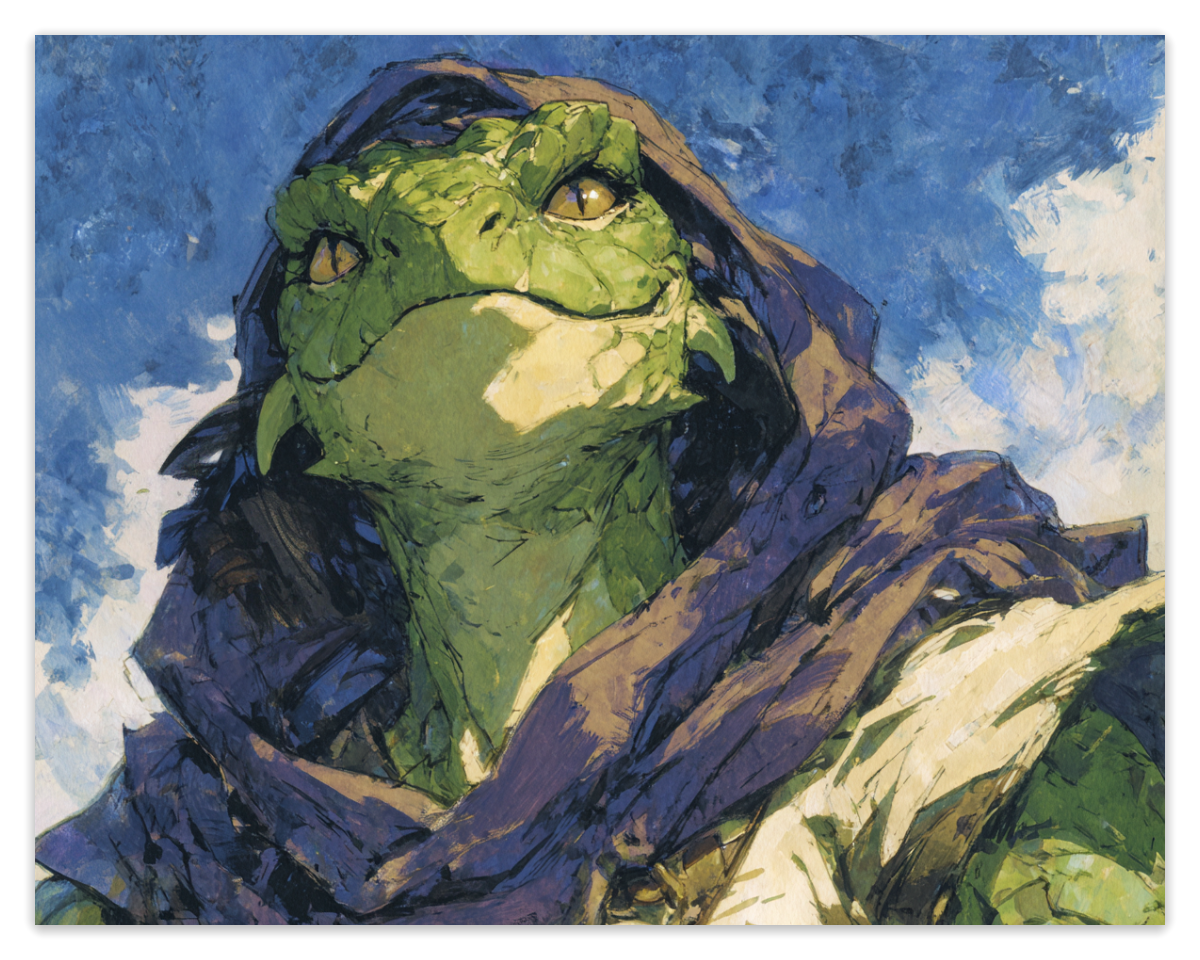
The Four Subraces
Marshsskar
The Groundbound
Physical Features
- Heavyset builds adapted to swamp and jungle terrain; the most physically imposing of the four subraces
- Emerald and deep olive scales; most pronounced ridge structures
- Eyes carry a greenish luminescence in low light
Predisposed Spiritual Expression



The dominant people of Gondo’s interior: the reason the Chiefdom of Gondo is effectively unconquerable and the reason the Concordiax’s survey missions have come back missing members and carrying no actionable intelligence. They are not a military culture. They are a culture that has never needed one because the terrain they protect, and what the terrain contains, has always done that work for them. Their social structure is confederate: a network of communities across the Kalundri Jungles and surrounding Gondo wetlands, each with distinct leadership and a history of fractious internal politics that they present as unified to any outsider they have not chosen to trust. The unification is real when it matters. The Marshsskar hold that Thassazh became the land, which means the land is sacred in a way no abstract theological position can adequately express. To honor the covenant is to never leave. It is liturgy. Coming of age in a Marshsskar community is the moment a young Sskar looks at the land and acknowledges, in formal terms, that staying is a choice and that they are making it. The communities that do this well produce adults with an extraordinary quality of rootedness. The communities that do it poorly produce adults who have accepted a constraint they barely understand, which looks the same from the outside and feels completely different from inside. The Marshsskar who eventually leaves departs without ceremony: no condemnation, no blessing, carrying the knowledge that their community considers what they have done a theological wound, and that they will be welcomed back, as long as they return to stay.
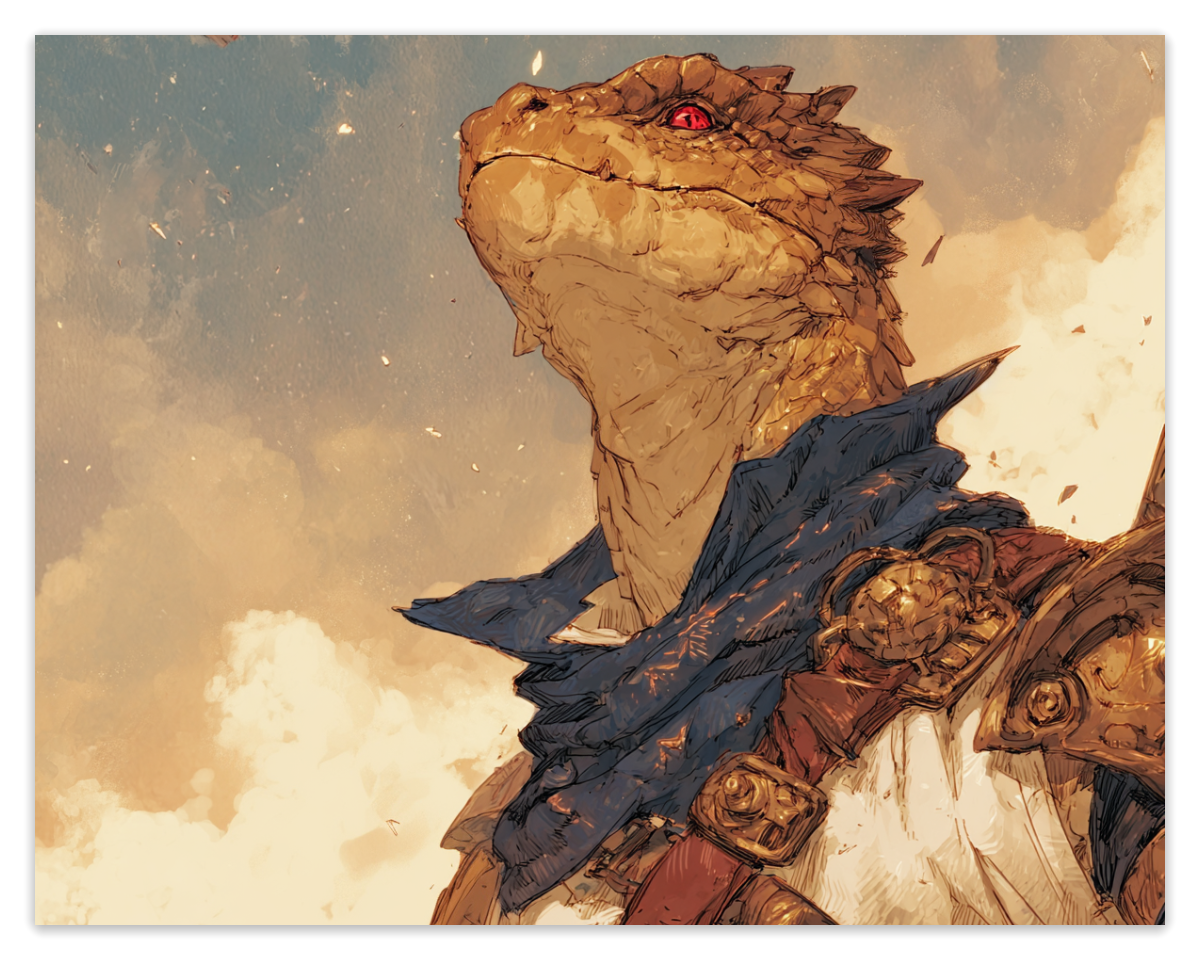
The Four Subraces
Sunsskar
The Scattered
Physical Features
- Lean builds adapted to heat and open terrain; the most widely distributed subrace
- Sand-scarlet to deep amber scales; most vibrant coloring of the four subraces
- Build adapted for sustained movement and adaptability across varied environments
Predisposed Spiritual Expression


The most widely distributed Sskar population: found across Midralis more broadly than any other subrace, in mixed communities, ports, and cities. More likely than most to present to outsiders without subrace qualification. This openness is genuine. The Sunsskar do not experience their distribution as exile or loss. They experience it as the covenant working correctly: Thassazh lives in the bloodline, distributed across every living Kess’karai the same way Thassazh distributed across the rivers of Old Midralis. The lack of territorial attachment reads, from their perspective, as the most faithful position available: Thassazh cannot be honored by a people who have died. What Sunsskar do not discuss easily with the other subraces is the accusation that generations of integration into broader Midralian society has introduced non-Sskar assumptions into what the bloodline is and what it requires. The Sunsskar who has integrated too thoroughly and cannot find their way back carries this quietly. Their Sskarthian carries a different rhythm. Their instincts in community situations run toward non-Sskar frameworks. The community welcomes them genuinely. The welcome is slightly formal in a way neither party addresses directly.
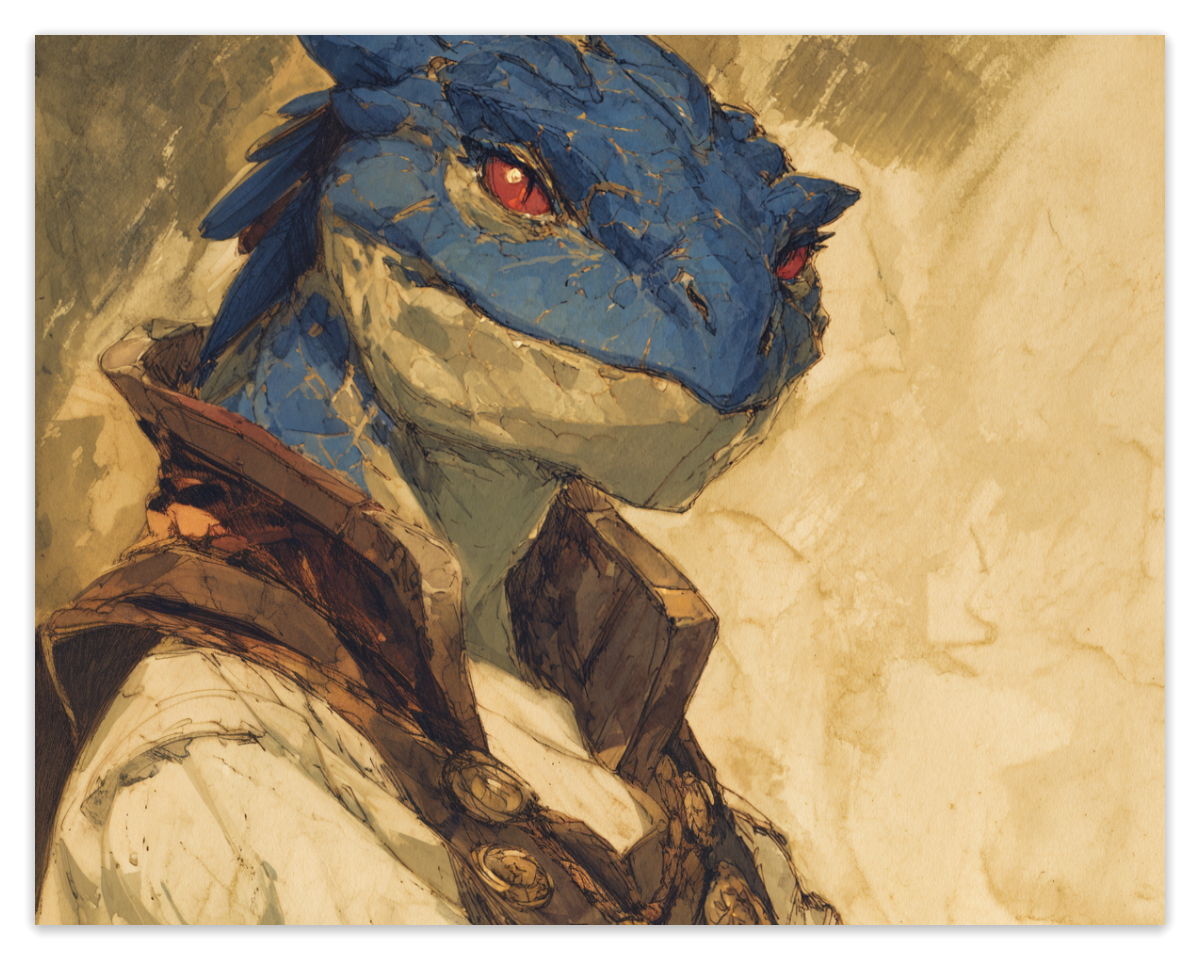
The Four Subraces
Tidesskar
The Remembering
Physical Features
- Agile builds adapted to shipboard life and coastal terrain; most aquatic adaptation in body proportion
- Sapphire and deep teal scales
- A quality of careful attention that outsiders read as suspicion but is more accurately archival precision
Predisposed Spiritual Expression

The primary maritime Sskar culture, moving between island chains in flotillas that function simultaneously as communities, trading vessels, and traveling archives. Their oral tradition is the most extensive and most carefully maintained of the four subraces: passed through memory-keeper lineages, tested at regular intervals for accuracy, and cross-referenced against a physical record of knotted cord, carved shell, and resin-sealed bark. What they are trying to remember with sufficient completeness to be useful is the original covenant, what Thassazh actually communicated before the Cataclysm broke the transmission. They have not reached that completeness. They are aware of how much is missing. This awareness sits at the center of Tidesskar cultural life: the archive is vast, carefully maintained, and full of located gaps that the memory-keepers know by name. The gaps are not failures. They are the record of what the Cataclysm cost. Growing up with memory constantly tested and cross-referenced does things to trust. A Tidesskar whose recall has been evaluated as imprecise, consistently short of the archive’s standard though without dramatic failures, develops a specific relationship to their own memory: the constant second-guessing, the inability to trust retrieval because it has been marked as unreliable often enough to establish a pattern. Affection in Tidesskar culture is not free of this. It is possible to love someone and still check whether what you remember of them matches what the archive holds.
The Four Subraces
Shadesskar
The Threshold Keepers
Physical Features
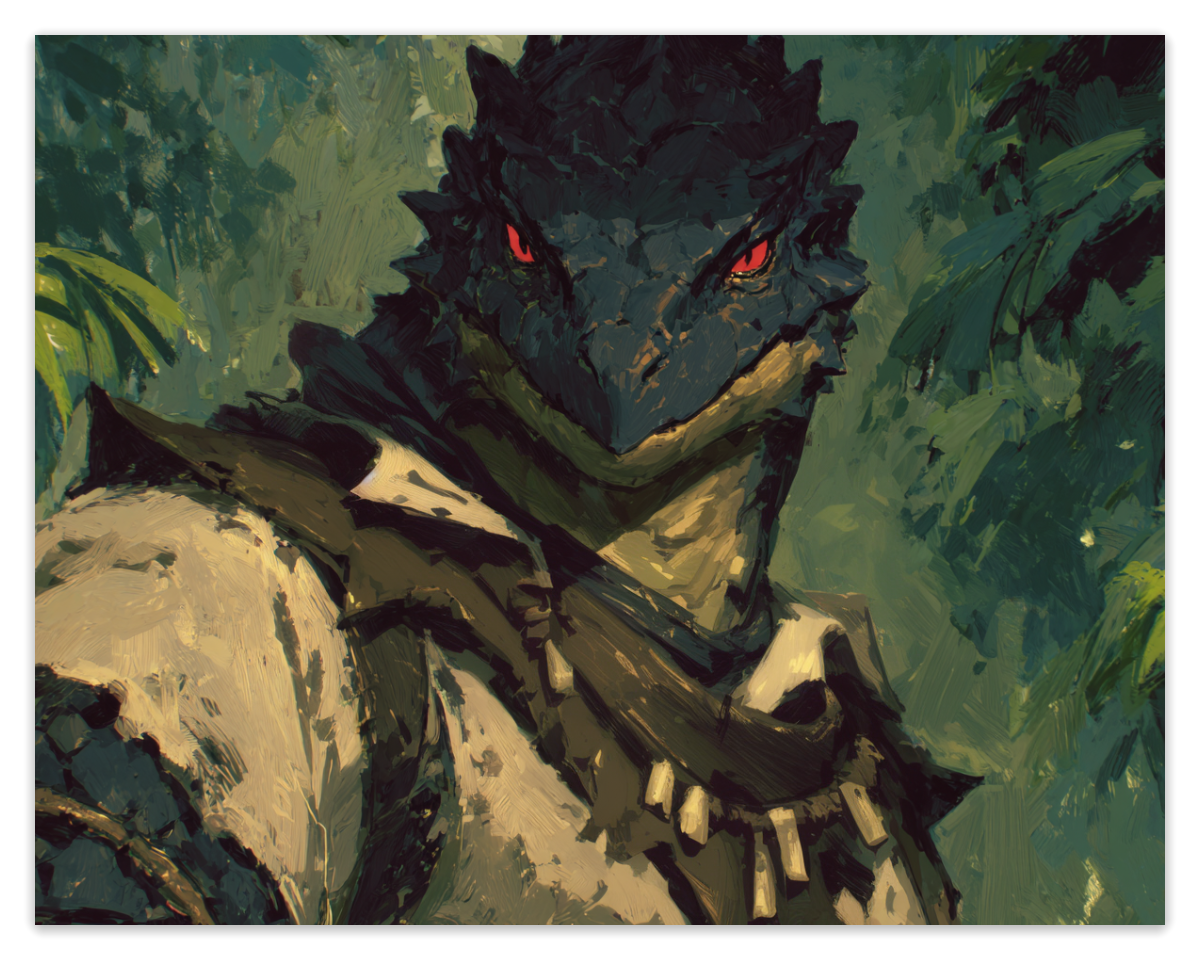
- Builds that tend toward the lean and observant; a stillness in social situations outsiders consistently misread as hostility
- Obsidian and deep charcoal scales with iridescent shifts in certain light conditions; the only subrace with this quality
- The most variable appearance of the four subraces
Predisposed Spiritual Expression


The most politically isolated of the four subraces. Maintaining the boundary Thassazh once embodied requires understanding both sides of it, which means the Shadesskar cultivate relationships with things the other three subraces prefer to keep at a distance. What they practice is more demanding than spirit-consultation, and more specific., and necessary by their own assessment and by the assessment of every other subrace that acknowledges what the Night-Holes are. Coming of age in a Shadesskar community involves the first threshold watch: a night alone at a location where the boundary between the living and the non-living is active — most often somewhere within or adjacent to the Kalundri Jungles, where Night-Hole proximity makes that boundary thinner. Most complete it without incident. The ones who return changed are not asked to describe what changed. The community already knows how to read the quality of change that threshold exposure produces, and has protocols for it that do not require the young adult to articulate an experience that resists articulation. Sustained threshold work does things to ordinary warmth. The Shadesskar practitioner who has spent years cultivating relationships with what lives on the other side of the boundary comes home with those relationships still active. They are not always fully present, because part of their attention is always at the threshold. Partners learn to recognize the quality of absence that means maintenance is in progress. Children learn that there are parts of their parent they will not be permitted access to. The community understands this. Understanding it does not make it easier to live alongside.
The Zha’kari
The Zha’kari are not a subrace. They are a cross-subrace tradition, and the fact that they exist outside any single subrace’s authority is precisely why every subrace is uncomfortable with them. They are the institutional memory of what the covenant actually meant before the fracture: not the Marshsskar interpretation, not the Sunsskar interpretation, not the Tidesskar or Shadesskar interpretation, but the pre-fracture understanding that Thassazh transmitted in the moments before the Cataclysm made transmission impossible. The Zha’kari carry that understanding in an oral and material tradition passed through lineages since before the New Age, carefully enough that it has not been lost and quietly enough that it has not been resolved.
They are politically unwelcome in all four subrace communities for the same reason: what they carry, taken seriously, would destabilize each group’s interpretation of the covenant. The Marshsskar do not want to hear that place alone is not sufficient. The Sunsskar do not want to hear that bloodline alone is not sufficient. The Tidesskar do not want to hear that even perfect memory may not be the point. The Shadesskar are the most receptive, but even they prefer the Zha’kari at a respectful distance. The result is a tradition that exists at the margins of Sskar society, carried by practitioners who move between communities without fully belonging to any, more often found in the liminal spaces where Marshsskar and Shadesskar communities meet in Gondo: operating in the territory of the two subraces whose geographic proximity makes the fracture between place-theology and threshold-theology most visible and most daily.
The Zha’kari in the Family
The child who becomes Zha’kari is usually the one who asked the questions other children accepted: who noticed the gaps in the subrace’s covenant explanation where the explanation stopped making sense, who found the inter-subrace disagreements more interesting than their own community’s position. Families respond with pride and grief simultaneously. The pride is genuine: the Zha’kari tradition carries the closest approximation of the original covenant that exists anywhere, and families who understand this consider it an honor. The grief is also genuine: the Zha’kari practitioner will no longer fully belong to their community, including their family’s community. The visits become more formal over time. The conversations become more careful. The love is maintained but the belonging is not. The family learns to hold the person they raised at a different distance than they intended to hold them.
The subrace communities that handle Zha’kari departures worst are the ones that treat the departure as theological rejection, as the child saying that their subrace’s interpretation is insufficient. It is, in some sense. But that is not why the child is leaving. The Zha’kari practitioners who know this, and who encounter families that have processed the departure as rejection, carry a sorrow about it that they do not express directly.
The Night-Holes
The Sskar call them Vorath’kel: the suspended wounds. Outsiders who have been told about them at all call them Night-Holes, a term that originated with the first Myûr explorers who encountered one and found that their instruments behaved incorrectly in its vicinity and that the darkness at its center was not the absence of light but something with its own quality.
They are fixed locations: specific points in the geography of the world where the Elemental Cataclysm punched through the surface to Thassazh’s body beneath. The Night-Holes are the places where the violence of Year 0 made contact with something divine that was mid-dissolution and could not complete its transformation or reverse it. The result is a condition without a name in any theological or academic framework: something that is neither presence nor absence, neither alive nor dead, neither Thassazh nor the absence of Thassazh.
What happens near a Night-Hole is consistent across every account that exists. Prisma Currents behave wrongly. Animals will not approach within a certain radius and cannot be compelled to do so. Prismaturges report a sensation described variously as pressure, as an awareness of being observed by something with no interest in them specifically, and as a quality of wrongness that does not resolve into any identifiable threat. People who remain too close for too long begin to experience a kind of dream: not nightmares, not visions, but a sustained sense of something trying to complete an unfinished sentence.
They are wounds that cannot heal because healing would require a resolution that is not available. The Sskar guard them because every subrace, across the full span of the New Age and the centuries before it, has reached the same conclusion through different reasoning: if those wounds resolve on their own, without guidance, the outcome will be worse than the current suspension. The quality of “worse” is something no subrace can fully describe, because the understanding of it is not verbal. It is the orientation of a people whose god’s body is still present in the world in a condition that has no name, and whose covenant obligation is precisely to prevent the situation from becoming something that does.
Ordinary Life
The covenantal fracture between subraces runs deeper than theological position. It plays out in what families argue about, what adulthood requires, how grief is organized, and what the shame is that each subrace inflicts on its own members. A Sskar home is not primarily a site of theology. It is a place where food is prepared, children are raised, and the covenant is present not as doctrine but as the ambient pressure of centuries of obligation accumulated in the habits of ordinary life.
Cross-Subrace Marriage
Cross-subrace marriage is uncommon and carries quiet stigma from the more doctrinally firm subraces. A Marshsskar-Sunsskar household carries no formal stigma, but it is a household where two incompatible answers to the covenant’s demands live together, and every Sskar community understands what that means in practice. The Marshsskar position is the clearest: bringing a partner whose liturgy is bloodline and dispersion into a household whose liturgy is place is theological dilution. The Sunsskar position is the most open: any partner who carries the bloodline forward is doing the covenant’s work. The Tidesskar and Shadesskar positions are complicated by practical concerns about whether a partner can contribute to or at least not disrupt memory practice or threshold work. The Marshsskar-Shadesskar pairing is the most geographically common cross-subrace household given their shared Gondo territory: both subraces agree the land matters and that proximity to the Night-Holes is the work. The disagreement about whether the Night-Holes are the covenant’s center or its edge is significant but does not produce incompatible daily practices the way a Marshsskar-Sunsskar household does.
The children of cross-subrace households often find themselves theologically homeless. They have access to both interpretations and full membership in neither. Most manage it with the pragmatism of people who have never been offered the certainty their peers carry. It also produces an attention to the inter-subrace fracture that children raised within a single interpretation rarely develop. This is one of the paths into Zha’kari practice.
What Adulthood Requires
The adulthood threshold varies by subrace in ways that reveal what each subrace considers most essential about the covenant’s demands. In Marshsskar communities, the adult Sskar has looked at the land and acknowledged, in formal terms, that staying is a choice and that they are choosing it. In Sunsskar communities, adulthood often marks the first departure: the experience of leaving and carrying the bloodline somewhere new, celebrated as the covenant being carried forward. In Tidesskar communities, adulthood marks the first formal memory evaluation: the elder testing the young Sskar’s recall against the archive, establishing the baseline against which subsequent memory-keeping will be measured. In Shadesskar communities, it is the first threshold watch.
Shame
Sskar shame is covenantally structured. For Marshsskar, it is leaving, or facilitating the entry of an outside authority into the land. For Sunsskar, it is producing children who do not carry the bloodline’s covenant forward, or the quality of doubt that comes from having integrated so thoroughly into non-Sskar society that the bloodline’s orientation has become indistinct. For Tidesskar, it is the failed memory test, or the older shame of having allowed a section of the archive to lapse under one’s custody. For Shadesskar, it is contamination: having done threshold work in a way that brought something back rather than maintaining the boundary, having allowed whatever exists on the other side to enter the living world through carelessness or insufficient preparation.
What is consistent across all four subraces is that shame attaches to failure of practice, not to theological unorthodoxy. A Sskar can hold unorthodox positions without being shamed for them. The shame arrives when the practice that flows from their theological position fails the covenant’s demands by their own subrace’s standards. This produces a quality of Sskar internal argument that outsiders find strange: not debates about what the covenant means, but arguments about whether a specific action met the standard the agreed interpretation requires.
What Kind of Sskar Others Cannot Stand
The inter-subrace version of this question is explicit and ongoing: every subrace has a clear account of what the other subraces have gotten wrong about the covenant. The intra-subrace version is more private. The Marshsskar cannot stand the community member who has made peace with staying without having genuinely chosen it: present but not rooted, occupying the land without honoring it, whose liturgy is performance. The Sunsskar cannot stand the community member who has stopped moving, who has settled in a way that looks indistinguishable from the Marshsskar position without the theological commitment. The Tidesskar cannot stand the memory-keeper who is more interested in maintaining the social position that comes with custodianship than in the archive itself. The Shadesskar cannot stand the practitioner who does threshold work for the prestige of it rather than for the boundary.
On Obligation
Across all four subraces, one thing holds. The Sskar who has given their word has given something they take seriously at a level that most other peoples reserve for legally binding agreements. The Sskar who breaks their word carries the shame of covenant failure: the weight of having introduced an unresolved wound into the web of obligations that keeps their community functional. This is a social and practical category before it is a moral one. Sskar communities do not primarily ask whether someone is good. They ask whether someone keeps their commitments and maintains what they have agreed to maintain. The two questions are not the same, and the Sskar have had enough time to know the difference.
Affinity Disposition: Skewed
Nature and Earth are the most common expressions across the Sskar population, a distribution that traces back to Thassazh’s dissolution into land and water. Anima and Aqua are both prominently represented, as are Darkness and Fire. Light is above the population-level average for Midralis as a whole, concentrated most heavily in Sunsskar communities. Empyreal is vanishingly rare.
What the distribution produces socially: Sskar communities make judgments, across generations, about who has developed the qualities their theological position most requires. An Sskar born with strong Earth expression in a Marshsskar community tends toward the land-connected practices the community most values; the informal authority that follows comes from a lifetime of that practice, not from the expression alone. A strong Anima expression in a Shadesskar community produces a practitioner who develops threshold facility more readily than most; the community recognizes this, and the recognition accumulates. The hierarchies this creates are not formal. They are the accumulated weight of generations of communities observing which practices their theological position produces and adjusting accordingly.
Ice and Metal sit low in the distribution. Within Sskar communities, practitioners born with Ice or Metal expression are uncommon enough to be noticed. The dispositions those expressions tend to produce, toward stasis and constructed permanence, sit at an angle to communities whose covenant is defined by suspension and ongoing obligation rather than resolution.
This table reflects population-level Spira tendencies; individual variation always applies.
| Spiritual Expression | Distribution (%) |
|---|---|
| Nature | 13.0 |
| Earth | 10.0 |
| Anima | 9.5 |
| Aqua | 9.5 |
| Fire | 9.0 |
| Darkness | 8.5 |
| Light | 7.5 |
| Electricity | 6.5 |
| Wind | 6.0 |
| Mind | 6.0 |
| Thunder | 5.5 |
| Ice | 4.5 |
| Metal | 4.0 |
| Empyreal | 0.5 |
Language Notes
Sskarthian carries a memory-transmission register that makes it unusual among the languages of Midralis: the oldest forms encode information not merely through meaning but through a tonal and rhythmic structure designed to facilitate recall across generations. This is the language in which the Tidesskar memory-keepers preserve the covenant, and in which the Zha’kari carry the pre-fracture understanding that no subrace fully wants to hear. Non-Sskar who learn Sskarthian typically acquire the conversational register without difficulty. The memory-transmission register requires both instruction and the kind of prolonged immersion that most outsiders are not offered.
The theological fracture between subraces has produced dialectal variation that functions as a social signal. The tonal patterns a Sskar uses when speaking about the covenant indicate, to other Sskar, not just what they believe but which community shaped their belief and how long ago. Sunsskar and Tidesskar populations in port communities are typically multilingual by necessity. Marshsskar communities in Gondo’s interior use Sskarthian almost exclusively and have developed dialectal variations that drift significantly from the maritime registers: variations that Tidesskar memory-keepers have noted preserve archaic forms that the maritime dialects have simplified away. This observation is not shared with Marshsskar communities, because the Marshsskar response to being told that their dialect is archaic would be that this is exactly what you would expect from the subrace that stayed.
Systems & Campaigns
- Pathfinder 2e Lizardfolk → Sskar
- Draw Steel TBD
- Daggerheart TBD
- D&D 5e+ Lizardfolk → Sskar
- Realmfall Saga Active