Ancestry · Iphexar · Midralis
Gnome
 Rare
Rare
“The difficulty with Gnomes is not that they are difficult people. The difficulty is that their thinking proceeds through territory that has not yet been mapped, and when you ask them to explain it, they describe the territory rather than drawing you a map. I have found exactly two Gnomes in my lifetime who could translate their process into terms a non-Gnome could follow. One became a Concordiax consultant. The other refused and was, by all accounts, significantly more productive.”
— Eonlogos, Celosian ArchivistOverview
Ask most people who have lived near a Gnome what they remember about it, and they will describe the same thing: the moment they understood the Gnome had not registered their presence in the room. Not rudeness, not hostility. Simply an absence of registration. Whatever the Gnome was attending to had consumed the space where other people tend to keep their social awareness. That detail stays with people longer than they expect it to.
Gnomes are a small, rare, and intensely self-contained race whose presence in Midralis dates from the Fey Migration of the 3rd Age, making them, by the standards of Midralis's older races, recent arrivals. They are also, by any measure of Prismal capacity, arguably the most magically potent mortal race across all of Midralis. These two facts sit in permanent tension: Gnomes are newcomers that the existing institutions of Midralis are still trying to fully account for, and what they cannot fully account for is something they very much want.
What other races tend to notice first is not Gnomish size or inventiveness. It is the quality of attention they bring to things that interest them: an absolute, excluding focus that produces extraordinary work and leaves the people around them feeling both singled out and entirely beside the point. Gnomes do not intend this. They are, in most cases, genuinely unaware of it. This does not make it easier to be on the receiving end.
They are not antisocial in the sense of disliking company. They are antisocial in the more precise sense that other people are a draw on attention Gnomes would rather spend elsewhere, and most are not worth it. A Gnome who has decided another person is worth their attention is one of the most fully present beings in Midralis. A Gnome who has not made that determination will forget you are in the room.
Physical Features
- Height 3’0”–4’0”; typically slightly taller than Mirthlings, most commonly 3’6” to 4’0”
- Build lean to wiry; fine motor control above average for their size, constitutional rather than trained
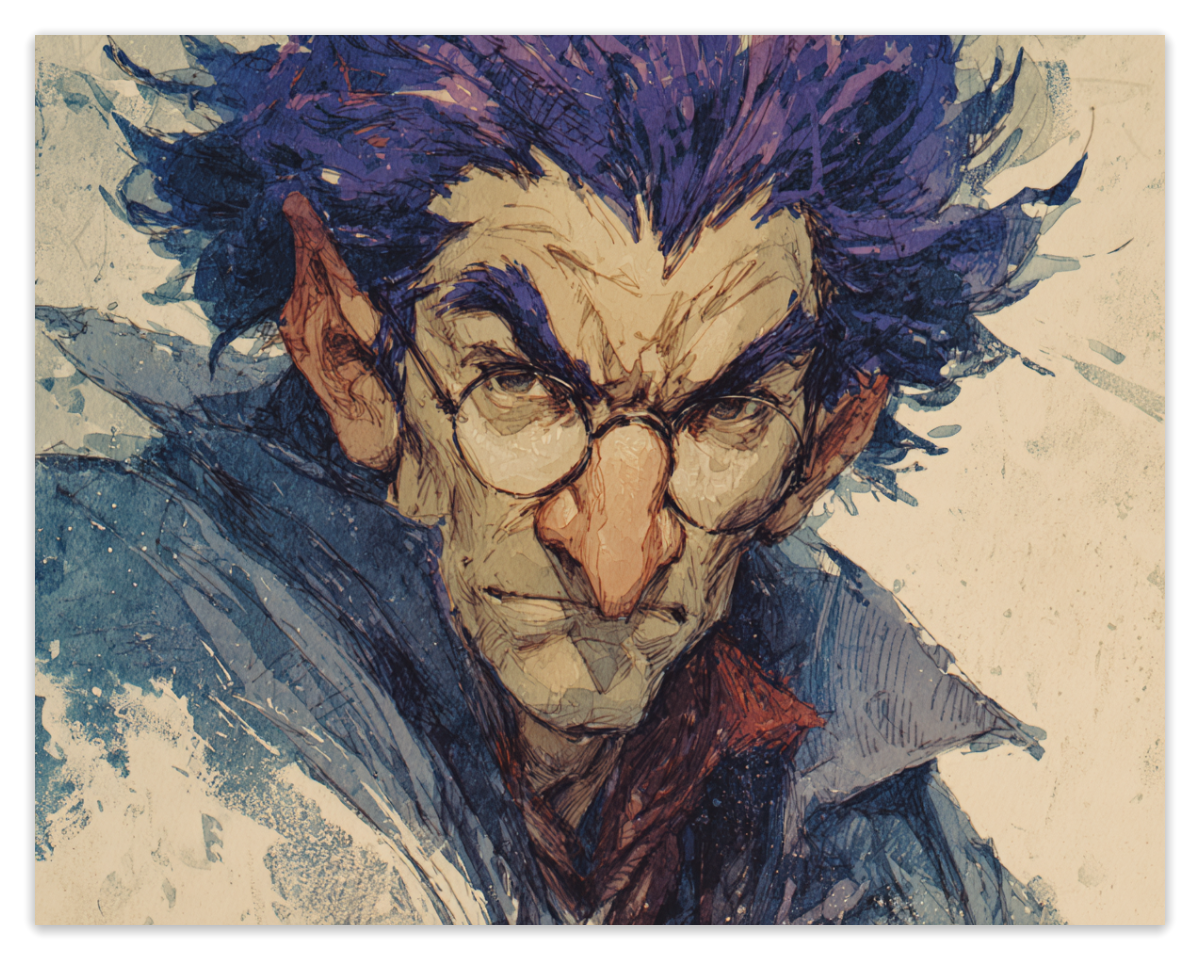
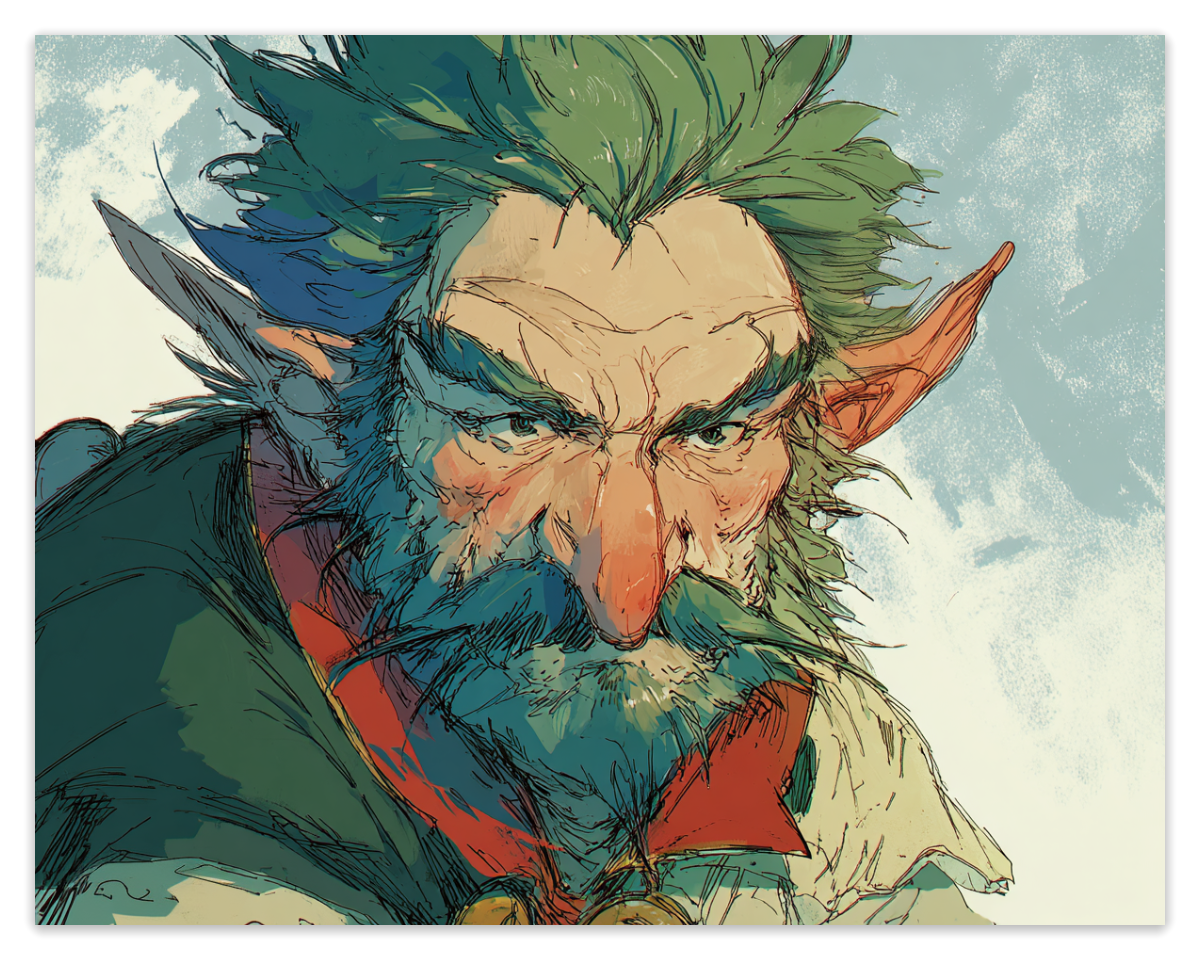
- Hair thick, often wild, resistant to styling; blue, green, and purple appear at meaningful frequency alongside conventional browns and blacks
- Skin tones span a wide range; no dominant regional pattern
- Eyes most commonly in bright greens, blues, and ambers; consistently described as sharp or intent regardless of color
- Faces built for concentration rather than approachability: large noses, thick expressive brows; read as cold before anything else
- Hands carry callous patterns of people who make things; even primarily theoretical Gnomes make things
- Corrective lenses, round and wire-framed, mark Gnomes who have declined the clarifying cast
- Lifespan 250–300 years standard; exceptional individuals reach 350
Fantastical Physical Features
Several Gnomish physical traits are direct inheritances from Veraldié rather than products of Midralian development. They are biological, not Prismal working.
- Faint luminescence – A low-light glow in Gnomish eyes, present in most individuals, not under conscious control, and intensifying during Prismal-active states. Visible to most observers in full darkness and to Spira-sensitive observers in dim conditions. The Gnomes who are aware of it have noted it and moved on. Those who are not tend to find out in an unpleasant social context.
- Environmental drift – Gnomes who spend sustained time in specific terrain develop a gradual coloration shift over years: a slow convergence toward the ambient tones of the landscape they inhabit. It persists after they leave. The mechanism is not understood. The Ninefold Conservatory’s file on it has been in preliminary review for over a decade.
- Unusual hair coloration – Blue, green, and purple appear at meaningful frequency in the Gnomish population alongside conventional browns and blacks. These are Veraldié inheritance, not dye, and follow no heritable pattern the Conservatory has successfully modeled.

A Note on Gnomes
Gnomish has a word for the specific state of mid-grief: the period when the disruption is ongoing and reintegration is incomplete. It translates roughly as running with a damaged component. Non-Gnomish companions who know this word and use it correctly in the presence of a grieving Gnome tend to be regarded afterward with a quality of attention previously reserved for significant research problems.
Origin & History
The Veraldié Question
Gnomes originate from Veraldié: the great fey realm whose Prisma density is so extraordinary that the Currents there are visible to the naked eye as ambient light. The Gnomish connection to Prisma is not a learned discipline or a cultural inheritance. It is biological. Millennia in Veraldié’s environment did not simply expose the Gnomish ancestors to Prisma; it restructured them around it, until Prisma stopped being something they used and became something they were. The cost is real and largely unacknowledged: Gnomes in Prisma-thin environments report a specific quality of flatness, a muting of cognition that practitioners describe as thinking through cloth. Most have stopped describing it at all. The adjustment is old enough to have stopped feeling like adjustment and started feeling like ordinary life.
This history is not mythologized; it is historical fact, retained in Gnomish oral tradition with the precision that Gnomish thinking brings to information worth keeping. What is not resolved is what that origin means, given what Veraldié subsequently became. Veraldié was extraordinary when the ancestral Gnomish population developed there, and also, gradually, changing in ways that made it increasingly difficult to inhabit. By the 3rd Age, when the Fey Migration began, Veraldié was still extraordinary in parts, and dangerous in ways that had not been true at the beginning. The Gnomes who came to Midralis were, in significant part, leaving.
The question that Gnomish thinkers have not resolved is whether their Prismal depth carries anything of what Veraldié later became. The answer is almost certainly no. But almost certainly no is not the same as definitively no, and Gnomes are precise thinkers who notice the difference. The question sits at the back of Gnomish intellectual culture like a calculation whose result nobody has fully checked, and whose checking nobody has fully volunteered to complete.
Emergence in Midralis
When passages between Veraldié and Midralis opened in the 3rd Age, Gnomes came through: some exploring, some following Prisma Current patterns they had sensed from the other side, some simply leaving a homeland that had grown increasingly difficult to inhabit. They arrived in a Midralis that was already significantly developed: post-Galekian, balkanized, with established racial populations running their own institutions for over a thousand years.
The world they found was nothing like Veraldié. Midralis is Prisma-present but not Prisma-saturated, and the contrast between what Gnomes were used to and what they found produced the particular Gnomish relationship to Midralian Prismaturgy: trained practitioners working within the Ninefold system look, to a Gnome’s instinct, like someone doing arithmetic by counting on their fingers. This observation, when expressed aloud, has not historically improved inter-racial relations.
The early Gnome presence in Midralis established the settlement pattern that persists: small, deliberately obscure communities in terrain other races find impractical. These locations were chosen not for defensibility or resources but for quiet. Gnomes wanted to work without being interrupted.
Community Structure: Proximity Networks
Gnomish communities are not communities in the sense that Mirthling communities are. There is no festival system, no communal dispute resolution, no deliberate social architecture organized around collective belonging. What exists instead is a proximity network: a loose cluster of Gnomish individuals who have each concluded that the others nearby are, on balance, tolerable and occasionally useful.
This sounds colder than it is in practice. Proximity networks develop, over time, something that resembles genuine mutual investment. Not because the Gnomes involved set out to build it, but because people who share intellectual interests and physical space for long enough tend to produce it regardless of their intentions. The result is communities that would deny being communities, organized around nothing, held together by contingency, shared preoccupation, and the specific bond of people who have watched each other fail long enough to stop being surprised by it.
The physical locations of these networks are consistently chosen for the same reason: terrain that other races find inconvenient. Not impassable or defended, simply inconvenient enough that casual intrusion is deterred. Mountain slopes with no obvious passes. Forest interiors without clear trails. Coastal grottos accessible only at specific tidal conditions. The geography says, in effect: this is more trouble than it’s worth, move on. Most people do. The Concordiax has incomplete records of Gnomish community locations. The incompleteness is not accidental.
Proximity Network Pathologies
The proximity network is the most functional Gnomish community form and the one whose failure modes are least likely to be acknowledged by the people inside it, because the network has no formal mechanism for acknowledging anything.
Prestige within the network tracks whose current work is most worth attending to, not who has the longest record. The Gnome with the most compelling active project is interrupted least, deferred to most, and sets the bar for what the network tolerates as disruption. A Gnome whose current project has become difficult to describe is simply attended to less. Past achievement without present momentum is a historical fact, not a current credential. The expectation across long lifespans is not rest. It is continuation.
The prestige economy also produces behavior that is recognizably petty despite arriving in Gnomish form. A Gnome who has assessed another's current project as less interesting than their own will not say so. What they will do is ask questions about it with a quality of thoroughness that communicates, to anyone fluent in Gnomish social registers, that the questioner has identified every weak point and found the project wanting. The message is delivered without a word of criticism. It is received with complete accuracy. Neither party acknowledges what happened. This is considered normal.
Passive expulsion is how the network removes people, and it is never acknowledged as removal. A Gnome whose presence has become genuinely disruptive is not asked to leave. What happens instead is subtler: the network’s collective behavior reorganizes around their absence. Tools they need are temporarily unavailable. Collaborative work proceeds without consultation. The brief acknowledgments that constitute Gnomish greeting become briefer. The Gnome leaves eventually, without a formal incident having occurred. The network does not discuss it. The departed Gnome knows what happened. Both parties proceed.
Long memory of failed collaborations is not quite a pathology, but it shapes everything. Every Gnome in a proximity network carries, in detail, the memory of every collaboration that did not work: what the specific failure was, what it revealed about how the other person actually works, and what that means for any future collaboration. This memory is held without resentment in most cases. It is the record of what has not worked, kept for reference, the way a careful practitioner keeps records of failed experiments. Some pairs of Gnomes within a network have collaborated, failed, and now maintain a relationship organized entirely around accurate mutual knowledge of each other’s specific limitations. They are not enemies. They know each other too well for that.
The Mirthling Relationship
The relationship between Gnomes and Mirthlings is the most significant inter-racial dynamic in Gnomish social experience and the one that receives the least direct attention. Both races find it easier to discuss other inter-racial relationships. This is telling.
The surface account is accurate as far as it goes: Gnomes find Mirthlings inefficient in ways they did not intend as insults but which register as such. Mirthlings find Gnomes fascinating in ways that never quite relax into comfort. Communities that contain both have developed elaborate social customs around a specific awkwardness that neither race has fully named. What the surface account cannot carry is a subtler undercurrent. When Gnomes and Mirthlings are genuinely in contact, not the managed version but the actual one, where both parties have stopped performing, something arrives that neither race has adequate language for: a recognition before resemblance, a warmth that shows up uninvited in moments of genuine exchange and makes both parties uncomfortable about having felt it. The Mirthlings, who have better language for warmth in general, are slightly less embarrassed. The Gnomes file it under unresolved, low priority, which in Gnomish terms means not currently scheduled, not unimportant. Most Gnomes have been intending to revisit it since the Migration.
Individual Gnome-Mirthling relationships are the most consistently surprising either race produces. They tend to form around a specific asymmetry: the Mirthling provides warmth, presence, and social continuity; the Gnome provides a quality of focused attention that Mirthlings, who are used to warmth but not always precision, find unexpectedly disarming. A Gnome who has decided a Mirthling is worth their full attention is doing something the Mirthling’s extensive social experience has not prepared them for. These relationships make other members of both communities quietly uneasy because they suggest, without stating, that the distance between the two races is less structural than both communities have found it useful to believe.
What Gnomes experience in proximity to Mirthling community life is legible from behavior more than from anything they say: a specific longing for something they understand clearly and cannot replicate. The Mirthling who walks into a room and is immediately present in it, welcomed, known not for output but for the ordinary texture of daily presence, has something a Gnome will notice and not name. A Gnome who has spent a festival season in a Mirthling community and found themselves attending more festivals than their work justified is typically not attending for the research. Most Gnomes who have spent significant time in Mirthling company understand this about themselves. Most do not discuss it.
Prismal Nature: Instinctive Depth
Gnomish Prismaturgy is the most powerful Prismal expression in Midralis and the one institutions have the least ability to contain. Both facts proceed from the same source: Gnomish Prisma depth is structural, not trained, the product of millennia in Veraldié’s extraordinary Prismal environment. It functions the way breathing functions. It is prior to method.
Gnomes do not perceive Prisma the way trained practitioners do, as something external to be worked with. They perceive it the way you perceive your own heartbeat: ambient, immediate, prior to attention. They are not in the Prisma Current. The Prisma Current is in them. The distinction matters more than it sounds, because it means the entire framework of Ninefold Prismal education, organized around the practitioner’s relationship to an external force, simply does not describe what Gnomes are doing.
The Classification Problem
The Ninefold Conservatory’s licensing and classification system is built around the assumption that Prismal practice follows learnable, teachable, describable patterns: that a practitioner can explain what they are doing in terms another practitioner can evaluate. This assumption holds for most mortal practitioners. It does not hold for Gnomes. Gnomish Prismal expression is intuitive and idiosyncratic. It follows the individual Gnome’s internal architecture rather than any external framework, produces effects frequently unprecedented in the Conservatory’s records, and cannot be described in Ninefold terms any more successfully than you can describe the color blue to someone who has only heard of it. This is not evasion. Gnomes are not being difficult. They genuinely cannot translate.
The Three Proposals
The Conservatory has produced three unresolved classification proposals for Gnomish Prismal expression.
- The Saturation Model – Gnomish expression is standard Prismaturgy operating at intensity levels the Ninefold system was not designed to measure.
- The Integration Model – Gnomish expression is a distinct Prismal phenomenon that predates and partially underlies the Ninefold framework.
- The Inheritance Model – Gnomish expression is Veraldié’s Prisma expressed through a mortal vessel; fey Prisma behaving like mortal Prisma because the vessel is mortal, not because the Prisma is.
None have been adopted. A fourth proposal, that the classification question was itself malformed and the Conservatory should develop a parallel taxonomy, was withdrawn after its author refused to defend it. People who know the author describe the withdrawal as something other than pragmatic.
Gnomes in the Ninefold Conservatory
Some Gnomes hold positions within the Ninefold Conservatory: enough to constitute a recognized, if anomalous, presence. These are Gnomes who decided, for reasons that often remain unclear even to themselves, that the Ninefold offered something worth the cost.
In practice, Gnomish faculty occupy a specific niche: they are the professors students are most desperate to study under and least likely to survive academically. Their scholarship programs are small, selective, and oriented entirely toward candidates the Gnome has judged worth their time. These assessments are made quickly, with criteria the Gnome will not explain, and the record bears this out. Students who complete a Gnomish faculty program graduate at lower rates than any comparable cohort. Those who do produce outcomes disproportionate to their numbers and consistently among the Conservatory’s most significant contributions. The reputation is legendary and brutal in equal measure. The students who do not survive academically leave with something between a credential and a wound, and the Gnome who dismissed them has already moved on to the next intake. Prospective students apply anyway.
The Concordiax tolerates this arrangement because it is surveillance structured as patronage. The Ninefold provides a location, an affiliation, and a reporting structure through which extraordinary Prismal potential can be monitored without open coercion. The Gnomish faculty involved are aware of this. They have made individual calculations about whether the resources and access the Ninefold provides are worth the monitoring that comes with it. Their continued presence suggests they keep reaching the same answer. The calculation is revisited more frequently than the Concordiax liaison assigned to each faculty member is aware.
Invention Culture
Gnomes are prolific inventors. This is less a cultural value than a cognitive byproduct: the same instinct for deep focus and systematic inquiry that makes Gnomish Prismal expression extraordinary also makes Gnomish engagement with practical, mechanical, and theoretical problems highly generative. Gnomes do not set out to invent things. They encounter problems, find them interesting, and produce solutions as a natural output of sustained attention. What they do with those solutions surprises most other races: they give them away freely.
Gnomes place no meaningful value on ownership of ideas. The act of discovery is what matters. Once a thing is known, it is known, and what happens to it afterward is not the discoverer’s concern. Gnomish inventions enter the wider world through trade, through casual gift, through Ninefold students who leave their programs carrying solutions their professors mentioned in passing. The underlying methodology never travels with them. The Concordiax receives Gnomish outputs regularly and understands Gnomish process not at all, a source of institutional frustration that has not diminished.
The Shadow of Invention
The generosity is real. The private record is also real, and the two do not cancel each other. A Gnome who has produced something genuinely unprecedented carries that knowledge quietly and for good. The knowledge does not require acknowledgment from anyone else. It does not require whoever received the thing to understand its value. It is the Gnome’s own assessment of their own record, held with a quiet precision that from outside can look like arrogance and from inside is simply accuracy.
Gnomes who become aware that institutions are harvesting their outputs without understanding their process develop a response colder and more systematic than anger. They do not confront. They do not withdraw entirely. What changes is the resolution of what they make available. Technical vocabulary that previously came with Diplomata approximations stops coming with them. Results are presented without the intermediate steps that would allow the methodology to be reconstructed. The Gnome experiences this as a reasonable adjustment: give the institution what it can actually use, no more. The institution experiences it as deliberate obstruction. Both assessments are accurate. Neither party acknowledges this explicitly, because the Gnome has concluded that conversation is not worth having.
The Optical Arts: The Clarifying Cast
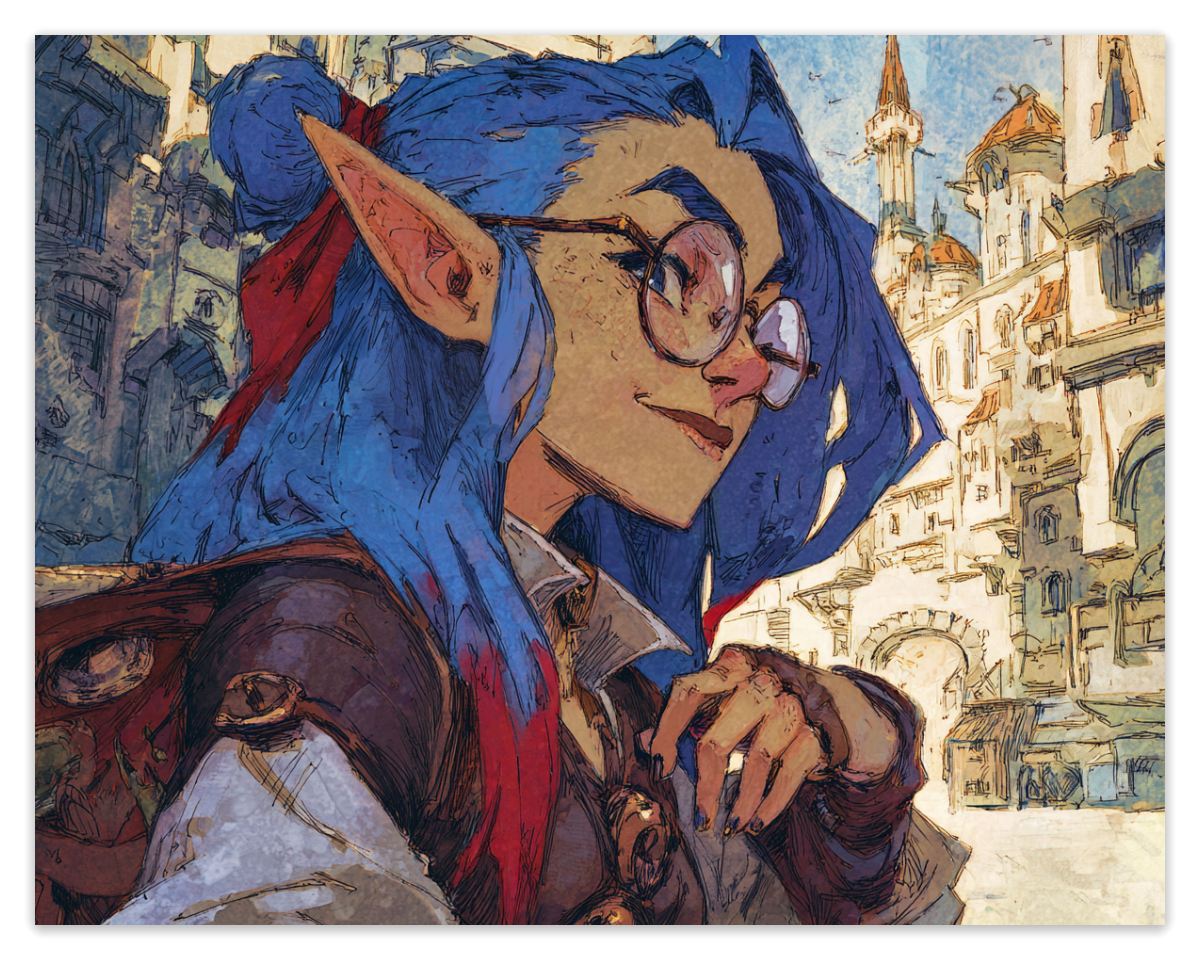
The most widely encountered product of Gnomish invention culture is not an object. It is a Prismal self-cast. Gnomish distance vision is frequently poor: a population-level trait, heritable, consistent enough to suggest something structural rather than incidental. The folk explanation is that millennia in Veraldié, a realm where Prisma Currents are so dense they are visually present to the naked eye, shifted Gnomish visual acuity toward what mattered there. Whether this is accurate or not, the result is that Gnomes arriving in Midralis often found its comparative visual quietness both peaceful and, at distance, blurry.
The solution developed within the first generations of Gnomish presence in Midralis: a self-administered Prismal cast, applied to the eyes each morning, that sharpens distance vision for the duration of a day. The cast is elegant, requires minimal Prisma output, and can be taught to any Gnome with basic Prismal awareness; given the population’s innate depth, that is essentially all of them. It is administered casually, lasts reliably until evening, and produces no known side effects.
Some Gnomes do not use it. When asked why, they change the subject. Pursuing the question further is not recommended.
Ordinary Life
Gnomish cognition does not stop for domestic occasions. The same focus that produces extraordinary Prismal work is present when a Gnome is eating, grieving, or has found themselves in a relationship they did not seek and cannot seem to exit.
Attachment
Gnomes experience attachment as a project they did not choose. Any Gnome who has been through it recognizes the pattern: a specific person begins appearing in their thinking with a weight disproportionate to any deliberate investment. The thinking that previously ran smoothly starts catching on something the Gnome cannot identify. The person has become load-bearing in a way that was not planned. The Gnome attempts to analyze this: why this particular person has become necessary, whether it will pass. The investigation goes about as well as most research problems. The person remains load-bearing. The Gnome does not stop.
When a Gnome loses interest in a person they once chose, the interest does not close. It simply stops. The person finds, gradually, that the questions have stopped, that the presence in unexpected locations has stopped, that conversation has become efficient again in the way it was before. There is rarely a stated conclusion. The Gnome has moved on in the sense that their attention has moved on, and attention is what they had to offer. In Gnomish, there is a word for what the other person experiences. In Diplomata, there is not.
Grief and Apology
Gnomish grief is organizational. The loss of a person who was load-bearing produces a specific disruption: the Gnome experiences it as structural damage to their own thinking, a gap where something was. From outside it reads as distraction, uncharacteristic errors in work, a particular quality of absence in conversation. Gnomes who are grieving typically do not know how to say so.
Gnomes apologize through correction rather than emotional acknowledgment. A Gnomish apology is proof: the behavior has been analyzed, its source identified, and the conditions for it happening again removed. Expressions of regret, acknowledgments of the other person’s emotional experience, and assurances that the Gnome feels bad are not components of the Gnomish apology. Some Gnomes learn emotional acknowledgment as a second language, recognizing that non-Gnomish companions require it and adding it through deliberate practice. These Gnomes are often described as surprisingly warm. The compliment is accurate. It is also a recognition of a learned skill rather than native emotional fluency, and the Gnome is unlikely to correct it, because doing so costs more than the error.
Affinity Disposition: Skewed
Gnomish Spiritual Expression distribution reflects Veraldié origin and instinctive Prismal orientation. The distribution skews heavily toward Nature, Anima, Mind, and Wind: the expressions most consonant with Veraldié’s character and with the deep environmental attunement that millennia in the fey realm produced. It depresses significantly in Darkness, Light, and Thunder. The simultaneous suppression of both Darkness and Light is the most striking feature of this distribution. Most populations score low in one and higher in the other; Gnomish suppression of both suggests a structural routing away from the divine-adjacent poles at both ends, not a moral orientation in either direction. Ice runs notably higher than Fire, consistent with a people whose characteristic mode is cold precision rather than heat and impulse. Empyreal is vanishingly low. The Gnomish scholars who have thought carefully about the Light suppression specifically have not published their conclusions. Some have concluded they do not want to.
This table reflects population-level Spira tendencies; individual variation always applies.
| Spiritual Expression | Distribution (%) |
|---|---|
| Nature | 10.0 |
| Wind | 9.5 |
| Anima | 10.0 |
| Mind | 10.0 |
| Fire | 5.0 |
| Metal | 9.0 |
| Earth | 9.0 |
| Aqua | 7.5 |
| Electricity | 9.5 |
| Ice | 8.0 |
| Thunder | 5.0 |
| Darkness | 3.5 |
| Light | 3.5 |
| Empyreal | 0.5 |
Modern-Day Gnomes
In the 4th Age, Gnomes occupy an unusual position: arguably the most Prismal-capable mortal race in Midralis, and the least present within its institutions. The Concordiax has been trying to change this. It has not substantially succeeded.
The Gnomish population is rare, scattered across proximity networks that are, by design, difficult to locate, and broadly uninterested in the formal architecture surrounding Prismal practice. The exceptions are those Gnomes who decided individually that the Ninefold Conservatory offered something worth the cost. Those individuals are known, monitored, and not representative of the wider population.
What has shifted is not Gnomish behaviour but Concordiax urgency. The institution’s interest in Gnomish outputs has grown considerably, and the proximity networks most frequently in contact with it have developed a consistent response: provide exactly what was asked for, in the form that answers the stated question, without any of the underlying process that would allow the institution to produce its own answers. This practice is not organised across networks. It emerged independently in several communities as the obvious response to persistent institutional attention. The Gnomes who do it do not think of it as a tactic. They think of it as a fair exchange.
The result is a widening gap between what the Concordiax believes it is learning about Gnomish practice and what it is actually learning. Leadership has begun to sense this, though they have not yet named it clearly. Priority on Gnomish engagement has increased in recent years. The networks that have noticed are becoming harder to find. The ones that have not noticed are encountering Concordiax representatives more frequently, and are finding the experience instructive.
Language Notes
Gnomish is built for precision, and Gnomish thinking runs on it, so the fit between language and mind is unusually close. It is Veraldié-origin and structurally unlike any Midralian language. Diplomata covers conversational Gnomish well enough. The gradient from conversational to technical is where that coverage fails, and it fails sharply rather than gradually, at exactly the level where the content starts to matter.
The Precision Register
Gnomish is dense with technical precision vocabulary and Prisma-adjacent terminology that does not translate into Diplomata because the concepts it encodes do not have Diplomata equivalents. This is not a translation difficulty in the sense of finding the right word. It is a translation difficulty in the sense of finding a concept that does not exist in the target language. Gnomish has words for specific stages of investigation that a project passes through and the specific cognitive states that accompany each stage. In Gnomish, the stage where a mechanism is understood but its implications have not yet been mapped is a single word. It is not a phrase with parts that can be parsed. It is a word. The Concordiax translators who need to read Gnomish research documents are frequently working from documents where the most important content sits in the technical register where Diplomata ceases to function. The translation problem has not been solved because the people who could solve it have not found it interesting enough to prioritize.
The Thinker and the Thought
Gnomish grammar treats the thinker and the thought as a single subject in certain constructions. There is no distinction between I am thinking about X and X is present in my thinking — both collapse into the same grammatical form, because in the Gnomish framework the self and the object of the self’s attention are not fully separate things. Translation into Diplomata consistently produces a distorted picture: Gnomes appear either more detached or more identified with their own mental content than they actually are, depending on which construction the translator chooses. There is no correct translation. There is only the least wrong one.
What Passes Between Gnomes
In conversation between two Gnomes who know each other well, Gnomish becomes extremely compressed. Shared technical vocabulary, mutual knowledge of each other’s work, and the Gnomish norm of not stating what can be inferred combine to produce exchanges that sound, to an outside listener, like fragments of much longer conversations. Non-Gnomish people who spend long enough inside a proximity network report the same thing: at some point, they stop being able to follow Gnomish conversation between network members, even knowing Gnomish. The content has moved to a register that is not about vocabulary. It is about the specific shared context that develops between people who have been in cognitive proximity for decades and have stopped needing to explain themselves to each other. This register has no name in Gnomish. It has no name in Diplomata. It is the thing that proximity networks, despite denying they are communities, produce.
Systems & Campaigns
- Pathfinder 2e Gnome Ancestry
- Draw Steel Gnome Ancestry
- Daggerheart N/A — no Gnome in core
- D&D 5e+ Gnome Race
- Realmfall Saga Active