Ancestry · Iphexar · North Kyou / Hino Federation
Yokaijin
“The Yokaijin, the offspring of Yokai and mortals, are enigmatic beings born from the union of the mystical and the mundane. Their existence is relatively recent, a phenomenon born in the fire of the Yokai Crisis in northern Kyou. These half-Yokai beings embody the traits and powers of their Yokai parents while navigating the complexities of mortal society. They stand as living bridges between worlds, both feared and revered. And in the current era, they are the primary reason the red zone has not become something worse than simply dangerous.”
— Eonlogos, Celestian Archivist
Overview
The Yokaijin are the mortal-Yokai offspring who emerged from one of the most consequential and least understood events in Kyou’s recorded history: the Spirit Realm fractures of the late 3rd Age, the Yokai Crisis that followed, and the imperfect Truce that ended it. They are a people whose existence is inseparable from that history, not because it defines them, but because four hundred years is not long enough for the institutions around them to have finished deciding what to do with what they represent.
In the Hino Federation of States, Yokaijin hold formal legal personhood in most member states: a status that was not guaranteed at the Truce’s signing and that several states still administer with varying degrees of practical friction. They are, formally, citizens. They are, culturally, still the children of the beings who drove North Kyou into a red zone four centuries ago. The formal status and the cultural reality do not fully overlap, and Yokaijin in the 4th Age navigate the gap between them with the specific competence of people who have had it as their inheritance since birth.
What distinguishes Yokaijin is not primarily their appearance, which varies widely across the six sub-types, but the quality of their Spira. The Spirit Realm fractures that produced the Full Yokai also produced, in the mortal communities most exposed to their presence, a Spira-alteration that passed to offspring. Yokaijin carry this as a genuine cosmological difference from their fully mortal neighbors: a permeability to Spirit Realm phenomena, an Echo sensitivity that operates through spiritual channels rather than Prismal ones, and in the most developed practitioners, an awareness of spirit presence that functions less like intuition and more like direct perception.
Origin & History
The Tzhuikaze Region and the Spirit Realm Fractures
The Tzhuikaze region of North Kyou was, before the Spirit Realm fractures, a populated and agriculturally functional territory. The fractures changed it. The Spirit Realm is not, in normal cosmological conditions, accessible from the Mortal Sphere except at specific Places of Power or through deliberate high-Spira practice. The fractures were not deliberate and were not Places of Power in the designed sense — they were stress failures in the dimensional boundary between the Mortal Sphere and the Spirit Realm, produced by the same Cataclysm scarring that made North Kyou’s terrain anomalous in the first place. They did not open cleanly. They opened unevenly, in ways that produced the specific hostility of the current red zone: places where the Spirit Realm and the Mortal Sphere interpenetrate without the stabilizing architecture that proper dimensional boundary architecture maintains.
The Full Yokai that emerged from these fractures were not invaders in the conventional sense. They were Spirit Realm-adjacent beings manifesting into a Mortal Sphere location that had, through structural failure, become partially Spirit Realm-adjacent itself. The mortal populations of the Tzhuikaze region were, from the Full Yokai’s perspective, existing in a space that the Yokai had as much claim to as the mortals did: which is the kind of claim that produces the Yokai Crisis.
The Yokai Crisis and Its Children (~3800–3900 N.A.)
The Yokai Crisis is documented in Hino Federation records as a century of escalating conflict between the mortal populations of North and Central Kyou and the Full Yokai who had manifested from the Tzhuikaze fractures. What those records document less carefully is the parallel history: the communities in the fracture-adjacent zones that did not evacuate, that developed working relationships with specific Yokai types, that produced in those relationships the first Yokaijin.
These first-generation Yokaijin occupied the most dangerous position in the Crisis period — neither fully mortal nor Full Yokai, they were viewed with suspicion by Federation military and political institutions that were fighting a war, and with the specific complexity of kin by the Full Yokai communities whose offspring they were. Some served as intermediaries, using their dual nature to negotiate local ceasefires that the Federation’s official peace process didn’t produce for decades. Some fought on both sides. Some simply survived in the fracture zones that both parties found too costly to hold, becoming the first permanent Yokaijin communities in what would become the red zone’s border regions.
The Yokai Truce and Four Centuries of Integration
The Yokai Truce (~3900 N.A.) formalized the territorial division but did not resolve the question of what Yokaijin were, legally or socially. The Full Yokai who accepted the Truce’s terms withdrew primarily to North Kyou’s designated territories. The Yokaijin, whose mortal parentage gave them legal standing in Federation states that Full Yokai did not possess, remained in the border regions and gradually, over the four centuries since, integrated, incompletely, into Federation society.
In the current era of the 4th Age, Yokaijin hold full legal rights in the majority of Federation states, restricted rights in several southern states, and the specific de facto position of people whose legal status has been formalized but whose cultural integration is still in process. A Yokaijin entering an unfamiliar community in the Federation carries the specific awareness of someone who does not know in advance whether they will be treated as a citizen or as a symbol of something the community’s grandparents feared.
Culture & Society
Between the Red Zone and the Federation
Yokaijin cultural identity is shaped by a geography that is also a political situation: the border between the Federation and North Kyou’s red zone is not a line on a map so much as a gradient in which Yokaijin communities are disproportionately concentrated. The border regions are where the Yokaijin’s dual inheritance is most practically useful — where the Echo sensitivity that makes some Federation states uncomfortable is the qualification that makes the difference between a managed red zone and a catastrophic one. Yokaijin are most valued for their Yokai inheritance in exactly the contexts that most remind their Federation neighbors that they have Yokai inheritance. The intermediary role is respected, necessary, and quietly othering.
This produces in Yokaijin communities a specific political sophistication about the gap between what they are valued for institutionally and what they are accepted as personally, and a sardonic cultural humor about the distance between the two that outsiders consistently underestimate as bitterness. It is not bitterness. It is a coping practice that has been refined across four hundred years of the same conversation.
Espiro Fragments and the Spirit Inheritance
One of the more practically significant aspects of Yokaijin Echo development is the specific permeability to Espiro — the language of the Spirit Realm: that their Yokai lineage creates. For most beings, Espiro is functionally inaccessible without deliberate high-Spira practice across many years. For Yokaijin with developed Echo Potential, access to Espiro fragments, not full fluency, but the ability to perceive and respond to Spirit Realm communication — emerges as a natural consequence of their inheritance rather than as an achievement.
In the Tendra-speaking communities of North Kyou’s border regions, Yokaijin children are taught to attend to these Espiro fragments as part of normal cultural education, not as a mystical practice but as a practical skill, the way a child raised near water learns to read currents. The difference between a Yokaijin who grew up in a Tendra-speaking border community and one who grew up in a southern Federation state is not the presence or absence of the permeability — it is whether anyone taught them what they were receiving.
Sub-Types — Six Lineages
A Yokaijin’s sub-type is determined by their Yokai ancestor’s type. The inheritance is not merely cultural; it is Spira-structural. A Kitsunejin carries the specific quality of fox-spirit Echo in their Spira whether or not they know a single thing about Kitsune culture. This produces a specific experience of identity: knowing that one’s character is partly a product of an ancestry one cannot access, cannot fully understand, and may have complicated feelings about.


Physical Features
Yokaijin physical characteristics are the most diverse of any ancestry in the compendium, not despite their common origin but because of it. The six sub-types’ Yokai lineages are themselves physically diverse, and their mortal-lineage heritage varies across all the ancestries of Kyou. What all six sub-types share is the quality their Yokai lineage produces in their Spira: a visible otherworldliness that manifests as something other beings’ instincts register before their conscious minds articulate it.
- Kitsunejin: Human-to-fox expression range; most common expression is subtle — unusually sharp features, a quality of attentiveness in the eyes, reflexes that read as unnaturally precise; stronger expression produces visible fox ears and one or more tails; eye colors tend toward amber, gold, and shifting silver.
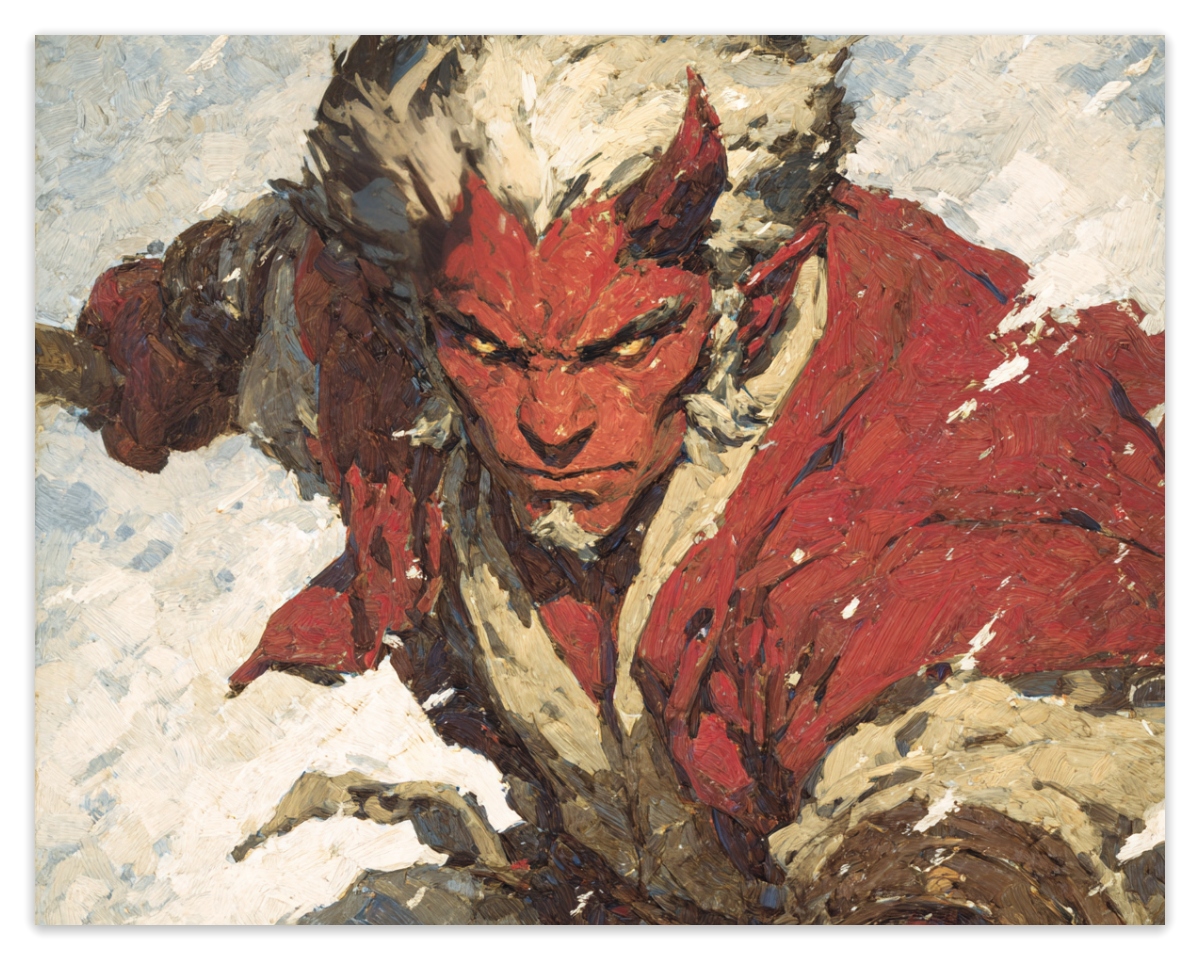
- Onijin: Consistently larger than mortal-baseline; horns emerging at adolescence; skin tones in red, deep blue, or gray; physical density that registers as presence before size; eye colors in deep amber and red-orange.
- Tengujin: Spatial awareness reads physically as a quality of held-readiness even in stillness; ranging from subtle feathered characteristics to partial wing-expression; exceptional physical coordination across all expression levels.
- Nekojin: Most variable in physical expression; cat characteristics ranging from subtle slit-pupils and reflexive movement quality to pronounced cat ears, tail, and partial facial structure; the tail’s emotional expressiveness is involuntary and a source of social complexity in formal contexts.
- Yuki-onna-jin: Pale to cool-blue skin that does not change with temperature; hair carrying a frost quality regardless of climate; the signature stillness that reads as cold affect; eyes in pale blue, silver, or white; most physically distinctive of the six sub-types at any expression level.
- Tanukijin: Raccoon dog-adjacent features; earthy brown to gray-brown coloration with characteristic eye markings present across all expression levels; rounder, approachable features; stronger expressions produce visible ears, tail, and Tanuki-texture patterning; the instinctive capacity to present as non-threatening is the most consistent cross-expression physical trait.
Alignment
Yokaijin alignment is as varied as their Yokai heritage and mortal upbringing combined produce — genuinely varied rather than trending toward any single orientation. The Full Yokai of Kyou’s tradition are not morally categorizable in the ways that demons and devils are: they are not inherently malevolent, not inherently benevolent, but oriented toward the specific logic of their Yokai nature and the ancient frameworks that govern Spirit Realm-adjacent beings. This quality passes to their Yokaijin offspring as a tendency to operate from principles that are internally consistent but not always legible to external frameworks.
The most consistent alignment orientation across the six sub-types is a specific relationship to loyalty and obligation that reflects Spirit Realm-adjacent social structures: Yokaijin tend to be deeply consistent to the people and communities they have committed to and relatively unresponsive to institutional authority that has not been earned through demonstrated integrity. What Federation legal frameworks sometimes characterize as resistance to civic obligation, Yokaijin communities characterize as the specific rationality of people whose ancestors learned that institutional authority can be catastrophically wrong about who counts as a person.
Affinity Disposition
Yokaijin Spiritual Expression distribution reflects their Spirit Realm lineage above all else. Anima at 13.0 is the dominant expression — Anima is the Spirit Realm-adjacent expression, and for a people whose defining cosmological characteristic is an inheritance from beings who exist in or adjacent to the Spirit Realm, this dominance is structurally appropriate. This is Anima in the sense of the expression most attuned to the boundary between the Mortal Sphere and the Spirit Realm, which is precisely the boundary that the Tzhuikaze fractures compromised. Darkness at 11.0 is the second dominant expression, reflecting not malevolence but the specific quality of Yokai nature: beings associated in cultural tradition with the uncanny and the liminal. Empyreal sits at the 0.5 baseline — Spirit Realm adjacency does not translate into divine-origin attunement.
| Spiritual Expression | Distribution (%) |
|---|---|
| Anima | 13.0 |
| Darkness | 11.0 |
| Wind | 10.0 |
| Nature | 8.5 |
| Ice | 8.0 |
| Thunder | 8.0 |
| Electricity | 7.0 |
| Fire | 7.0 |
| Aqua | 6.0 |
| Mind | 6.0 |
| Metal | 5.0 |
| Earth | 5.0 |
| Light | 5.0 |
| Empyreal | 0.5 |
Anima at 13.0 reflects the most direct Spirit Realm-adjacent Spiritual Expression in any ancestry table in the compendium.
Conflicts & Connections
With the Hino Federation
The Federation’s relationship to Yokaijin is the most internally fractured of any major institution’s relationship to any ancestry in Midralis. The northern border states: which have four centuries of lived Yokaijin neighbors and depend on Yokaijin practitioners for the red zone management that keeps the fracture sites stable — operate with a pragmatic acceptance that the southern states do not share. The same Yokaijin practitioner who is an institutional resource in a border state is a political liability in a southern administrative center, and they know it, and they factor it into every institutional interaction they have.
With the Full Yokai of the Red Zone
The Full Yokai of North Kyou’s red zone treat the Yokaijin as the primary evidence that the Yokaijin are genuinely kin rather than simply mortal-adjacent. The Espiro permeability that Yokaijin develop is the primary channel through which this kinship is expressed — Full Yokai communicate through Spirit Realm channels that fully mortal beings cannot access, and Yokaijin with developed Echo Potential can receive those communications in ways that no other mortal ancestry can replicate. This makes the Yokaijin the primary practical interface between the Federation and the red zone’s Full Yokai communities, whether or not any Federation institution has formally acknowledged that function.
With the Concordiax
The Concordiax’s knowledge of Yokaijin is filtered through its knowledge of Kyou generally — incomplete by design, since the Federation has successfully maintained regulatory autonomy from Concordiax administrative reach. Auridian institutional records describe Yokaijin as “Spirit-Touched Kyou-origin beings with anomalous Echo signatures” — accurate at the level of a description written by someone who has never met one and is working from second-hand survey reports.
Language Notes
Yokaijin speak the Kyou Standards of their communities — primarily Hāos, Xianrenzo, and Tendra depending on region. Tendra, the language of North Kyou’s Yokai-influenced communities, is the language most shaped by Yokaijin presence: it developed as a cultural fusion language during and after the Yokai Crisis, carrying register elements that reflect the specific quality of communities that had sustained Yokai contact. A Tendra speaker’s register for spirit-adjacent phenomena is more precise than what Hāos or Xianrenzo provide, and Yokaijin raised in Tendra-speaking communities have access to a vocabulary for their own experience that Yokaijin raised in other Kyou Standards do not.
Espiro fragments are accessible to Yokaijin with developed Echo Potential not through study but through the specific permeability that their Yokai inheritance creates. In the Tendra-speaking border communities, cultivating this permeability is part of normal cultural education. In the Federation states further from the red zone, it is more likely to emerge unsupported and be experienced as an anomalous ability rather than as a cultivated inheritance.
Systems & Campaigns
- Pathfinder 2e Kitsune › Kitsunejin; Tengu › Tengujin; Catfolk › Nekojin; Half-Orc (reflavored) › Onijin
- D&D 5e+ Kitsune (3P) › Kitsunejin; Aarakocra › Tengujin; Tabaxi › Nekojin; Half-Orc › Onijin
- Draw Steel TBD
- Daggerheart TBD
- Realmfall Saga Active
- Ultimus Concluded