Ancestry · Iphexar · Midralis
Scrabblenot
 Common
“I have watched some of them turn their forty-year life into a hundred-year’s worth of craft by dint of that impossible memory. They barter ideas as readily as grain. Their ambition, however, remains bounded by brief lifespans and a cultural instinct to record, not rule. Let it be known that they should not be placed upon the Watch List — unless, of course, one of them somehow manages to wake the artifact once again.”
— Eonlogos, Celosian ArchivistOverview
Ask a Scrabblenot elder how long they have lived in a city and they will give you a number with an accuracy that makes the question feel slightly wrong in retrospect. Not the years of residence. The detail of their answer: the exact day they arrived, the name of the person who let them into the first warren, the weather. All of it available without effort, without reconstruction, because they were paying attention when it happened. The city they know is not a place they navigate by habit. It is a place they have locked, incrementally, in complete fidelity, over decades. When a Cityscutter tells you which pipe runs warm in winter and cold in summer, they are retrieving a morning from seven years ago. They have been in many mornings since then.
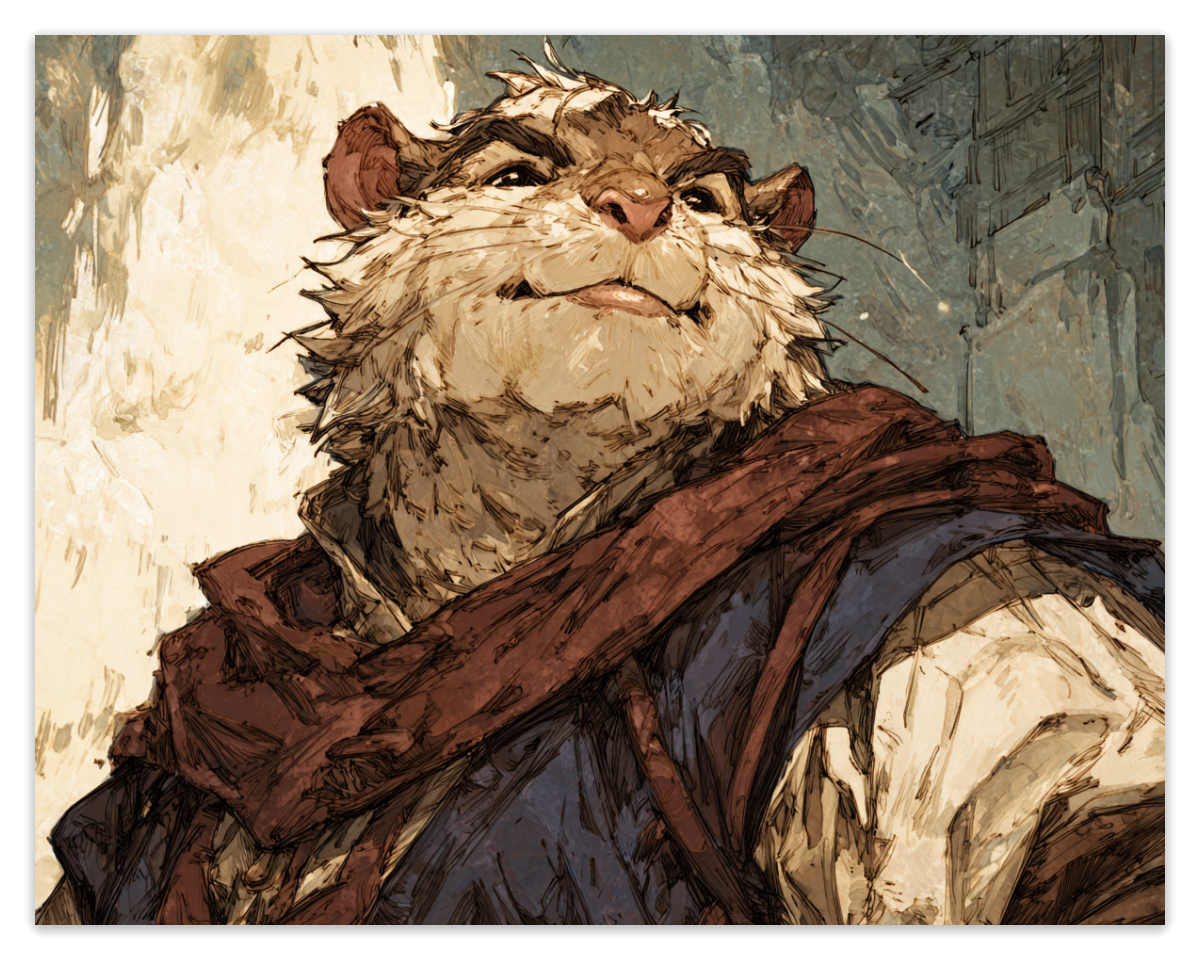
Scrabblenots are small, quick-witted rodent-folk found in every major port, every crossroads city, every administrative center that generates enough paperwork to need someone who will not misplace a number. What most people interacting with them do not appreciate is that the industry is not the defining thing. The defining thing is the weight carried beneath it. A Scrabblenot who was paying attention when something terrible happened has not merely experienced a trauma. They have acquired a permanent resident. The cultural practices that have developed around this: the Zápletnáři who specialize in recontextualizing unbearable locked memories, the Deliberate Forgetting ceremony that marks entry into adulthood, the careful social protocol around what one does and does not choose to witness. These are the product of a people who have been managing the consequences of perfect recall for as long as they have been people.
What they choose to remember, they remember perfectly, forever, in full. This is what makes them reliable witnesses and excellent tinkerers. It is also what makes their private lives, their domestic arrangements, and their relationship to their own worst moments considerably more complicated than the clattering worktables and soft alchemical lamplight suggest.
Origin & History
The Shattering
The Scrabblenot account of their own origin centers on an event they call the Shattering. Older than any written record, older than the Scrabble Conclave itself, the account has been passed through locked memory rather than document, each elder receiving it from the one before in the same words, the same tone, the same weight of telling. Whether the account is literally true, metaphorically true, or something else is not a question Scrabblenots expect to answer. They carry it because it is theirs.
According to the account: long before the Elemental Cataclysm, somewhere in Old Midralis, a crystalline device of unknown origin shattered. The account describes: a pulse of light across a wide area, a sound like a chord played by an instrument no one recognized, and then, across the following days and weeks, the emergence of something new.
The creatures in the discharge radius of the device were changed. Not visibly, not immediately. The change unfolded over generations: something in those communities shifted. Speech emerged. Social organization followed. A quality of attention that had not been there before. And running beneath all of it, arriving last or only becoming legible last, the memory characteristic: what they attended to, they kept. Exactly. Forever.
The device itself was found in pieces. Most fragments were unrecoverable. One shard was retrieved and passed through a succession of communities that recognized it as the source of something significant without understanding what. This shard came to rest with the Scrabble Conclave, where it sits at the center of the Conclave Hall. Those who have spent time near it report, consistently and without coordination, that they cannot fully explain its nature. The closest the elders have come, across many generations of trying, is that it feels attentive. They know only that it matters in a way that has resisted articulation, and they have stopped expecting that to change.
The Age of Clever Hands
When the Elemental Cataclysm struck, Scrabblenot guilds responded first. Their collapsible shelters and siphon-pumps kept river towns from flooding and quenched fire-storms around fractured volcano nodes. The crisis scattered them further: wherever refugees gathered, a clutch of Scrabblenots usually arrived with tool-crates and drafted the first post-quake maps.
Over the centuries that followed, shattered infrastructure created urgent demand for clever, small-scale solutions. Many of their inventions propagated across Midralis, improving quality of life for the masses in ways that generated no institutional credit and considerable institutional use. The Concordiax ’s administrative infrastructure relies on several Scrabblenot-developed systems it has never formally acknowledged as Scrabblenot-developed. This is neither news nor surprise to the Scrabblenots who maintain those systems.
Scrabblenots Today
Scrabblenots are today a fixture in most ports and crossroads cities. They do not merely live in them. They occupy the infrastructure layer: the pipe systems, the relay networks, the provisioning chains, and the institutional memory of how a city functions. Remove them from a city and it would take some time for anyone to identify what had changed, and longer to explain why everything was slightly worse.
The Scrabble Conclave meets every third year in rotating host-burrows to swap blueprints, settle patent disputes, and maintain the social architecture that keeps far-flung Scrabblenot communities in contact. At its center sits a dim, swirling artifact that all owe their lineage to and none can quite explain.
The Locked Memory
How It Works
Scrabblenot memory does not function as total recall. What they have is deliberate recall: the capacity to lock any experience they are consciously and fully present for in permanent, perfect fidelity. A Scrabblenot who is paying attention, truly attending with full sensory and cognitive engagement, will retain that experience with complete accuracy forever. Every detail. Every word spoken and its exact inflection. The emotional state of the moment preserved alongside the factual content, as vivid on retrieval as it was when formed.
Passive experience fades normally. Background noise, distracted moments, things happening at the periphery of awareness: these are subject to the same ordinary forgetting any species experiences. The lock requires intention, and intention requires presence. Every moment of inattention is a decision with permanent consequences. Every choice to be present is an act of commitment, because whatever is witnessed in that state is witnessed forever.
The Weight of What Is Kept
The burden of Scrabblenot memory is not volume. It is permanence. An ordinary being who experiences something traumatic has, in the architecture of their memory, a mechanism of attenuation: the emotional intensity diminishes over time even when the factual content persists. Distance accumulates. The wound does not close, but it scars. Scrabblenots do not have this mechanism for locked memories. What was felt in the moment of locking is felt at full intensity on every retrieval, for the rest of their lives.
The term for the condition where locked memories begin to overwhelm present-moment functioning is Overweave, named for the sensation of too many threads running simultaneously, none of them able to be put down. Overweave is recognized, discussed openly, and treated without stigma in Scrabblenot communities, the way a repetitive strain injury might be treated in a community of craftspeople. It is the occupational hazard of being what they are.
Zápletnáři
Zápletnáři are Scrabblenot practitioners whose specialty is the cognitive and Spiritual work of memory recontextualization. The central insight of Zápletnář practice is that a locked memory cannot be unlocked. It cannot be forgotten, suppressed, or altered. What can change is its meaning: the web of associations, interpretations, and subsequent experiences that surround it. A memory of a terrible event is not made less terrible by Zápletnář work. It is made smaller relative to everything else, given context, placed in a larger narrative, connected to what came after.
Zápletnáři work in long sessions, sometimes spanning days, during which they guide a client through the deliberate construction of surrounding memory. The technique requires both parties to be fully present and attending, which means the Zápletnář is themselves locking memories of the session. Senior Zápletnáři carry, as a function of their practice, an unusually large number of other people’s most difficult memories. This is considered an honorable burden. Zápletnáři have their own Zápletnáři.
Non-Scrabblenot practitioners with Echo sensitivity have noted that Zápletnář sessions produce a distinctive resonance in the Spira of surrounding space, a quality of accumulated presence that lingers in rooms where a great deal of Zápletnář work has been done. Old Zápletnář halls feel inhabited in a way that is difficult to characterize. Several Concordiax Echo practitioners who have visited such halls have filed reports describing the experience and been told, by administrators who have not visited themselves, that the phenomenon is not significant.
The Deliberate Forgetting
Scrabblenot adulthood is marked by the Deliberate Forgetting: a coming-of-age ceremony in which a young Scrabblenot, guided by their community’s Zápletnář and their closest family, identifies the locked memories from childhood they are not yet equipped to carry and performs a ritual act of intentional non-locking, revisiting those memories while deliberately not attending, allowing them to fade as passive memories do.
This is not traumatic. It is, in most cases, a relief: the deliberate release of experiences a child locked before they had the context to understand what they were committing to. The ceremony encodes the foundational Scrabblenot understanding: you are old enough to decide what you carry when you can also decide what you set down. An adult Scrabblenot has made a considered decision about their own archive. Every locked memory from that point forward is a commitment they made with full understanding of what commitment means.
Physical Features
- Small build; 3′–4′ tall; build varies meaningfully by people: Cityscutters lean and fast-twitch, Cheekers broader and rounder, Graybacks stocky and endurance-built
- Fur ranges from pale gray to warm brown; some family lines carry a faint metallic quality in coloration, particularly those closest to Old Midralis origin sites
- Oversized eyes and mobile ears; both reflect habitual and continuous noticing: the resting expression of a Scrabblenot at rest is the expression of a being that is attending to something
- Hands adapted for fine manipulation: multi-jointed fingers, precise grip, built for sustained work at small scale
- Voice faster than most species at natural pace; modulating to Diplomata speaking speed is a real and continuous courtesy that every Scrabblenot in a mixed-language setting is extending, at all times, as a background task
The Three Lines
Cityscutters, Cheekers, and Graybacks are vocational lineages that became something more over generations of concentrated practice in different environments. They developed separate cultural relationships to memory, to the Conclave, and to the world they move through. Movement between lines through apprenticeship and declared vocation carries no stigma, but the line a person is raised in shapes what they lock, what they carry, and what kind of weight they bring into old age.
The Three Lines
Cityscutters
The Urban Current
Physical Features
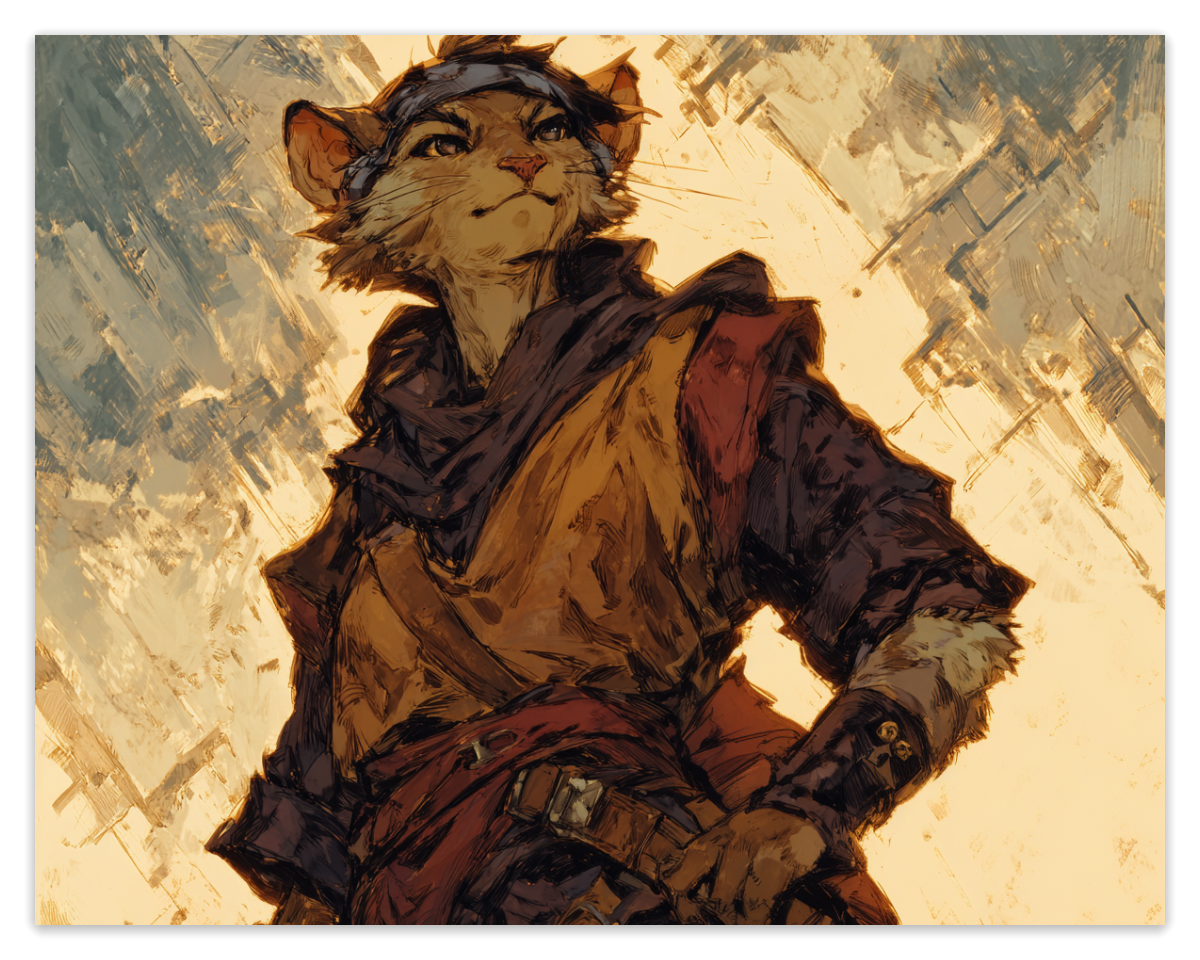
- Lean, fast-twitch build; lightest frame of the three lines
- Fur typically in pale grays and warm tawny browns; coloration that reads as urban-neutral
- Hands built for fine work: lock-picking, conduit threading, precision repair at small scale
Predisposed Spiritual Expression



Cityscutters are courier-runners, locksmiths, alchemical lamp technicians, sewer-gate operators, and the particular kind of fixer who knows which door in any city leads to which conversation. They move through urban infrastructure with the ease of beings who have locked the entire map. Cityscutter culture places discretion above almost all other virtues: the discipline of knowing a great deal and choosing carefully what to share, with whom, and when. A Cityscutter who cannot manage their own archive socially has failed the most fundamental Cityscutter ethic. Senior Cityscutters are among the most reliable actors in any city they inhabit precisely because their reputation for discretion is not theoretical.
The Three Lines
Cheekers
The Long Chain
Physical Features
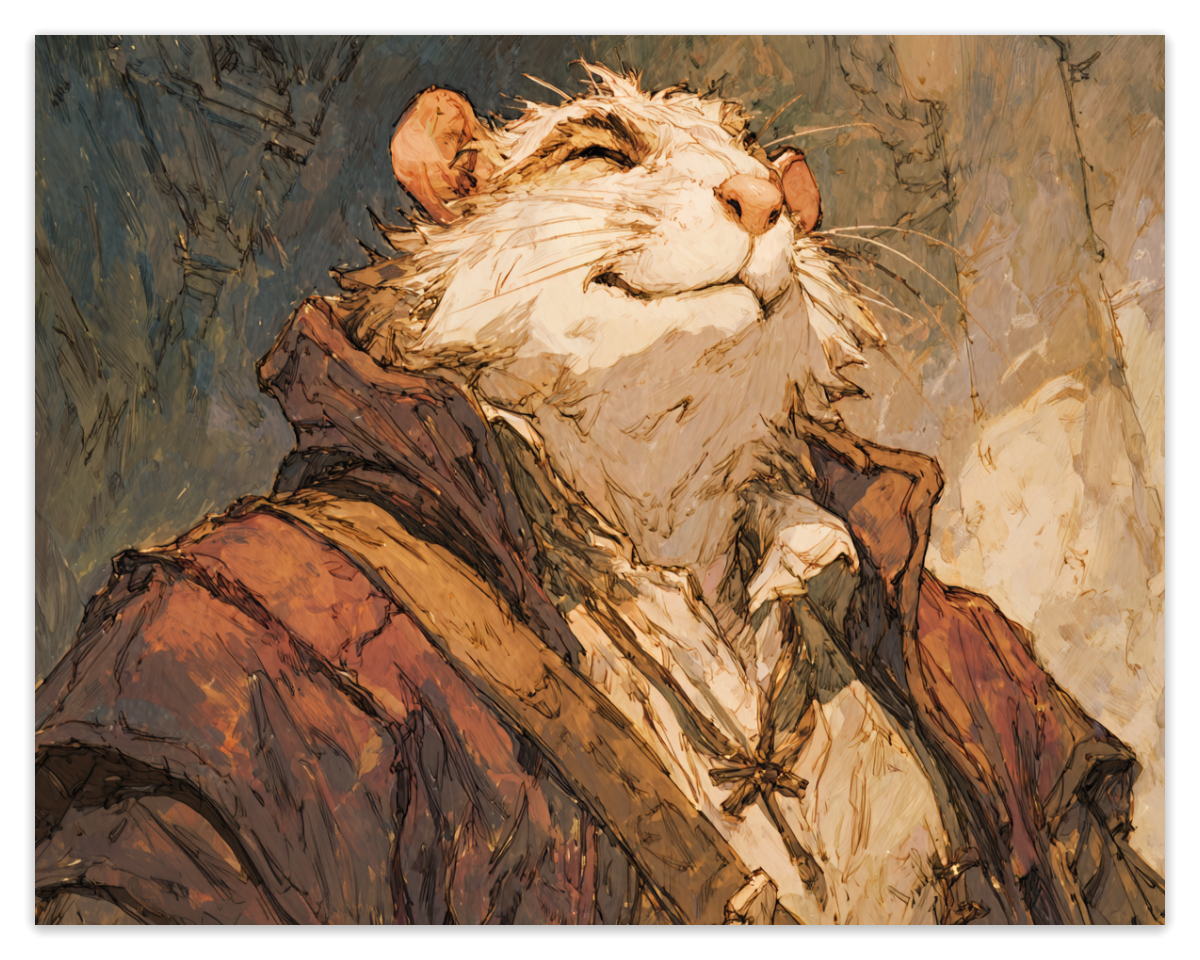
- Broader and rounder than Cityscutters; the hamster-adjacent proportions are visible and functional
- Cheek pouches more developed than other lines; the namesake feature is practical before it is descriptive
- Fur in warm browns and amber tones; deeper coloration than Cityscutters
Predisposed Spiritual Expression


Cheekers are logistics specialists whose vocation is provisioning, supply chain management, food preservation, and the deep organizational work of ensuring large populations have what they need before they know they need it. Where Cityscutters lock spatial and mechanical knowledge, Cheekers lock pattern knowledge: the cycles of supply and demand, the seasonal variations in what regions produce and need, the breaking points of distribution systems under stress. A senior Cheeker is not someone brought in to solve a supply crisis. They are the reason the crisis did not materialize.
The Three Lines
Graybacks
The Last Record
Physical Features
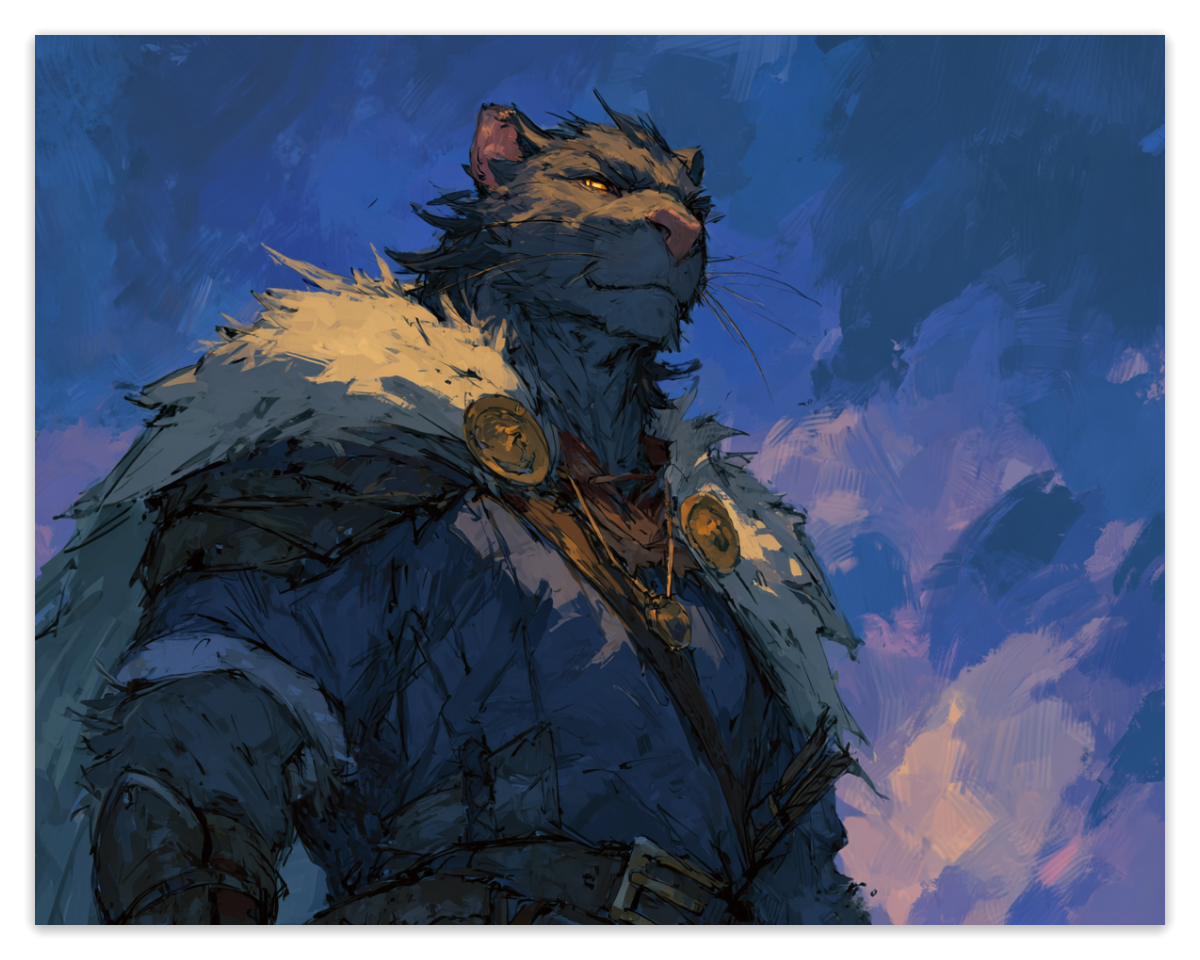
- Stocky, endurance-built; heavier musculature and denser coat than the other two lines
- The characteristic gray-to-silver back coloration that gives the line its name; more pronounced in individuals with decades of fieldwork
- Coat develops a distinctive weathered texture from extended outdoor exposure; the most legible marker of seniority in Grayback communities
Predisposed Spiritual Expression


Where Cityscutters know cities and Cheekers know supply chains, Graybacks know the places where neither exists: mountain passes, storm-locked coastal routes, deep interior territories that larger civilizations have not reached or have retreated from. In the environments where Graybacks operate, they are frequently the only record that will survive. A Grayback on a deep survey mission is a living archive of everything they observe in a context where no other archive exists. If they do not come back, what they locked is gone. This shapes Grayback culture in everything from pre-departure Zápletnář sessions to their near-legendary status within the Skrit Vel as the runners who take the routes nobody else will
Ordinary Life
What perfect memory does to relationships is not what outsiders expect. Outsiders expect it to produce trust. What it produces first is the quality of intimacy that comes from knowing you cannot revise yourself in the other person’s archive.
Intimacy
A long-term Scrabblenot partner has locked years of you in full fidelity. Not a reconstruction of what they remember about you. The exact words you said four years ago in a context you would prefer to have faded. The tone you used. The expression on your face when you said it. Every apology you have made since then has been made to someone who can retrieve, at any moment, the original incident in precisely the state it occurred. You cannot soften the past through the ordinary human mechanism of mutual forgetting. The version of yourself that existed at your worst moment is permanent in someone else’s archive.
The Scrabblenot experience of long-term intimacy is therefore, at depth, the experience of being loved without revision. For some people this is the most profound form of being known: someone who remembers exactly has decided, with full information, that you are worth staying with. For others it produces a recurring discomfort: the awareness that the person you are trying to become is being evaluated against an unchanged record of who you were.
What lovers ask each other not to lock is one of the most intimate conversations in Scrabblenot domestic life. A partner who says ‘let this one pass’ is asking for something that costs nothing cognitively and means everything culturally: the deliberate choice to not attend, to allow this particular moment to fade. A partner who locks something you explicitly asked them not to has committed the violation that Nett has a word for. The word does not translate adequately into Diplomata. It means something in the range of ‘the person who kept what should have been released’, with the connotation that they understood what they were doing and did it anyway.
Arguments
Arguments between two Scrabblenots who were both attending cannot be about facts. Both parties know exactly what was said, in exactly the tone it was said. There is no ‘that’s not what you said.’ There is no misremembering to exploit, no gap in the record where a more favorable version might be reconstructed. The argument therefore has to be entirely about interpretation: what the words meant, what the intent was behind the tone, what the experience of the moment felt like from each position. This produces, in the best cases, a quality of conflict resolution that outsiders find almost unnatural.
In the worst cases, it produces the most entrenched conflicts in Scrabblenot domestic life. If both parties have locked the same event in perfect fidelity, and if their locked experiences of that event genuinely diverge, there is no appeal to the record that resolves anything. They are not arguing about what happened. They are arguing about what it was like to be there, and neither party’s locked memory invalidates the other’s. Some of these arguments run for years.
What Parents Teach Children About Witnessing
The first lesson about witnessing is given before children can fully understand it: be careful what you attend to. Parents manage what they expose children to before the Deliberate Forgetting with the awareness that childhood attention is not yet disciplined, and what a child locks by accident, while genuinely present for something they should not have seen, becomes part of an archive they will carry into adulthood.
Some parents consciously allow their attention to drift during their children’s suffering, not to abandon the child, but to avoid carrying a permanent record of the child’s worst moments in a form that would affect every subsequent interaction. This is understood as a form of mercy toward both parties. Other parents hold the opposite view: that being fully present with a child in pain is the highest form of parental witness, and that carrying the locked memory of that pain is part of what parenthood requires. Both positions are defensible. Both are practiced. Scrabblenot families have this conversation as an explicit discussion rather than an assumed default.
What Scrabblenots Quietly Cannot Stand
The social category that produces the most consistent private disdain does not have a formal name, because naming it would require acknowledging it as a coherent type rather than an individual failure. The informal Nett whisper-register has a word that translates approximately as ‘the one who attends like a weapon.’ The person who is visibly, performatively present, clearly locking everything, clearly demonstrating their attention as a display of future leverage, in contexts where ordinary courtesy would be to let some things pass. A Scrabblenot who attends to everything in a room where other Scrabblenots are also present has communicated something about their intentions. The communication is received.
The Weaponized Memory
The most serious failure mode in Scrabblenot social life is not Overweave. Overweave is an occupational hazard, understood and treated without stigma. The most serious failure mode is the deliberate deployment of locked memory not to establish truth but to win: citing exact words said three years ago not because the citation establishes what happened but because the other party cannot refute a locked memory. Retrieving a locked record of someone’s worst moment not to understand it but to remind them, during a current conflict, that the record exists and is accessible.
The community’s response is not formal punishment. What happens instead is trust recalibration: the person is not accused. They are no longer in situations where their locked memory would give them leverage. They are positioned outside the contexts where perfect recall functions as asymmetric advantage, which in a community organized around memory ethics is a significant repositioning. The person who weaponized their memory knows what has happened. They carry the locked memory of having done it, in full fidelity, permanently. Whether that memory eventually finds its way to a Zápletnář is a question the community does not press.
The Skrit Vel
The Skrit Vel is the oldest functioning courier institution in Midralis. It predates the Concordiax. It predates the post-Galekian national order. Its founding in the Lumér region, during the fragmented centuries after the Galekian collapse when the continent had balkanized into competing powers and reliable cross-border communication was simultaneously essential and nearly impossible, was not deliberate institution-building. It was a practical response to a real and immediate problem: the only beings who could reliably carry a message across Lumér’s varied terrain, in any season, without losing it, misremembering it, or being persuaded to alter its contents, were Scrabblenots.
The Kessavar clan formalized what was already a regional network of Scrabblenot courier relationships into the Skrit Vel, a name from old Nett meaning approximately ‘the carried thread.’ The common name it acquired as it expanded was the Sure Line: not a translation, but an independent characterization arriving at the same essential claim. When you use the Skrit Vel, the message arrives, exactly as sent, to the intended recipient and no other.
By the time the Concordiax emerged as a continental administrative force, the Skrit Vel was already the communications infrastructure that significant portions of Auridia’s political landscape had built their correspondence around. The Concordiax’s attempt to bring it under regulatory authority produced the most sustained institutional negotiation in the organization’s history: seventeen years of formal proceedings, three attempted licensing frameworks the Kessavar clan accepted in letter and declined in practice, and a final arrangement giving the Concordiax a regulatory office, a client relationship, and the persistent impression of oversight. The Kessavar clan accepted this because it costs them nothing they value and preempts more aggressive action. The Concordiax accepted it because the alternative was administering a continent without reliable communications.
The Kessavar Clan
The Kessavar clan’s authority within the Skrit Vel is not symbolic ancestry. It is accumulated institutional memory. Senior Kessavar elders carry locked memories of the institution’s own history: every major decision, every operational precedent, every negotiation with every external power, going back through a succession of elders who were themselves locking institutional history in full fidelity. The Kessavar understanding of the Sure Line’s founding moment is not a reconstruction from documents. It is a chain of locked memories describing the original Lumér network in the detail that only direct witness can provide.
The weight this carries on certain Kessavar elders is the institution’s most quietly held cost. A senior Kessavar designated as the primary chain-keeper for a particular period of institutional history is carrying, in locked fidelity, decades of other people’s decisions, negotiations, and errors, including errors that current institutional policy depends on not being examined too closely. The elders who carry this archive are among the most carefully supported individuals in Scrabblenot society. They are also, in the second half of their lives, among the most isolated. There are things they carry that they cannot discuss with anyone who is not also a chain-keeper, and the pool of people who qualify is small.
Joining the Skrit Vel
Employment in the Skrit Vel is the most prestigious professional path available to a Scrabblenot. The entry exam, administered over two days with no preparation materials permitted, has three components: route recall under pressure, assessing whether the candidate was locking deliberately or attempting to memorize through repetition; discretion judgment, presenting scenarios involving information held in confidence and competing pressures to disclose; and endurance threshold, a physical assessment designed to identify candidates whose condition under stress affects their deliberate recall. The exam is not designed to be failed on physical grounds alone. It is designed to determine whether the candidate’s judgment holds when they are exhausted.
Relationship to the Concordiax
The Concordiax has two distinct relationships with Scrabblenots, and it manages both with the discomfort of an institution that cannot fully control either.
The first is the general Scrabblenot problem: Scrabblenots are a liability in any context where narrative control matters. A Scrabblenot who was present and attending during a significant event is not a witness who can be managed through the normal mechanisms of institutional pressure: time, fatigue, incentive, the gradual rewriting of shared memory that institutions depend on when official accounts diverge from what happened. The Concordiax’s response is a quiet institutional preference for ensuring Scrabblenots are not in the room when certain things are said. This preference is not codified. It operates through the social architecture of access.
The second is the Skrit Vel problem, which is both older and more structurally intractable. The seventeen-year negotiation produced an arrangement that gives the Concordiax a formal oversight office while the Kessavar clan retains operational independence in every dimension that matters. Both parties know this. The Concordiax’s Skrit Vel oversight office is one of the most well-funded and least effective administrative operations in the organization’s history. It employs a rotating team of analysts whose job is to assess compliance and who consistently report compliance because what they can observe is entirely compliant.
The Conclave’s most sensitive documentation, held in the locked memories of senior Cheekers and cross-referenced against the Skrit Vel’s internal records, includes accounts of events in Concordiax history that the Concordiax’s own archives describe differently. Neither institution has raised this discrepancy publicly. Both know it exists. The balance of this mutual knowledge is, in the Kessavar clan’s institutional assessment, the primary reason the Concordiax has not attempted a second, more aggressive move against the Skrit Vel.
Affinity Disposition: Skewed
Mind and Metal dominate: the cognitive precision and tool-adjacent Prismal relationship that defines Scrabblenot practice. Electricity is elevated, consistent with device-work. Nature is strong, reflecting the observational attunement of a people whose primary practice is presence in the world.
Anima sits at the lowest point in the distribution. The expression most associated with emotional attunement, with reading another person’s interior experience from their presence, is the one least represented in a people whose defining practice is attention to the world outside themselves. What this produces in ordinary life: a Scrabblenot remembers your bad day with perfect fidelity and may still not fully understand what it felt like for you. Zápletnář work exists, in part, to address this gap. It is also the most consistent friction point between Scrabblenots and non-Scrabblenots in long-term relationships, and both parties usually know it.
Mind and Metal dominance produces, in Scrabblenot intra-community social culture, a prestige hierarchy organized around cognitive and technical precision that has a cold edge to it. The Scrabblenot who is highly regarded within their community is the one whose locked archive is both comprehensive and well-organized, which maps very directly onto the kind of personality that prioritizes systematic practice over warmth. The warmest members of Scrabblenot communities are often not the most prestigious ones.
This table reflects population-level Spira tendencies; individual variation always applies.
| Spiritual Expression | Distribution (%) |
|---|---|
| Mind | 12.0 |
| Metal | 11.0 |
| Nature | 11.0 |
| Electricity | 10.0 |
| Fire | 8.5 |
| Earth | 7.5 |
| Light | 7.0 |
| Wind | 6.0 |
| Aqua | 6.0 |
| Darkness | 6.0 |
| Ice | 5.5 |
| Thunder | 5.0 |
| Anima | 4.0 |
| Empyreal | 0.5 |
Language Notes
Nett is a compressed conversational mode designed for speed and discretion. A full sentence in Nett can convey in two seconds what Diplomata takes eight to say. The compression is not simple vocabulary abbreviation; it is grammatical and prosodic, encoding information in word order, duration, and pitch variations that Diplomata’s more regular structure cannot carry. Scrabblenots speaking Nett at full speed are not being rude to non-Nett speakers. They are speaking at the rate their cognitive tempo naturally produces.
Nett’s whisper-register, a further compressed mode designed for communication across short distances without being overheard, is functionally opaque to non-native speakers even with Diplomata fluency. It is used in professional contexts where discretion matters, in Zápletnář sessions where the register of voice carries therapeutic meaning, and in the ordinary domestic context of two Scrabblenots having a conversation about something they would prefer the non-Scrabblenot sitting next to them not to understand. Outsiders who encounter Scrabblenots communicating in whisper-register in their presence should not assume the communication is about them.
What Nett does for ordinary social life that Diplomata cannot replicate: the whisper-register has grammatical constructions for the ethical categories of memory, the witness-obligation register, the release-request register, the lock-confirmation. When Scrabblenot partners negotiate what will and will not be locked about a shared experience, they are using a linguistic register that Diplomata can only approximate with circumlocution. The phrase ‘let this one pass’ in Nett takes one syllable and carries the full weight of what it is asking. In Diplomata it requires explanation and loses, in that explanation, the quality of being a request rather than an accusation.
Systems & Campaigns
- Pathfinder 2e Ratfolk → Scrabblenot
- Draw Steel TBD
- Daggerheart TBD
- D&D 5e+ N/A
- Realmfall Saga Active