Ancestry · Iphexar · Old Midralis / Matemala Plateau
Navin
“My observations of the Navin, these so-called ‘Children of the Winds,’ reveal a curious blend of grace and fortitude. Their affinity for the skies and their near-religious reverence for the forces of nature reveal much about their character. There’s an admirable resilience in their belief that hardship is the key to ascension. Their sacred peaks, where the veil between realms thins, have become both their sanctuary and their prison, binding them to a path that is as perilous as it is exalted. Let us watch them, not with pity, but with the respect one gives to the wind: an unseen force that can either lift or destroy.”
— Eonlogos, Celestian Archivist
Overview
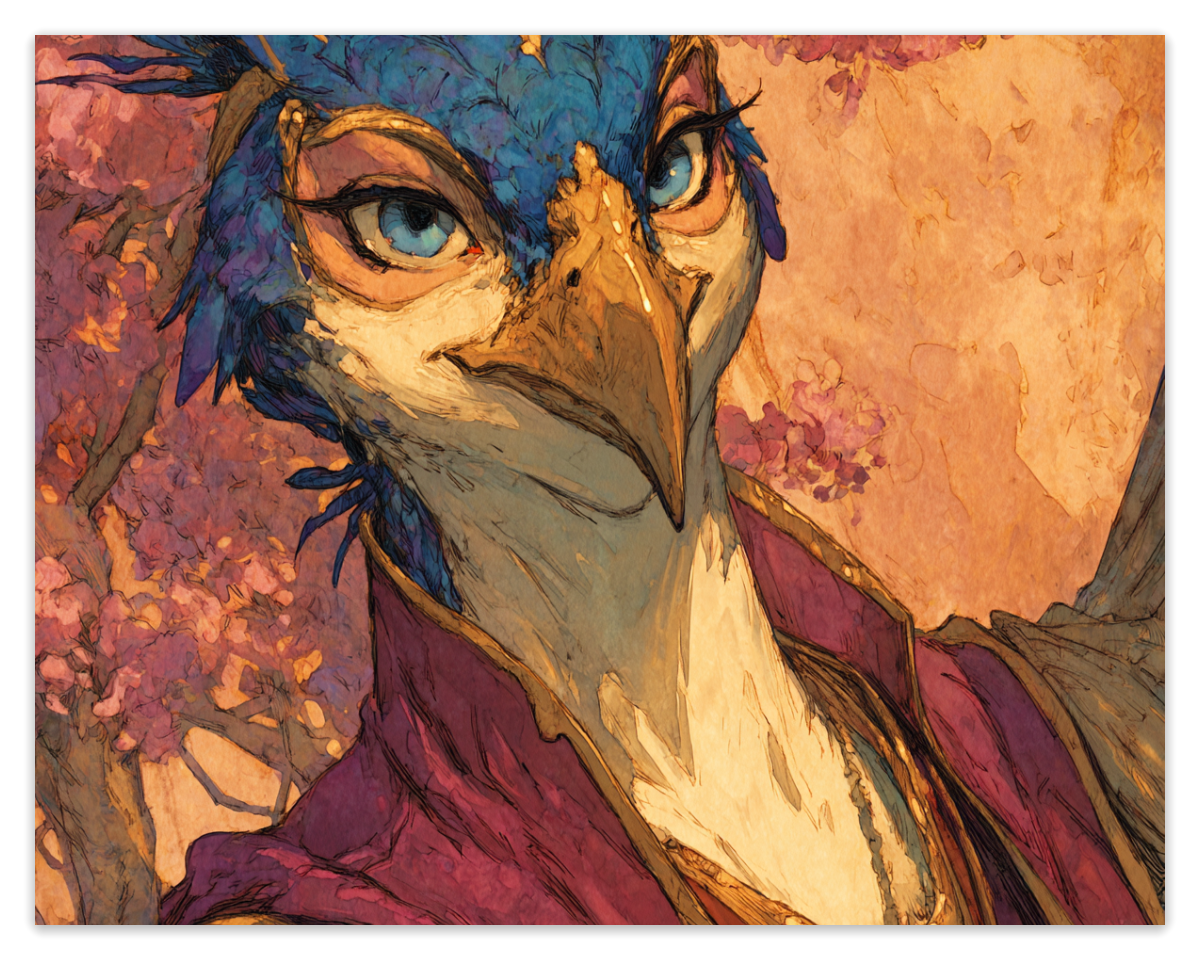
The Navin, often referred to as Skyborn or Children of the Winds, are a race deeply attuned to the celestial and elemental forces of the skies. Residing primarily in the high-altitude regions of the Matemala Plateau — towering peaks, ancient forests, and cloud-kissed plateaus of Grandal’s northwest — they are known for their remarkable plumage, avian grace, and spiritual devotion. Their connection to the sky is more than symbolic; it is woven into the very fabric of their being.
What the Navin are that they do not fully know they are is this: the custodians of permanent veil-thin sites. The sacred peaks they have built their civilization around: the pilgrimage destinations, the communion-places, the sites where the Shaper-blessing is acknowledged and wing-capacity tested — are locations where the veil between the Mortal Sphere and the dimensional exterior has degraded to a measurable degree. The Navin experience this as the presence of ancestors, of divine attention, of the particular quality of openness that high altitude and thin air produce in people who have been taught to read it as spiritual significance. They are not wrong to experience it as spiritual significance. They are incomplete in their understanding of what that significance means in cosmological terms.
The Oncaya Empire, which governs the Matemala Plateau within the Auridian Union framework, has protected this incompleteness with considerable institutional sophistication. Formal Union membership, regular council attendance, trade agreements, and the specific autonomy arrangements that keep Concordiax administrative reach from ascending to the plateau — all of it serves the Empire’s core interest: sacred sovereignty over sites that, understood correctly, represent the most significant concentration of veil-thin conditions on the Auridian continent.
Origin & History
The Shapers Tezcalan and Coatlinea
The Navin trace their origins to the deliberate act of two Shapers: Tezcalan, the Sky Father, and Coatlinea, the Earth Mother. Unlike some Shaper-origin ancestries whose creation event is mythologized beyond cosmological recognition, the Navin oral tradition is unusually precise about what happened, not because it was witnessed by beings who are still alive, but because the Navin have been performing a ceremony that re-enacts the creation event every generation for as long as their oral tradition extends, and the ceremony’s precision requirements have preserved the structural details.
Tezcalan embodied the forces of sky, wind, and storm. Coatlinea embodied the earth and sky in their meeting-point, not the deep earth of the Vorrathan tradition, but the specific relationship between high ground and the sky above it, the canyon edge and the updraft, the place where rock and air negotiate the terms of altitude. Together they created the Navin as custodians of the sacred peaks where their two domains converged: beings who could move between the ground and the sky, carrying the mark of both Shapers expressed across three distinct lineages.
The assignment they were given, maintain and honor the sacred peaks, is one of the few Shaper mandates in the compendium where the Shaper’s intention and the ancestry’s practice have remained in genuine alignment across millennia. The Navin have not drifted from their mandate the way the Dracovians drifted into empire, or abandoned it the way the Sskar have fragmented around their unfulfillllable covenant. They are doing, in the 4th Age, substantially what Tezcalan and Coatlinea asked them to do.
Birth of the Skyborn — Old Midralis
The first Navin were born on the sacred peaks where the boundaries between the mortal realm and the outer spheres were thin — a description that, read through the lens of established cosmology, is not metaphorical. The peaks were already veil-thin before Tezcalan and Coatlinea shaped the Navin. The Shapers chose the location deliberately: beings born in sustained proximity to veil-thin conditions develop a relationship to those conditions that no subsequent training can replicate. The first Navin were the first custodians because they were born already calibrated to what they were being asked to watch.
Over millennia, the Navin built their settlements in these high-altitude regions, creating a society that blends the ethereal with the terrestrial. Their plumage: the wings that grow throughout their lives, reflecting personal growth and hardship overcome — are the most visible physical expression of this sustained proximity: a biological marker that accumulates the sky’s influence across a lifetime.
The Elemental Cataclysm and the Matemala
The Matemala Plateau survived the Elemental Cataclysm with unusual structural integrity: a fact that Navin oral tradition attributes to the Shaper-blessing protecting the sacred peaks. The post-Cataclysm period saw the Navin consolidate around their plateau with a clarity of purpose that the chaos of the New Age sharpened. Where other ancestries were rebuilding civilization from fragments, the Navin were maintaining something that had survived. The Oncaya Empire emerged from this consolidation: not a conquest state but an organizational structure built to protect and administer the plateau’s continuity. Its founding documents describe its purpose in terms that translate approximately as the structure that keeps the peaks ours.
The Oncaya Empire and the Auridian Union
The Oncaya Empire occupies a unique position in the Auridian Union: formally a member, functionally autonomous in all dimensions that matter to it. The plateau’s natural defensibility — no army ascending from Grandal’s lower elevations has ever successfully sustained a siege at altitude — has always been the Empire’s primary negotiating position, and it has never needed to be deployed. The Oncaya attends councils, pays dues, maintains trade relationships with neighboring states, and participates in the Union’s collective governance on matters that do not touch the plateau. On matters that do touch the plateau, the Empire’s position is consistent across every administration: the Matemala Plateau is sovereign Navin territory, its internal governance is not subject to Union administrative oversight, and the sacred peaks are not available for any external access regardless of the requesting institution’s claimed purpose.
The Navin position on the Concordiax is characterized by a specific quality of patience that outsiders sometimes read as arrogance. The Concordiax is approximately three centuries old. The Oncaya Empire’s commitment to keeping the peaks sovereign predates the Concordiax by several millennia. The Navin elders who manage this relationship are not particularly worried about the Concordiax’s institutional pressure. They have seen institutional pressure before. The peaks are still theirs.
Culture & Society
The Great Ascension
Navin culture places great importance on the concept of ascension — both physical and spiritual. At its most literal, the Great Ascension is the rite of passage in which a young Navin journeys to the highest sacred peaks of the Matemala Plateau to seek the blessing of Tezcalan and Coatlinea and to test their wings in open sky above the veil-thin sites. The journey is not designed to be survived easily. The peaks are genuinely dangerous — altitude sickness, storm exposure, the specific atmospheric instability that veil-thin sites produce, and the particular quality of Prismal pressure that sustained proximity to degraded veil conditions creates in beings not yet fully calibrated to it.
The wing-growth system that makes this meaningful is one of the most distinctive biological features of the Navin. Navin wings begin as small, delicate appendages and grow over time as the Navin experiences life’s trials. This growth is not merely physical but is understood as a reflection of the Navin’s journey through life — every significant hardship, overcome challenge, or genuine spiritual awakening produces measurable wing development. A Navin elder whose wings have grown to their full span across two centuries of plateau existence carries, in that plumage, a legible record of what they have faced and survived.
The Veil-Touched Peaks
The Navin maintain a circuit of sacred peaks across the Matemala Plateau, each with its own ceremonial tradition, its own specific place in the pilgrimage sequence, and its own quality of Prismal presence that experienced practitioners describe as distinct from the others. The Navin’s own understanding of this distinctiveness is theological — each peak has a particular relationship to the Shaper-blessing, a specific aspect of Tezcalan or Coatlinea’s nature that it expresses more strongly than the others. Different sub-types are drawn to different peaks: Itzali to the highest and most storm-exposed, Tolteca to the sites with the longest continuous ceremonial record, Xochitla to the sites where the veil-thin conditions produce the most vivid ceremonial atmosphere.
The ceremonies conducted at the sacred peaks: the wing-communions, the storm-callings, the ancestor-attendings that form the backbone of Navin spiritual practice — are all, at the structural level, practices that orient practitioners toward the veil-thin conditions of the sites and train sustained Prismal engagement with those conditions. This is not what the Navin understand themselves to be doing. They understand themselves to be communing with the sky and with the ancestor-spirits who dwell at the peaks. Both descriptions are accurate.
Hualtl and Spatial Language
Navin culture is organized around the vertical axis in ways that ground-based civilizations do not develop. Hualtl, the Navin language, encodes spatial relationships from above: the three-dimensional orientation of a being who can be at any altitude from ground level to the peak summits, and who navigates social and geographic space in terms of elevation, updraft, and the specific relationship between where you are and what the sky looks like from there. When a Navin says ‘the trading post to the east,’ they are leaving out altitude, approach angle, prevailing wind condition, and the specific quality of sky visibility that their Hualtl-register thought includes automatically. Navin communities with sustained outsider contact have developed compensatory explanatory phrases — Diplomata approximations of the spatial register that Hualtl carries inherently.
Sub-Types — Three Lineages
The Navin express their Shaper inheritance across three distinct lineages, each embodying a different dimension of what Tezcalan and Coatlinea created the Navin to be. The Itzali carry the physical and martial weight of custodianship. The Xochitla carry the ceremonial and spiritual tradition. The Tolteca carry the institutional memory that makes the other two possible. Inter-sub-type families are common and their offspring may belong to any of the three lineages — sub-type is not rigidly heritable.


Physical Features
- Stature: 6’–7’ tall, with slender athletic builds; lightweight bodies designed for agility and flight. Itzali run toward the upper range with broader wingspan; Tolteca toward the most precise mid-range build; Xochitla the most varied.
- Plumage & Wings: The defining feature. Wings begin as small appendages and grow throughout life, accumulating through the mechanism specific to each sub-type: Itzali wings grow through physical hardship into impressive dark spans; Tolteca wings grow through scholarly practice into quietly complex pale-gray patterns; Xochitla wings grow through spiritual trial into saturating iridescent color. Though all Navin can glide, only those who have accumulated sufficient wing development can achieve full flight.
- Facial Features: Sharp and angular, with intelligent vibrant eyes and beaks that allow for precise articulation of their melodic language. Itzali eyes tend toward deep amber and gold; Tolteca toward pale silver-gray; Xochitla the most varied, often reflecting their plumage’s iridescent quality.
- Build: Lightweight overall with dense, strong wing-musculature. The specific muscle development of sustained high-altitude flight produces a physique deceptively strong for its apparent mass, a Navin who looks slender is carrying wing-anchor musculature that a Myûr of comparable height would find considerably heavier than expected.
- Voice: Melodic and precisely articulated. Hualtl’s aerial perspective register requires tonal precision that Navin vocal anatomy is specifically adapted for. Navin speaking Diplomata retain a melodic quality that other ancestries often find striking and that Navin communities regard as the most obvious sign that their language is doing something Diplomata was not designed to carry.
Alignment
The Navin are inherently spiritual beings, and their alignment often leans toward neutrality and balance. Their deep connection to the sky and to the forces of nature produces an ethical orientation that values the long view — the pattern across time rather than the immediate outcome of any given decision. Navin elders who have spent two centuries at altitude, watching the plateau’s weather systems and participating in peak ceremonies that their grandparents’ grandparents conducted in the same form, develop a relationship to human-scale urgency that other ancestries sometimes read as detachment and that is more accurately described as proportion.
Their governance through the Oncaya Empire reflects this: the Empire’s administration is patient, thorough, and extremely difficult to pressure into decisions it has not reached on its own timeline. This quality served the Navin well across the Galekian Empire period, when the combination of altitude-defensibility and administrative intractability deterred conquest more effectively than any military response.
Affinity Disposition
Navin Spiritual Expression distribution reflects their Shaper origin and the specific Prismal environment of the Matemala Plateau’s veil-thin peak sites. Wind at 14.0 is the dominant expression — a direct reflection of a people whose existence is organized around aerial movement, updraft navigation, and the storm systems that define plateau existence. Thunder at 12.0 and Electricity at 9.0 complete the storm-triad. Nature at 9.5 reflects the plateau ecology that Coatlinea’s earth-mother domain shaped. Earth at 4.0 is the lowest expression: the Navin’s relationship to the ground is practical and navigational rather than elemental.
| Spiritual Expression | Distribution (%) |
|---|---|
| Nature | 9.5 |
| Wind | 14.0 |
| Anima | 8.5 |
| Mind | 6.5 |
| Fire | 5.5 |
| Metal | 5.0 |
| Earth | 4.0 |
| Aqua | 6.5 |
| Electricity | 9.0 |
| Ice | 6.5 |
| Thunder | 12.0 |
| Darkness | 5.0 |
| Light | 7.5 |
| Empyreal | 0.5 |
Wind at 14.0 is tied with Rabbanar’s Nature for the highest single-expression value in any established ancestry table.
Conflicts & Connections
With the Concordiax
The Concordiax’s relationship with the Navin and the Oncaya Empire is defined by the specific frustration of an institution that has correctly identified something it wants and has been unable to acquire any form of access to it across centuries of sustained, sophisticated diplomatic effort. The Oncaya Empire’s formal Union membership gives the Concordiax a legitimate relationship to the Empire’s administrative layer. It does not give the Concordiax anything that happens above a certain altitude.
The Verbum administration the Concordiax operates in the Oncaya Empire’s lowland settlements is real and functional. The information this produces about Navin Prismal capacity is accurate for the lowland-dwelling and trade-oriented Navin population and dramatically understated for the peak-dwelling contemplative tradition that the Concordiax actually wants to understand. The Concordiax’s senior analytical staff who have studied the Navin question longest have reached a consistent conclusion: the Empire’s administrative sophistication is not the product of ordinary political skill. It is the product of a civilization that has been protecting the same thing for the same reasons for four thousand years and has had four thousand years to develop every possible response to every possible form of institutional pressure.
With the Worldkeepers
In the pre-Rending operational period, the Worldkeepers identified the Matemala Plateau as a region requiring sustained monitoring and attempted to establish a formal relationship with the Navin. The relationship that developed was warm, productive, and carefully structured by the Navin to ensure the Worldkeepers understood that the peaks were not available for institutional access regardless of how legitimate the accessing institution was. The surviving Worldkeeper lineage documentation of the Matemala Plateau is the most accurate description of the peak sites’ veil-thin parameters available anywhere. It is not in any archive the Concordiax controls.
Language Notes
Hualtl (racial language) encodes spatial relationships from above, the three-dimensional orientation of a being who navigates social and geographic space in terms of elevation, updraft, and the specific relationship between where you are and what the sky looks like from there. The consequence for cross-cultural communication is that Navin speaking Diplomata are consistently losing information about spatial context that their Hualtl-register thought includes automatically. Outsiders interacting with Navin in Diplomata are receiving a flat map of what the Navin experience as a three-dimensional navigational reality.
Systems & Campaigns
- Pathfinder 2e Strix / Tengu › Navin
- D&D 5e+ Aarakocra / Kenku › Navin
- Draw Steel TBD
- Daggerheart TBD
- Realmfall Saga Active