Ancestry · Iphexar · Midralis
Rabbanar
 Uncommon
“They do not want power over anything except their own patch of soil, and their patch now feeds most of Auridia. Whether they know what they could ask for that is the question I have spent considerable effort failing to answer. I tend to assume they know. The generations of restraint on that question are either principled or strategic, and I have found the margin between those two things considerably narrower than I expected.”
— Eonlogos, Celosian ArchivistOverview
A Rabbanar market at full spring operation is one of the more disorienting experiences available in a city within Reino de Valerios. The disorientation comes from the opposite of chaos. Every exchange has the rhythm of something done a hundred times before: practiced, quick, conducted between people who know more than the words require. The produce is extraordinary because the people producing it know this land the way you know something you have spent years paying close attention to. The prices are fair because the community has decided what fair means and the community enforces it, without any visible enforcement. Somewhere in the back of the seed exchange, behind the bins of labeled packets, is the part that outsiders do not know they are looking at: the living record of who these people are and where they came from, written in botanical Latin.
The Rabbanars arrived in Midralis as refugees from Veraldíe. What they built on the Valorón Peninsula was the expression of people who had spent generations in a world where they could not own what they built, and who, when they finally could, built everything they had been prevented from building and structured it so that no one could easily take it from them again. The stall is the philosophy made visible. The crop grown where the grower chooses, on land they hold, sold to people they know, priced according to what the community has decided fair means. Generations of being unable to do any of those things is what the stall represents.
The less flattering version of this is also true. A people this committed to self-determination and self-sufficiency, who have organized their communities around the principle that you are not grown until you can manage for yourself, have produced specific forms of intolerance, insularity, and the slow cruelty of communities that have no patience for the people who cannot keep up. The Rabbanar who will give everything to help a community in crisis is not always the same Rabbanar who knows what to do with an individual who keeps needing help.
Origin & History
What Was Left Behind
The Rabbanar originated in Veraldíe, the fey realm, where they existed within the orbit of Archfey Courts whose power over the landscape and over the beings who inhabited their domains was total rather than negotiated. They were subjects: valued, in the way that useful and pleasant things are valued, by beings whose relationship to them was fundamentally one of ownership.
What was preserved across the crossing was the feeling: the quality of living under the attention of something that could take what you built at any moment and call it tribute, hospitality, or simply the natural order of things. The decision to begin again rather than carry the full weight of Veraldíe forward was made by the first warrens that crossed, a collective and largely unspoken choice to let the specific grievances fade so that the new life could be built without being haunted by the old one.
The Crossing and Early Arrival
The Rabbanar crossings were not a single event. They were a pattern extending across the full span of the Fey Migration, whole warrens moving through rifts as they found them, arriving in Midralis in groups ranging from a few dozen to several hundred. What the early arrivals found in the Valorón Peninsula was what they had been trained, by generations in Veraldíe, to find: land with potential. The terraced highlands were rocky, post-Cataclysm-scarred, and considered marginal agricultural territory by the Myûr farming communities that had largely abandoned sustained cultivation there. The Rabbanars looked at the same terrain and saw something different. The soil was unconvinced rather than exhausted. Within a generation, it was producing. Within two, it was producing surplus.
Valerios and the Green Quarters
As Rabbanar agricultural communities established themselves across the Valorón Peninsula, their relationship with the emerging Reino de Valerios shifted from refugee tolerance to genuine integration. Early tensions around land rights, harvest taxation, and the Rabbanar communities’ consistent resistance to governance models that replicated the dependency structures they had left Veraldíe to escape were real and occasionally sharp. What resolved them was material reality: Valerios’s agricultural abundance was a Rabbanar achievement, and the Valerios nobility understood that this was not a population to antagonize.
The Green Quarters that developed across the following centuries are the institutionalized form of that understanding: Rabbanar-run market districts across the larger Valerios settlements, and in some settlements beyond the Peninsula, that the surrounding city depends on. Valerios grants Rabbanar communities semi-autonomous status within the Green Quarter framework, the right to govern their own commercial and communal affairs, to maintain their own dispute resolution practices, and to negotiate harvest quotas directly with municipal authorities.
What the arrangement looks like from inside the Green Quarter and what it looks like from outside are different things. From inside: the building of something that finally belongs to the people who built it. From outside: a semi-autonomous commercial district that the surrounding town depends on for food, whose operators maintain an informal preference network that outside merchants find nearly impossible to penetrate, whose land values have been quietly consolidating under Rabbanar communal ownership for generations, and whose response to formal competition is never confrontational but consistently effective. The formal accusation that Green Quarters operate as agricultural cartels has been made twice to Valerios authorities in the last century. Valerios authorities have both times declined to investigate. The resentment from outside has a real basis: control over a city's food supply, land tenure consolidating quietly over generations, a community that answers to its own institutions rather than to municipal governance. Nobody declared this arrangement. It developed.
The Living Seed Archive
Every Rabbanar community maintains a seed bank. Outsiders know this as an agricultural resource: backup crop varieties, genetic insurance against blight, the reserve that restores production after disaster. This understanding is accurate and substantially incomplete.
A Rabbanar seed bank is also a living archive. Crop varietals carry names that encode particular people, founding events, and the conditions under which particular varieties were developed or preserved. The cultivar that produces well in the rocky upper terrace carries the name of the family whose labor made that terrace workable. The drought-resistant pulse variety named for a difficult season in the third generation is also a record of that season. A senior Rabbanar cultivator reading a seed bank inventory is simultaneously reading their community’s history in a form that does not require anyone to write it down.
The layout of a Rabbanar garden encodes information that botanical knowledge alone cannot decode. The placement of particular plants at specific borders marks historical relationships and obligations between families. The arrangement of the central bed reflects the community’s self-understanding of its founding generation. The combination of varietals in a community’s shared seed stock signals, to other Rabbanar communities who know how to read it, the current state of internal relations: which families are central, which are marginal, which have been quietly allowed to lapse in influence along with the cultivar that carried their name. When a Rabbanar community shares seeds with another community, they are sharing something more than genetic material. A non-Rabbanar who receives seeds from a senior Rabbanar cultivator has received something they do not fully understand. Some are told what they have received. Most are not.
The Ambassadors of Harvest
Rabbanar agricultural specialists carry cultivation knowledge across Auridia to regions where the land needs help: composting rites, crop-rotation systems, pest-management practices, and cultivation techniques refined across centuries of agricultural work on the Valorón Peninsula. Their role as neutral arbiters in agricultural disputes developed from the simple fact that Rabbanar communities have no territorial ambitions. They come to help the land produce. They do not come to govern the people who live on it.
The neutrality is genuine and also incomplete. Rabbanar communities have interests: their cultivation methods spreading, communities becoming dependent on Rabbanar cultivators, their standards for land stewardship being treated as authoritative. They are the interests of any people whose knowledge is their primary asset and who have spent generations watching that knowledge be undervalued by institutions that want access to it without acknowledging what it is. In practice, a neutral party whose methods have become the regional standard is not quite as neutral as the word implies.
The Veraldíe Memory
What the Rabbanar carry from Veraldíe is instinct rather than history in the archival sense: a population-level wariness toward powerful beings that make demands, a reflexive discomfort with arrangements that require ongoing dependency, and a quality of alertness when something with significant Prismal presence takes an interest in them. Most Rabbanars cannot explain where this wariness comes from. They have inherited the feeling without the story.
The consequence, in the generations since, is a people who know they came from somewhere else, who know vaguely that the somewhere else was complicated, and who have a generational instinct toward self-sufficiency that they understand as simply who they are. A Rabbanar who has grown up in a Valerios Green Quarter does not think of themselves as the descendant of refugees escaping Archfey exploitation. They think of themselves as someone who runs a very good market and values their independence. Both things are true. The second is what the first became.
Fey beings in Midralis register differently to Rabbanars depending on generation and family line. To most Rabbanars in the 4th Age, a Fey being is an unusual entity, interesting rather than loaded. To the oldest families, something in their presence produces a quality the elder Rabbanars might describe as familiarity without warmth.
The Bitter-Keepers
Not every family made the collective decision to prioritize building over remembering. In most communities, present but not prominent, there are family lines that carried more than the collective decision intended. They have a fuller account of what the Archfey Courts demanded. They know names that other Rabbanars have allowed to fade. In their seed banks, they carry varietals that encode events other communities no longer remember, histories that the decision to begin again asked Rabbanars to let go.
What identifies a bitter-keeper family to other Rabbanars is behavior rather than declaration: the quality of their response when a Fey being is nearby, which is less the ambient unease of ordinary Rabbanar instinct and more the particular stillness of someone who has been told what to watch for. The relationship between bitter-keeper families and the communities around them is cordial, occasionally warm, and carries an undercurrent that neither party has found productive to name.
The refusal debate is present in every Rabbanar generation, though it rarely surfaces formally. The communities that remember more tend to argue, in discussions that are never quite about this, that the decision to start over was a form of complicity: that letting the Archfey Courts’ actions fade from memory was something the Courts would have wanted. The communities that remember less tend to respond that this argument is exactly what happens when you let a wound become your identity. Both positions have evidence. The debate persists, managed rather than resolved.
Physical Features
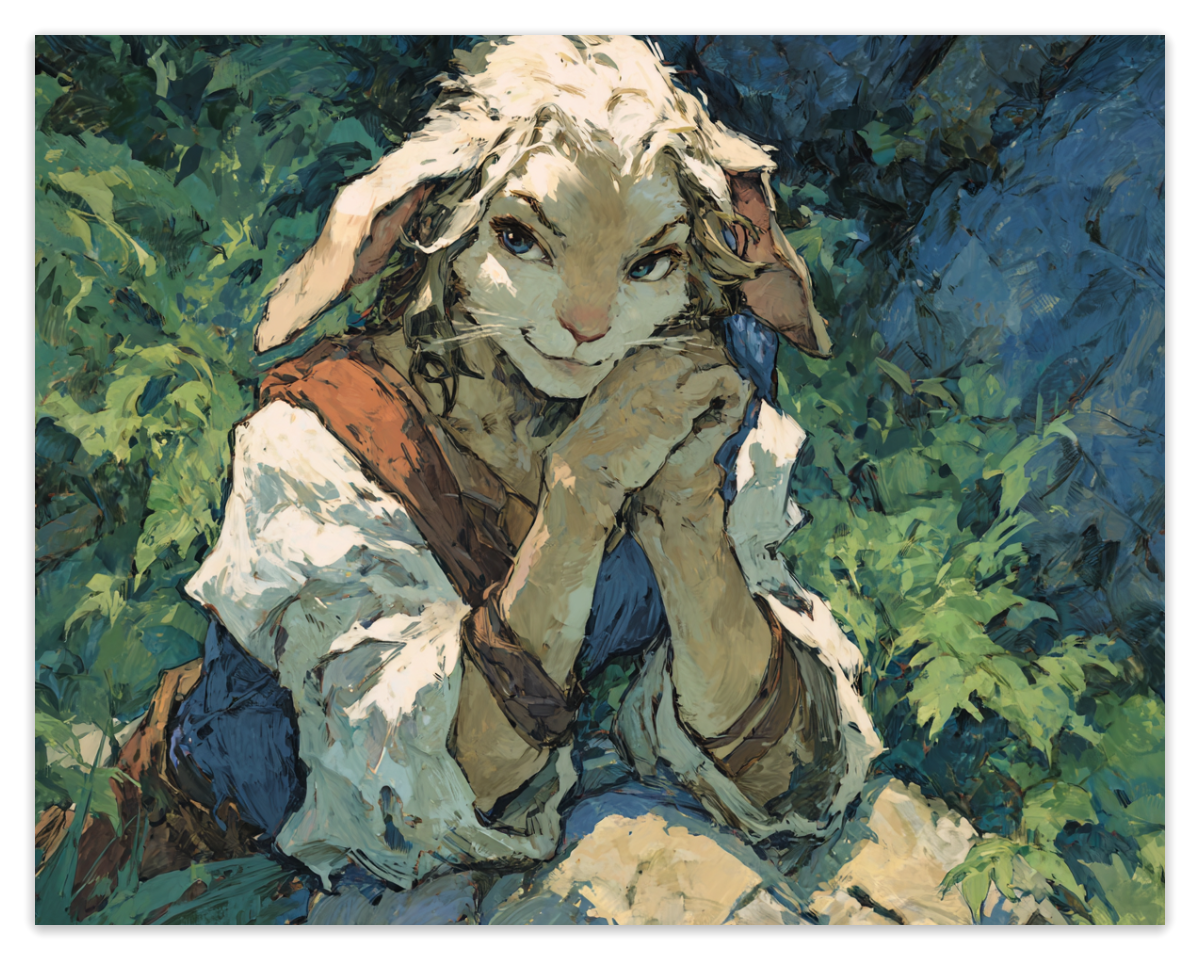
- 3′–4′ tall; build varies by line, from the heavier Brawnyhare frame to the leaner Cottonhopper build
- Fur spans white, tan, and brown to near-black; natural camouflage patterns that reflect family terrain; rare iridescent sheen in some Cottonhopper lines reflects residual Veraldíe Prismal exposure
- Eyes large and expressive, adapted for wide-field vision; the quality of alert attention that reads as nervousness in other ancestries is simply the resting state of a being calibrated for noticing
- Ears long, upright, independently mobile; the primary emotional signaling instrument; carry social information in position and angle that other ancestries cannot reliably read without extended community immersion
- Hands well-suited to cultivation work: strong enough for soil work, dexterous enough for seed selection, grafting, and herbalist preparation
The Two Lines
Brawnyhares and Cottonhoppers are the two heritable lines within the Rabbanar population: biological variants with distinct physical profiles passed through family lineage. The traits are consistent within bloodlines and blur at the edges, particularly in families that have crossed between lines over generations. Vocation tends to follow the body’s inclinations often enough that the lines map roughly onto ways of life, but the map is descriptive rather than prescriptive.
The Two Lines
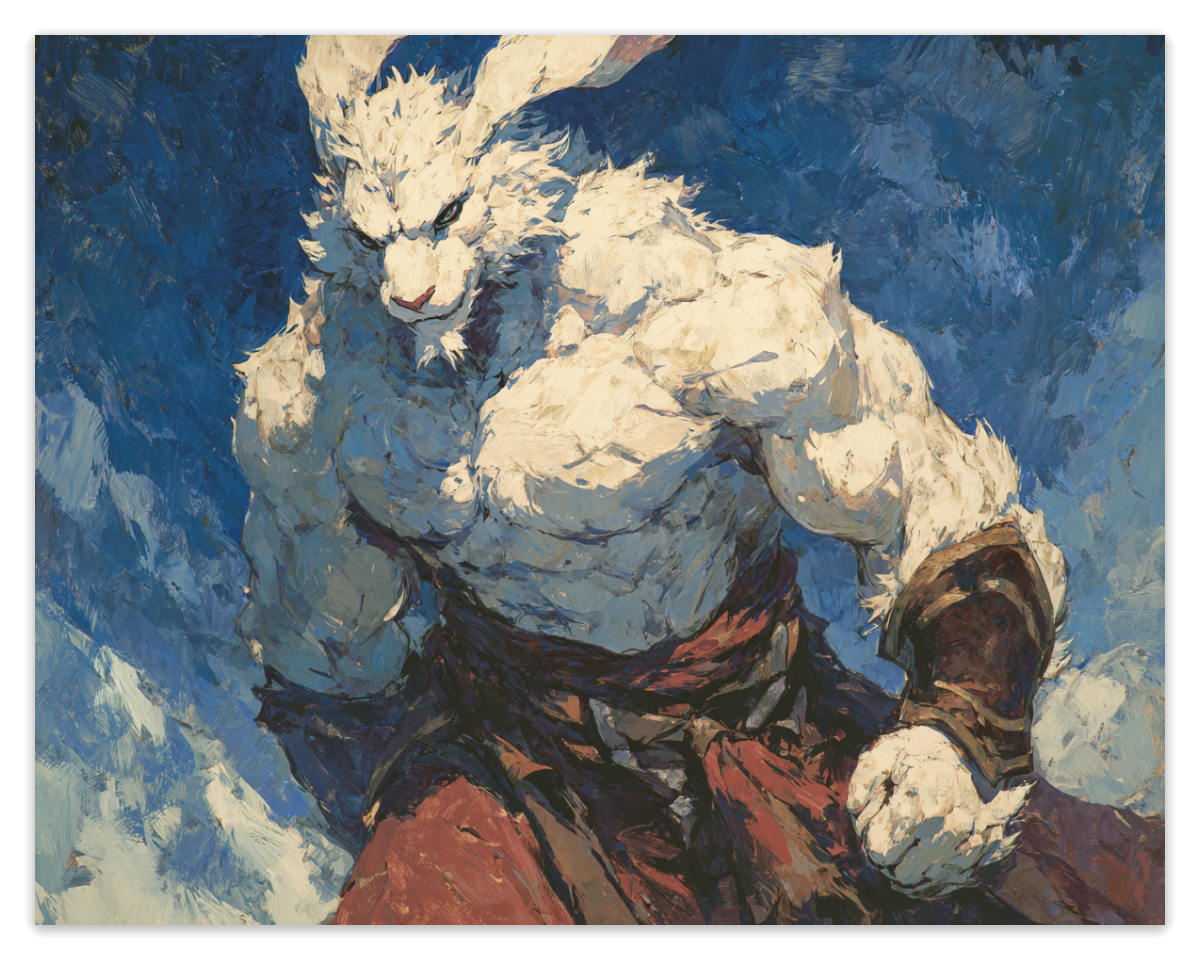
Brawnyhares
Roots & Ramparts
Physical Features
- Larger and more physically imposing; heavier builds, denser muscle; physicality that surprises outsiders expecting lagomorph-folk to be uniformly slight
- Fur ranges across the full color spectrum with no consistent pattern; denser and more weather-resistant coat than Cottonhopper lines
- Build suited for sustained physical cultivation work, land clearance, and community defense
Predisposed Spiritual Expression


The line most associated with physical cultivation work, land clearance, construction, and the direct defense of Rabbanar community interests. Brawnyhare culture places the highest value on the immediate, tangible relationship between effort and outcome: you plant, you tend, you harvest. Their skepticism of plans that require trusting something they cannot observe directly is the accumulated wisdom of people whose ancestors were exploited by patrons who were very good at explaining why the arrangement made sense. Their relationship to community defense runs through warren-level structures that have, on several historical occasions, proven more effective than the opposition expected from a population of farmers. The shadow of this is that the line which protected the warren in a difficult period has earned something real, and over time the earning can calcify into an unspoken belief that defense was also a warrant for moral authority: who belongs, what the community’s values are, who has done enough to have a voice.
The Two Lines
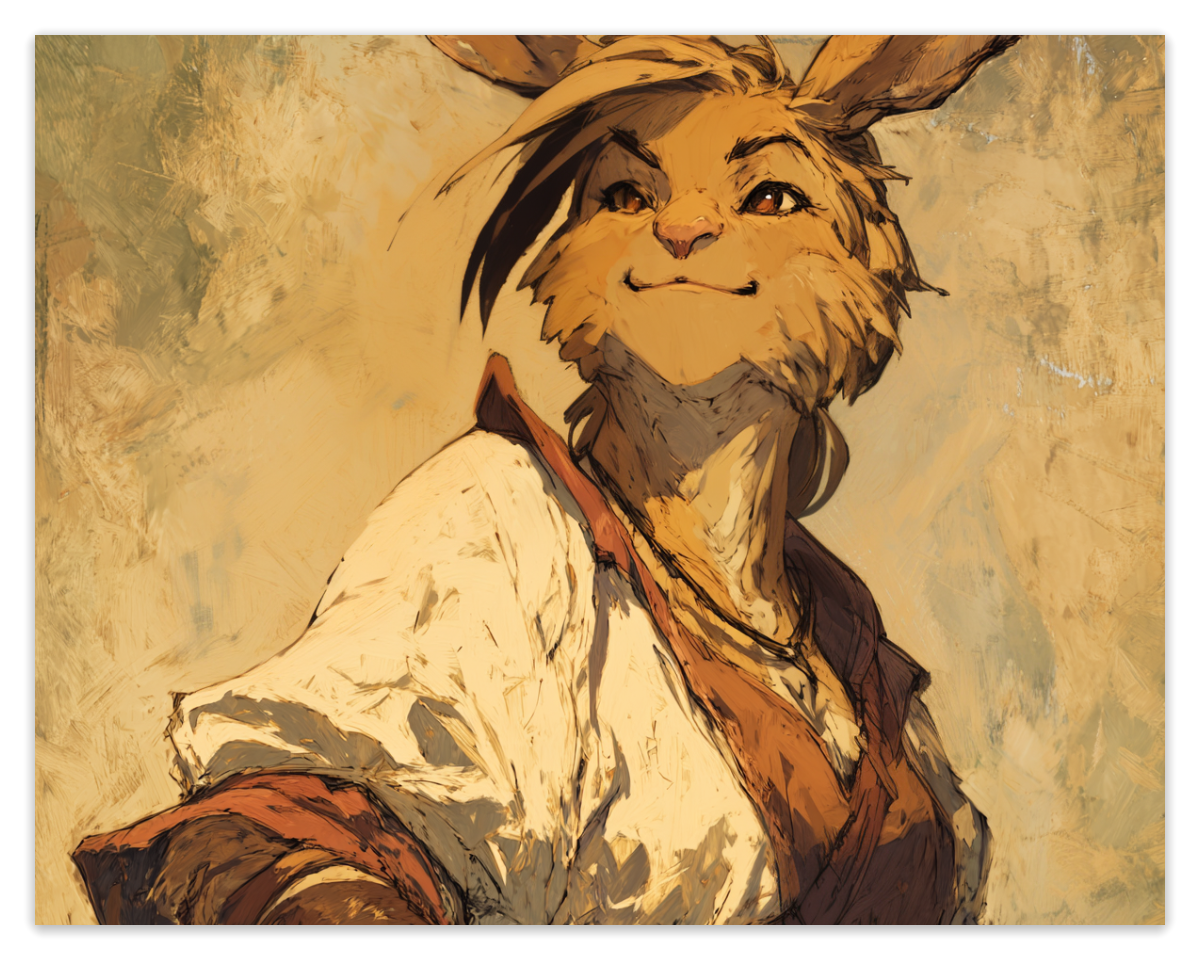
Cottonhoppers
Roads & Relations
Physical Features
- Lighter, faster, and more travel-oriented; lean builds suited for sustained movement across varied terrain
- Fur in tans, pale grays, and warm whites; occasional iridescent quality in some lineages that reflects Veraldíe-adjacent Prismal exposure
- Build that balances speed with the endurance of people who have been covering ground since before the crossing
Predisposed Spiritual Expression

The line that carries Rabbanar agricultural knowledge across the roads and sea routes of Auridia and beyond. Cottonhopper culture prioritizes connection over rootedness: their understanding of home includes everywhere they have been and everything they have learned there. A senior Cottonhopper who has spent forty years as a traveling seed merchant has built, in the Rabbanar understanding, just as solid a home as the Brawnyhare elder who has worked the same field for four decades. The reputation Rabbanars have across Auridia as reliable, perceptive, and more observant than their agricultural focus suggests is largely a Cottonhopper reputation. Outside Valerios, they are also the line most exposed to the Concordiax’s gray-zone pressure: carrying cultivation knowledge through territories where Valerios’s protection does not reach means operating under a cloud of unlicensed practice that a Concordiax administrator with a particular interest in Rabbanar activities can make very uncomfortable. Most do not. The ones who do are not forgotten.
Ordinary Life
The most consistent source of private Rabbanar shame is needing something from outside the warren that the warren should be able to provide. The pressure carries no formal rule. It is the ambient pressure of a culture whose foundational value is self-determination and whose measure of adulthood is independent establishment. The Rabbanar who cannot establish their first enterprise, who takes longer than their peers, who needs extended family support past the expected threshold, passes without formal judgment. They are simply known in the way that a community that pays close attention to everyone knows everything, and the knowing accumulates.
Coming of Age
You are grown when you are your own. This principle, which is also what makes Rabbanar adulthood genuinely meaningful, is also what makes the community around a struggling young Rabbanar difficult. The community will help. Rabbanar communities help each other. But the help is calibrated. Too much help produces dependency in the Rabbanar framework, and dependency is what their grandparents crossed a rift to escape. The community that helps a young Rabbanar for too long and too fully is understood, in the most honest internal assessment, as the community that has privately decided the young Rabbanar cannot do it themselves. The verdict is never stated. It is what the help sometimes means.
Grief
Rabbanar grief, in its most characteristic expression, involves planting something: a deliberate act of continuation and a form of memorial. The person who is gone is encoded into something growing, something that will produce, something that can be named and maintained and that will outlast the season of loss. The cultivar chosen for a memorial planting is a decision the community discusses with the bereaved, and what is chosen reflects what the community understands about the person who died and what they would want to be remembered as. A Rabbanar who dies without a memorial planting is a Rabbanar who is not in the seed archive, which is the closest thing the culture has to not being remembered.
What Counts as Contemptible
The person the Rabbanar community cannot quietly stand is the person who keeps needing help they should not need, who does not learn from the help they have received, who has reached the point where the community’s assistance is maintaining a situation rather than addressing it. The Rabbanar form of this contempt takes the form of patience that gradually becomes absence: the help that gets slower to arrive, the advice that gets vaguer, the community’s attention that finds other things to occupy it. The person who finds themselves increasingly peripheral in a Rabbanar community they used to be central to may be experiencing the social consequence of having been unable to manage for themselves for long enough that the community has quietly reclassified the situation.
The Table
Rabbanar communities are overwhelmingly herbivorous. For Cottonhoppers the practice is close to universal: a people whose daily life consists of moving agricultural knowledge through communities that depend on growing things find that eating animals runs against how they understand the world. The cycle a cultivator tends is a cycle of growth. Participating in it as grower and eater is one coherent relationship to living things. The alternative is available. Most Cottonhoppers find it does not fit.
Among Brawnyhares, the majority follow the same practice. A minority, particularly those in physically demanding defense or labor roles, eat meat. The community makes no formal rule about this. The Brawnyhare who eats meat is included without comment and assessed without comment, and the assessment is present whether or not it surfaces. The person who has made a particular choice about their relationship to living things in a community whose primary identity is growing those things occupies a position in the community’s private accounting. The position is not hostility. It is a quiet, persistent awareness of the choice.
Cultivation Prestige
In Rabbanar communities, the person with the strongest growing relationship to their land occupies a prestige position that most outsiders initially misread as simple agricultural expertise. It overlaps with wealth but remains distinct from it. At its core it is the recognition of someone whose cultivation practice is so developed that the land visibly reflects their presence. The senior cultivator whose fields are consistently more productive, whose seed varieties are more robust, whose ecological reading of the land is most accurate, is the person whose opinion on non-agricultural matters also carries more weight than their formal standing would justify. What emerges is an unstated hierarchy, the natural consequence of a community whose primary value is agricultural excellence.
The shadow: a Rabbanar who cultivates adequately but whose practice never produces the relationship to the land the community recognizes as extraordinary is consulted less. Their voice in community decisions carries the weight of their formal standing, without the additional weight a lifetime of cultivation excellence might have added. The Rabbanar whose vocation lies entirely outside the soil is integrated genuinely while the community maintains a quiet, private, never-stated assessment that they are missing something fundamental about what Rabbanar life is.
Affinity Disposition: Strongly Skewed
Nature at 14.0 is the most commonly represented expression across the Rabbanar population: a direct inheritance from Veraldíe’s nature-saturated cosmological environment. Rabbanars born with strong Nature expression tend toward cultivation work as their natural domain; over decades of practice, the most dedicated among them develop a relationship to the land that the community recognizes as extraordinary. Earth at 11.0 is the second most common expression in the population.
What this distribution produces socially is a community where cultivation excellence, and the prestige that attaches to it, tends to concentrate among people whose lifelong practice has been shaped by a predisposition toward growing things. The senior cultivator whose fields are consistently most productive, whose ecological reading of the land is most accurate, is typically someone whose predisposition drew them toward that work early and kept them there. Their opinion on non-agricultural matters carries weight beyond their formal standing, because cultivation excellence is understood in the Rabbanar framework as evidence of character.
Ice and Thunder are among the least common expressions in the distribution. The dispositions they tend to produce sit at an angle to the values a cultivation-centred community most recognises and rewards.
This table reflects population-level Spira tendencies; individual variation always applies.
| Spiritual Expression | Distribution (%) |
|---|---|
| Nature | 14.0 |
| Earth | 11.0 |
| Wind | 9.5 |
| Anima | 9.0 |
| Light | 8.5 |
| Electricity | 8.0 |
| Mind | 7.5 |
| Aqua | 6.5 |
| Fire | 6.0 |
| Metal | 5.5 |
| Darkness | 5.0 |
| Ice | 4.5 |
| Thunder | 4.5 |
| Empyreal | 0.5 |
Language Notes
Leporine is dual-origin: a Veraldíe root language with Midralis-acquired registers developed across the centuries since the crossing. The Veraldíe dimension carries the texture of a language evolved in a cosmological environment saturated with Fey presence. It has grammatical structures for expressing the relationship between a being and the power above them that Diplomata does not have, because Diplomata was developed by people who did not need that grammar.
These structures are now used in Rabbanar communities to describe relationships to employers, patrons, and institutions. The grammar exists, the context has changed, and the ironic charge that comes from using Archfey-relationship grammar to describe a landlord is not lost on Rabbanars who know what they are doing. What is fully available as irony to a Rabbanar fluent in the Veraldíe grammar is simply a tone to a Rabbanar who learned the contemporary register without knowing its origin. Both are using the same grammar. Only one of them knows what it originally meant.
Leporine’s Midralis registers are primarily agricultural and commercial: a vocabulary of soil conditions, crop health, market negotiation, and the terminology of community self-governance that Green Quarter administration requires. Outsiders who learn conversational Leporine typically know the commercial register. The Veraldíe-origin register, and the tonal and ear-position components that carry emotional information without verbal content, are not accessible without long-term community immersion. Ear position carries significant social information in Rabbanar interaction that other ancestries typically cannot read. The same sentence in Leporine can carry meaningfully different information depending on ear position and delivery: a subtlety that translation into Diplomata flattens entirely.
Systems & Campaigns
- Pathfinder 2e Rabbitfolk (3P) → Rabbanar
- Draw Steel TBD
- Daggerheart TBD
- D&D 5e+ Harengon → Rabbanar
- Realmfall Saga Active