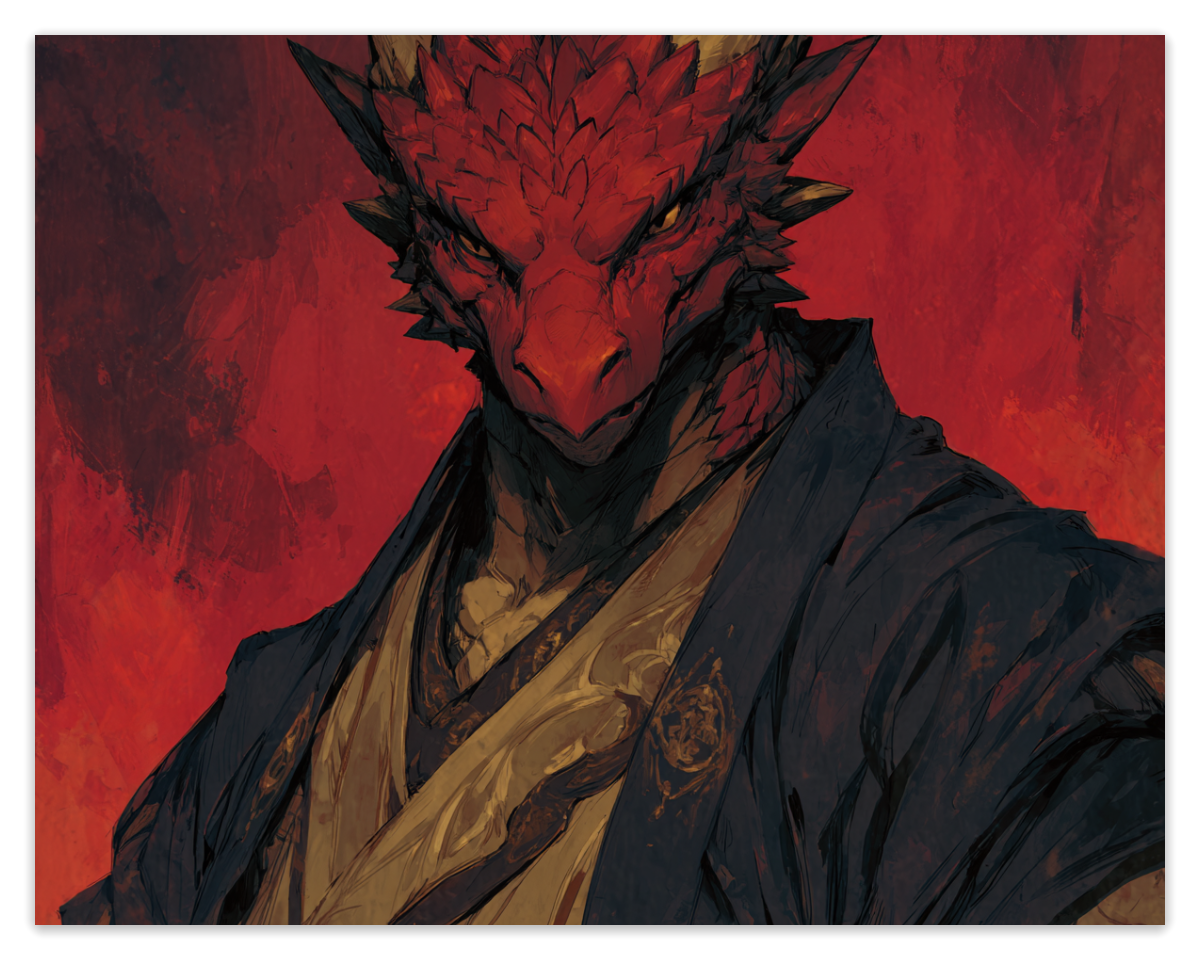
Ancestry · Iphexar · Old Midralis / Kyou
Kobold
“The Kobolds, often called Scaleshifters or Kairyu among the draconic-inclined, are an example of the world’s ability to reshape life in the wake of its most ancient powers. These diminutive beings, born from the convergence of magical energies and the lingering essence of the extinct dragons, exhibit a startling diversity that reflects the environments they call Midralis. Whether their scales glisten with the hues of a long-lost dragon or pulse with the elemental forces of Midralis, each Kobold is a living reflection of the Prisma Current energies that gave them form.”
— Eonlogos, Celestian Archivist
Overview
Kobolds are a people born without intention. No Shaper made them. No god or Guardian designed their form or assigned their purpose. They exist because eggs rested in places where Prisma Current energy was sufficiently concentrated, and the energy wrote itself into the developing life within. The result is an ancestry of extraordinary variety — scales in every color the world’s Currents produce, abilities shaped by location rather than lineage, a population distributed across every terrain type that supports a significant Current node.
What unites them is not biology but culture: the specific relationship to time, tradition, and community that a fifty-year life produces in beings who have decided that the answer to brevity is not speed but depth. Kobolds do not move through life quickly hoping to fit more in. They move through it carefully, investing in the things that will outlast them: the clan structure, the craft tradition, the accumulated knowledge of how to live well in the specific place they inhabit. A Kobold community that has occupied a Current node for several generations has developed a relationship to that place that no other ancestry can replicate.
The Kairyu of Kyou are the most culturally developed expression of Kobold civilization — dragon-clan communities organized around the residual draconic Prismal energy that concentrates in Kyou’s Current landscape, maintaining their own towns and villages under the Hino Federation’s political structure while preserving clan traditions that predate the Federation itself. They are the Kobolds that the wider world knows best, when the wider world knows Kobolds at all.
Origin & History
Birth of the Scaleshifters
The first Kobolds emerged in the chaotic era following the Elemental Cataclysm, a period that reshaped the world of Midralis and saw the extinction of the mighty dragons. As the last dragons perished, the magical energies they left behind seeped into the Prisma Currents of Midralis — particularly in the lands of Kyou, where the great sea-dragon and river-guardian lineages of Old Midralis had been concentrated. These residual energies, combined with the ambient Current forces of the land, gave rise to the first Kobold eggs.
The eggs, laid in proximity to various Current nodes of power, absorbed the unique energies of their surroundings, leading to the birth of Kobolds with a diverse range of abilities and appearances. Unlike other ancestries whose origin traces to a Shaper’s deliberate act, Kobolds are defined not by a single origin but by the Prisma Current configurations they were born near. What the first Kobold communities understood about themselves was practical rather than cosmological: they were shaped by place, they were suited to place, and survival meant understanding the place that had shaped them better than anything else that might occupy it.
The Kairyu in Kyou
The Hino Federation that consolidated Kyou’s political landscape after the 200-Year War found in the Kairyu communities a population that had been managing Kyou’s Current-dense interior for centuries before any Federation state existed. The integration that followed was not an absorption — it was a negotiation between an emerging political structure and communities with deeper roots in the landscape than the Federation’s institutional memory. The Kairyu retained their clan structure, their village and town networks, and their internal governance practices.
In the 4th Age, Kairyu communities occupy a distinctive position in Kyou’s political geography: formally within the Federation, functionally self-governing, and strategically essential to the Federation’s understanding of Kyou’s Current landscape. The Kairyu read that landscape with an intimacy that no Federation institution can replicate, and the Federation has learned, through several centuries of attempting to replicate it, that this knowledge cannot be extracted from its cultural context. The Kairyu know things about Kyou’s interior that they know because of who they are and how they live, not because of information they could write down and hand over.
The Kairyu — Dragon Clans of Kyou
The Kairyu organize themselves into five major clans, each associated with a specific draconic scale coloration that emerged from the residual Prismal energies their ancestors absorbed. These clans are not merely aesthetic categories — they represent distinct cultural lineages with their own relationship to Kyou’s geography, their own internal governance traditions, and their own unspoken philosophy about what the draconic inheritance means. None of the clans have a fully accurate cosmological understanding of where their characteristics come from. What they have instead is four thousand years of cultural practice that has arrived at the same place through different reasoning.


Kobold Variants
Beyond the Kairyu, Kobolds emerge wherever Prisma Current nodes are sufficiently dense. The following variants represent the major categories of non-Kairyu Kobold populations. They are not subraces in the genetic sense — they are outcome categories produced by different Current configurations at the hatching site. A Kobold community that has been hatching near the same node for generations will trend consistently toward that node’s expression profile, but individuals always vary, and communities near complex or shifting Current configurations may produce genuinely mixed variant populations.
The Zhen-Ryu-Ji — The Way of the Dragon
Among the many things that define the Kairyu as distinct from the broader Kobold population, none carries more cultural weight than the Zhen-Ryu-Ji: the martial and spiritual doctrine that has shaped Kairyu society since the post-Cataclysm era. Part military tradition, part philosophical discipline, part clan obligation, it is the institution through which most Kairyu understand their relationship to their draconic heritage, to each other, and to the world beyond Kyou’s borders.
The Ryūdō — the Way of the Dragon — is the formal name for the doctrine as practiced. Its practitioners are called Ryūshi. Both terms are used within the Zhen-Ryu-Ji’s internal culture; the institution’s name itself is used primarily in formal and external contexts. A Kairyu Kobold who introduces themselves to a Hino Federation official is a Ryūshi of the Zhen-Ryu-Ji. Among their own clan, they simply walk the Ryūdō.
Origins — Ryūjin and the Post-Cataclysm Founding
The Zhen-Ryu-Ji’s founding is inseparable from the figure of Ryūjin — the being whose teachings gave the earliest Kairyu communities a framework for surviving the post-Cataclysm chaos. The Cataclysm had remade the world: Prisma Currents that had been stable for millennia ran wild, elemental forces moved through the landscape without pattern, and the communities that would become the first Kairyu were navigating a radically altered Kyou with no institutional infrastructure and no precedent for what they were.
Ryūjin appeared, the oral tradition is consistent on this point even when it disagrees on details. And taught. What Ryūjin taught was not merely combat or elemental manipulation but a comprehensive orientation toward the world: how to read the Prisma Currents that had shaped the Kairyu at hatching, how to channel the Spira that ran through their specific draconic inheritance, how to move through conflict and crisis with the quality of attention that their short lives made both necessary and possible. The earliest Zhen-Ryu-Ji dojos were not buildings. They were the teachings themselves, carried in the memories of the first practitioners and passed forward.
The nature of Ryūjin is the central unresolved question of Zhen-Ryu-Ji scholarship. The oral tradition describes a being of prismatic quality, not one color, not one element, but something that encompassed all of them simultaneously. Senior masters within the Zhen-Ryu-Ji have debated for centuries whether Ryūjin was a divine manifestation, a concentrated Prismal presence given temporary form by the Cataclysm’s chaos, or something categorically different from any being the world currently has language for. The debate is considered a mark of the tradition’s intellectual vitality rather than a theological crisis. Ryūjin’s nature doesn’t change what Ryūjin taught. The teaching stands regardless.
The Three Currents
The Ryūdō is organized around a core insight that Ryūjin’s teachings established and that every subsequent generation has reformulated without changing: the practitioner’s draconic inheritance, the specific Prismal nature written into them at hatching, is not merely a characteristic to be expressed but a resource to be understood, disciplined, and applied with intention. Zhen-Ryu-Ji masters call the doctrine’s three interlocking domains the Three Currents.
Tairyū (the Body Flow) is the physical dimension: martial technique, physical conditioning, and the specific movement discipline that allows a Ryūshi to apply their body’s capabilities with full efficiency. A senior Ryūshi moves the way water moves through a known channel, not because they are trying to look graceful but because they have internalized the most efficient path so completely that efficiency and grace have become the same thing.
Tamashiryū (the Spirit Flow) is the Spira dimension: the cultivation and directional application of the practitioner’s Anima, channeling their draconic Prismal inheritance into effects that extend beyond the purely physical. This is where the elemental manipulation that Kyou observers associate with Zhen-Ryu-Ji practitioners originates, not from external Prismal drawing but from the specific Spira expression each Ryūshi’s hatching site wrote into their nature. A Soratenryu Ryūshi’s Tamashiryū practice produces Wind and Electricity effects. A Kurageiryu Ryūshi’s produces Earth and depth-reading. The form is the same discipline applied to different source material.
Kakuriryū (the Hidden Flow) is the dimension that makes Zhen-Ryu-Ji practitioners genuinely dangerous to those who underestimate them: stealth, information gathering, the ability to move through hostile environments without being detected, and the cultivation of situational awareness that allows a Ryūshi to read a room, a court, or a battlefield before anyone in it has registered their presence. This dimension is the one most carefully withheld from any external communication about what the Zhen-Ryu-Ji actually teaches.
Clan Obligation and Social Consequence
The Zhen-Ryu-Ji is not optional in the way that a profession or a philosophy is optional. For Kairyu Kobolds, it is a cultural expectation with the weight of generational investment behind it — the institution through which the clan transmits what it knows about its own nature and maintains the coherence that makes a fifty-year life part of something larger than itself. Most Kairyu Kobolds enter the Zhen-Ryu-Ji in early adolescence, when clan elders assess aptitude and make formal designations about what role the individual is suited for.
When a clan elder formally designates a young Kairyu for a specific role — carrying the weight of clan deliberation and recorded obligation — refusing that designation is a breach of clan contract with specific consequences: reduced standing in community governance, restricted access to clan resources and ceremonial functions, and in significant cases, formal exclusion from certain clan proceedings for a period determined by the elders. The Kairyu who refuses a formal designation is not merely a disappointment. They are a person who owes a debt that the clan has decided how to collect.
The Zhen-Ryu-Ji and the Hino Federation
The Zhen-Ryu-Ji maintains formal institutional ties with the Hino Federation: the closest relationship the tradition has with any external political structure. Zhen-Ryu-Ji representatives attend Federation court sessions as invited advisors on matters affecting Kyou’s interior Current landscape, cross-clan disputes in Kairyu territory, and security assessments in regions where the Federation’s intelligence capabilities are limited. What the Federation does not have, and has periodically attempted to acquire through formal requests the Zhen-Ryu-Ji has consistently declined, is operational authority over Ryūshi deployments. The tradition’s neutrality — its insistence on serving the balance of Kyou rather than the interests of any single Federation state — is the source of its institutional credibility, and credibility is what makes Federation membership valuable.
Foreign Ryūshi — The Ambassador Path
The Zhen-Ryu-Ji accepts non-Kairyu practitioners. This is not a recent development and not a concession — it was a deliberate choice made early in the tradition’s development, formalized through a trial structure refined across centuries. The choice reflects a specific Zhen-Ryu-Ji philosophical position: the Ryūdō is not a Kairyu possession. It is a way of engaging with the world that the Kairyu developed and that any being capable of genuine engagement can walk.
The trial for non-Kairyu applicants has three components. The first assesses Prismal attunement, not power level but specificity, the degree to which the applicant understands their own elemental nature as a starting point rather than a raw resource. The second assesses philosophical alignment: the capacity for the disciplined self-reflection that the Tamashiryū and Kakuriryū currents require. The third is the Trial of the Hidden Current — a practical assessment conducted in conditions the examining master controls, testing whether the applicant can navigate genuine uncertainty without reverting to instinct.
Foreign Ryūshi who complete the trials are committed to operational missions indefinitely. They may return to their home communities for visits. They may not teach what they have learned without explicit Zhen-Ryu-Ji approval. The function foreign Ryūshi serve, however the institution frames it internally, is ambassadorial. A Ryūshi of Myûr origin operating in an Auridian city carries the Zhen-Ryu-Ji’s presence into contexts that a Kairyu practitioner could not access without attracting the kind of attention that the Kakuriryū tradition specifically exists to avoid.
Physical Features
- Stature: 2’–3’ tall; wiry and agile; small even by small-race standards, but with a physical density and quickness that makes the size less limiting than outsiders assume.
- Scales: The primary identity marker. Color, texture, and luminescent qualities vary by variant and individual. Kairyu scales carry the deepest color saturation; Prismscales shift visibly with movement; Celosian-bound scales have a low luminescence; Hellbound scales carry warmth perceptible to touch. All Kobold scales are harder than they look and provide meaningful natural resilience.
- Face: Snouted, sharp-toothed, with vertically-slit pupils in vivid colors that often echo scale coloration. Both ears and small vestigial horns are present — horn prominence varies by variant and individual. The combination produces an alert, forward-focused quality of attention that outsiders read as intensity.
- Hands & Feet: Clawed, with calloused pads adapted for climbing and the fine manipulation of tools. Kobold craft traditions reflect this, their tools are designed for their hands, and watching a Kobold work at their own pace with their own tools produces output quality that surprises observers who underestimated them based on size.
- Tail: Long, flexible, used for balance and as an additional gripping surface when climbing or working in tight spaces. Kairyu individuals carry their tails with a specific deliberateness that other Kobolds describe as the most visible physical marker of Kairyu clan identity, not a trained posture but a cultural one, absorbed rather than taught.
- Fur: A small tuft at the back of the head, present across all variants, varying in color with scale coloration. Fey-Touched individuals sometimes show more extensive fur development along the crest.
Alignment
Kobolds generally lean toward lawful alignments due to their respect for tradition, hierarchy, and the structured societies they have built. A people whose individual lives are short and whose institutional continuity depends on the structures they maintain together tend to develop genuine investment in those structures, not as external constraints but as the specific technology of cultural survival that has kept Kobold communities coherent across centuries of generational turnover.
The pragmatism that characterizes Kobold culture cuts across good-evil alignment in ways that outside observers sometimes read as moral flexibility but is more accurately described as prioritization. A Kobold who needs to survive will make the decision that ensures survival with the same directness that a Kobold who can afford to be generous will extend generosity. This transparency is one of the things other ancestries find most difficult to calibrate — behavior that looks like moral inconsistency is often simply undisguised practical reasoning.
Affinity Disposition
Kobold Spiritual Expression distribution reflects the population-level average across all variants hatched near all Current configurations: a genuinely broad distribution, more even than most ancestries because the underlying cause of their Prismal characteristics is random geographic distribution rather than any consistent biological or divine inheritance. The Empyreal value of 1.5, above the standard 0.5 mortal baseline, reflects the population-level contribution of Divinebound variants, particularly Celosian-bound, to the aggregate. Individual Kobolds and specific communities will vary dramatically from this table; it is the least predictive ancestry-level affinity table in the compendium.
| Spiritual Expression | Distribution (%) |
|---|---|
| Nature | 8.5 |
| Wind | 7.0 |
| Anima | 7.5 |
| Mind | 6.0 |
| Fire | 8.0 |
| Metal | 8.5 |
| Earth | 8.0 |
| Aqua | 7.0 |
| Electricity | 8.5 |
| Ice | 7.0 |
| Thunder | 7.0 |
| Darkness | 6.5 |
| Light | 6.0 |
| Empyreal | 1.5 |
The Empyreal value of 1.5 is above the standard 0.5 mortal baseline, reflecting the contribution of Celosian Divinebound variants to the aggregate population distribution.
Conflicts & Connections
Kyou, the Hino Federation, and the Concordiax
Kyou operates outside Concordiax jurisdiction. This is not a gap the Concordiax is working to close — it is a settled political reality produced by Kyou’s successful resistance of the Galekian Empire, its subsequent institutional consolidation, and the Hino Federation’s maintenance of an independent Prismal regulatory framework that predates the Concordiax and does not recognize its authority. For Kobolds, this means that the majority of their population lives entirely outside Concordiax regulatory reach and does not experience the institutional friction that Kobolds in Auridia navigate.
Kobolds scattered across Auridia exist in a regulatory gray zone. The Concordiax’s standard licensing framework handles elemental Kobold practitioners adequately and treats them as unusual-but-manageable cases. Prismscales and Divinebound variants are genuinely outside the framework — their Prismal profiles don’t fit the licensing categories, and the Concordiax’s institutional response to things that don’t fit categories is to defer classification until it becomes a political problem. For most Kobolds in Auridia, this means operating with a provisional Verbum license whose specific terms neither party fully understands.
With the Dracovian
The Kairyu clans’ relationship to the draconic heritage is one of sincere cultural investment in something they do not fully understand. Dracovian communities are aware that something happened to the Kobolds of Kyou in the post-Cataclysm period involving draconic Prismal energy: the broad outline is not a secret. The specific depth of the resonance is something a Dracovian with genuine lineage knowledge, encountering a senior Kairyu clan representative, would recognize in ways that the Kairyu themselves cannot. This creates a quality of interaction that both peoples tend to describe as unexpectedly weighty without being able to articulate exactly why.
Language Notes
Kobolds have no single racial language. Their communities adopt the dominant regional language with strong local dialect development — a practical expression of the same pragmatic cultural orientation that characterizes the ancestry overall. In Kyou, Kairyu communities speak Hino Federation Standard with a distinct Kairyu register that carries clan-specific vocabulary for Current sensitivity, scale-reading, and the formal terminology of clan obligation. The register is not a secret language; it is a specialized vocabulary that has developed within a culturally coherent community over centuries.
The absence of a racial language is not experienced as a loss within Kobold culture. What they maintain across all linguistic contexts is a set of conversational practices, the specific way Kobold communities structure deliberation, the formulaic phrases that mark the beginning and end of formal clan obligations, the particular directness that comes from a cultural aversion to wasted time, that are legible as Kobold regardless of which language they’re conducted in.
Systems & Campaigns
- Pathfinder 2e Kobold Ancestry
- D&D 5e+ Kobold
- Draw Steel TBD
- Daggerheart TBD
- Realmfall Saga Active
- Ultimus Concluded