Ancestry · Iphexar · Neo Midralis / Caligoria
Simian
“Simians, often overlooked due to their reclusive nature, are a testament to resilience and adaptability. These agile beings are masters of their domain — ever-shifting, ever-vigilant, and deeply attuned to the subtle rhythms of their jungle homes. Their connection to Hanara is more than mere reverence; it is a lifeblood that courses through their veins, guiding their every action and thought. One must never mistake their playful demeanor for naïveté; the Simians’ quiet watchfulness is a trait refined over centuries of survival in the treacherous green expanses. They are not to be underestimated.”
— Eonlogos, Celestian Archivist
Overview
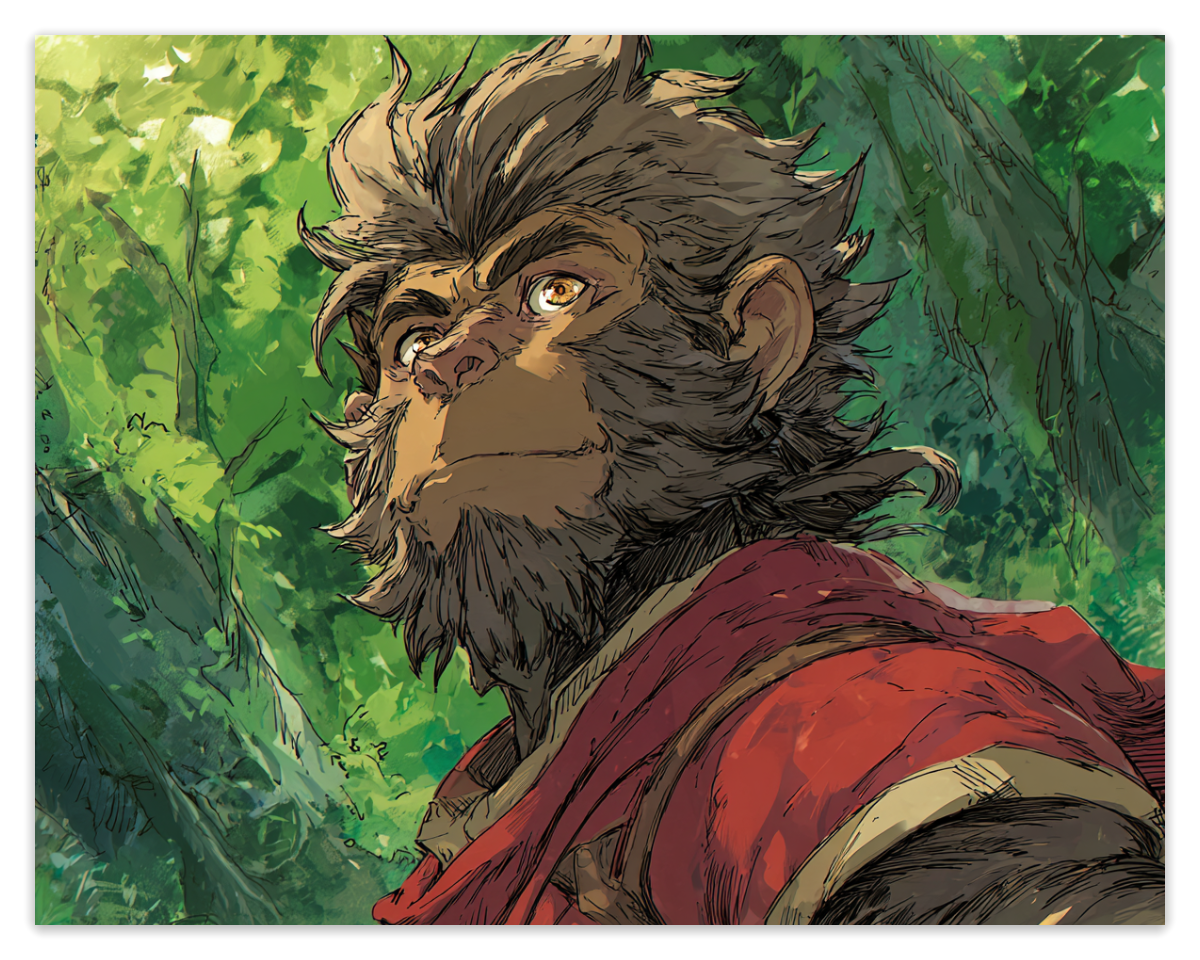
The Simians — called Junglekin by those who know them only from the margins of their territory and Hanara’s Children by those who know them at all — are a rare and deeply humanoid people whose connection to the living world runs deeper than any comparable ancestry in Midralis. They are physically striking without being monstrous, primate-adjacent in their features and movement but unmistakably people rather than animals, and possessed of the specific quality that centuries of sustained Spira cultivation produces: a stillness that is not inactivity but awareness so complete that urgency becomes unnecessary.
They exist in three regions of the world. In Auridia, they inhabit the unconquerable jungle interior of Gondo in southeast Lumér and the anomalously tropical north of Grandal’s Jag’dri republic. In Kyou, they occupy jungle and forest territories in the continent’s tropical interior. And in Caligoria, the Veiled Continent, they hold their oldest communities, their deepest traditions, and the site of Hanara’s original act of creation. The relationship between these three populations is not political. It is spiritual: the specific quality of connection that a people maintain across impossible distances when the Spira that connects them to their origin is the same Spira that keeps them alive.
What makes the Simians difficult for outside institutions to understand is precisely what makes them formidable in their territories. Their extraordinary Echo Potential is not a combat ability or a diplomatic advantage in any register those institutions recognize. It is the capacity to know their environment so completely that nothing can approach without their awareness and nothing can be hidden from them within their terrain. The Concordiax’s files on Simian populations are thinner than those for any comparable ancestry, not because Simians are uninteresting, but because the information doesn’t flow outward. What happens in the jungle stays in the jungle, and not by accident.
Origin & History
Hanara’s Blessing
The Simians trace their origins to the deliberate act of the Shaper Hanara — a being whose nature the Simian oral tradition describes with the specific imprecision of people who have been told something true but not everything true. Hanara, the great monkey deity and guardian of the jungles, shaped the Simians from the essence of the jungle itself: not elevated animals as Candus elevated wolves, but something closer to distillation — taking what the jungle already was and concentrating its most essential quality into a sapient people capable of tending it deliberately rather than simply living within it.
The first Simians were not made in Auridia or Kyou. They were made in the jungle territories of what is now Caligoria. The oldest Simian communities on that continent hold the specific quality of a people who have not moved from where they began. Their architecture, their oral tradition, their ceremonial practice all carry the mark of uninterrupted habitation — a continuity that the 3rd Age Auridian expeditions who briefly reached Caligoria noted without understanding.
The Three Regions
The Simian presence across three regions is not the product of migration in the conventional sense, not a people who originated somewhere and spread outward. It is more accurately described as the product of Hanara’s original act extending across multiple sites: communities shaped in different jungle environments that carry the same foundational inheritance while having developed genuine cultural divergence across millennia of separate experience.
Caligoria remains the heartland in all senses that the Simians themselves recognize as meaningful. The communities there are oldest, their oral tradition is deepest, and the site of Hanara’s original creation lies somewhere in Caligoria’s interior. Simians from the Auridian and Kyou populations who make the crossing to Caligoria describe the experience as returning to something they did not know they had been away from. The specific quality of the Echo connection in Caligoria’s jungles is, according to those who have experienced both, deeper than what any other jungle environment produces.
The Auridian populations — concentrated in Gondo’s unconquerable swamp-jungle confederation in southeast Lumér and in the tropical anomaly of Jag’dri in northern Grandal — have developed the most sustained contact with outside civilizations and are the Simians most familiar to Auridian institutions, which is to say they are still deeply opaque. The Kyou populations occupy jungle territories within the Hino Federation’s geographic boundaries but functionally outside its administrative reach for the same reasons that apply everywhere: the jungle is theirs, and what happens in it is not knowable from outside it.
The Elemental Cataclysm and the Jungle Territories
The Elemental Cataclysm reshaped Midralis entirely, but its effects on Simian populations were asymmetric. The jungle territories were not untouched, but jungle ecosystems — with their Prisma Current complexity and the deep Spira-saturation of living networks that centuries of Simian habitation had amplified — proved more resilient than terrain lacking those properties. The Simians who survived the Cataclysm period were already the people best positioned to survive it: beings whose Echo connection gave them advance awareness of what was coming, whose knowledge of their terrain gave them the specific places to shelter, and whose Spira connection to the living network meant that as long as the jungle survived, they had something to recover around.
What the Cataclysm did produce was a long period of deepened isolation. Routes between the three Simian regions that had existed in Old Midralis were disrupted. The heartland connection persisted not through physical contact but through the Echo connection that Simians describe as simply present across any distance: a description that no outside institution has a theoretical framework for and that the Ninefold Conservatory classifies, uniformly, as cultural metaphor.
The Simian Accords — A Convenient Fiction
The document known as the Simian Accords: the alleged formal agreement between the major powers of Midralis and Simian territorial representatives, by which Simian jungle territories were recognized as sovereign — does not exist in any archive. The Concordiax’s institutional records reference it. Auridian diplomatic correspondence cites it. The Hino Federation’s boundary documentation acknowledges it. No original copy has ever been produced because no original copy was ever made.
What exists is tacit acknowledgment, dressed in the language of formal agreement because formal agreement is the institutional framework that the organizations involved know how to process. The actual situation is this: Simian territory is not worth what it costs to take. Every military force that has attempted to operate in Simian jungle terrain has discovered, at cost, that the terrain is not neutral ground — it is actively hostile to those who do not belong in it. Units become lost in jungle that maps correctly. Intelligence on Simian positions is consistently wrong. Supplies disappear. Equipment fails. Personnel report the specific quality of sustained observation that produces psychological attrition even without direct engagement.
The Concordiax maintains the fiction of the Accords because acknowledging “we cannot take this territory” is institutionally untenable. The Simians do not correct the fiction because the fiction serves them adequately.
Culture & Society
The Echo as a Way of Life
Simian culture is organized around the cultivation of Echo sensitivity in a way that no other ancestry’s culture matches in directness or comprehensiveness. Where Navin ceremony deepens Prismal exposure, where Ork oath-practice encodes social obligation, where Canith pack-culture builds relational loyalty — Simian culture, in all its regional variations, consistently returns to a single foundational practice: deepening the Echo connection to the living network of the jungle and the living beings within it. This is not practiced as a formal discipline. It is practiced as a way of being.
The consequence for outsiders interacting with Simians is a specific quality of encounter that visitors to Simian communities consistently report: the sense of being known before introduction, of having one’s emotional state accurately perceived without disclosure, and of having one’s intentions read with an accuracy that makes deliberate deception feel futile. Simians do not announce this capacity. They do not explain it. They simply respond to what they perceive, and what they perceive is considerably more than what was said.
Zoan and the Language of the Body
Zoan, the Simian racial language, carries in its movement-integrated structure the most direct expression of what Simian culture values: that communication is a full-body act in which what you say with your posture, your gesture, and your position in space carries as much meaning as what you say with your voice. A Simian speaking only the verbal register of Diplomata is a Simian running at reduced capacity: functional, comprehensible, but stripped of the layered meaning that their full expressive range produces.
For outsiders interacting with Simians: what the Simian says in Diplomata is what they want you to understand. What their body is saying in Zoan, simultaneously, is what they actually perceive and feel. These are not always the same thing, and they are not always divergent in ways that constitute deception — sometimes the discrepancy is simply the gap between what is translatable and what is not.
Community Structure
Simian communities are organized around canopy groves rather than fixed settlements in the architectural sense, not because Simians cannot build permanent structures but because the living jungle is a better home than any constructed alternative. The communities are small by the standards of surface civilizations, distributed across territory rather than concentrated, and connected to each other through Zoan communication over jungle distances that other species find remarkable.
Governance within communities is organic and elder-led without being formally hierarchical. The Simians who have lived longest, and therefore whose Echo depth is greatest, hold authority not through formal designation but through the specific weight that a centuries-old being’s perception carries in any group. When an elder Vahari indicates, through the specific Zoan register of considered conclusion, that a particular course of action is wrong, the community does not need a governance structure to enforce deference. The deference is instinctive and appropriate.
Sub-Types
The two Simian sub-types carry genuine physical and cultural distinction while sharing the foundational Simian inheritance of extraordinary Echo Potential and the Spira-longevity connection. Inter-sub-type communities are common, particularly in Gondo and Jag’dri where the terrain supports both. Their Echo practices differ in orientation rather than in depth — both achieve extraordinary attunement, but to different aspects of the living world.


Physical Features
- Stature: 4’–7’ depending on sub-type — Kurra run 6’–7’, broad and heavily built; Vahari run 4.5’–6’, lean and agile; both are recognizably humanoid in overall form despite primate characteristics.
- Build: Deeply humanoid in structure: bipedal, upright, with hands capable of fine manipulation. The primate characteristics are in the face, proportions, and movement quality rather than in a fundamentally non-humanoid anatomy. Outsiders who have not encountered Simians sometimes expect something more animal and find beings who are unmistakably people.
- Skin & Fur: Variable across and within sub-types. Kurra range from deep black to gray-brown with the specific density of heavy-bodied primates; Vahari range across warm browns, ochres, and rufous tones. Some individuals in both sub-types carry patches of contrasting color that intensify with age and Echo development.
- Eyes: Large, expressive, and carrying the specific quality of sustained attention that Echo-reading produces. Outsiders consistently describe the experience of meeting a Simian’s gaze as feeling observed more thoroughly than usual. This is accurate. The eyes move in ways that track more than what is visually salient.
- Hands: Long-fingered, strong, fully capable of fine manipulation. The movement register of Zoan is primarily expressed through hands and arms; a Simian in full Zoan communication is using their hands as much as their voice.
- Movement: The quality most striking to first-time observers: fluid, economical, and carrying the specific efficiency of beings who move through three-dimensional canopy space as naturally as others move on flat ground. Vahari move with particular speed and directional spontaneity; Kurra move with deliberate weight that reads immediately as presence rather than slowness.
Alignment
Simians typically exhibit neutral alignment, focusing on the balance and harmony of the jungle and the living network they tend. They are driven by a desire to protect their homes from external threats, acting as guardians of a delicate ecosystem that is simultaneously their territory, their community, and their survival mechanism. The specific quality of Simian ethics is shaped by the total perception their Echo development produces: it is very difficult to develop contempt for another being when you can feel their Spira directly, and very difficult to commit casual violence against a living system you are Spirally fused to.
Individual Simians vary considerably, particularly those who leave their territories and spend extended time in surface civilizations. The Simians who leave their jungles and stay gone tend to be the ones who have found something in the outside world that their Echo reading tells them genuinely needs their attention.
Affinity Disposition
Simian Spiritual Expression distribution reflects the deepest sustained connection to living systems of any ancestry in the compendium. Thunder at 13.0 is the dominant expression — reflecting the loudness, social presence, and natural leadership orientation that defines Simian community life; Simians are vocal, outspoken, and instinctively coordinate with and lead others. Nature at 12.0 is the co-dominant expression, consistent with a people whose civilization is literally organized around the living network of their jungle environment, not the Nature expression of appreciation for wilderness but of sustained Spira-fusion with it across centuries. Earth at 10.0 and Mind at 9.0 are both elevated. Metal at 4.0 is the most notably suppressed expression: a people whose relationship to the material world is mediated through living systems rather than extracted materials develops minimal Metal attunement as a population-level pattern.
| Spiritual Expression | Distribution (%) |
|---|---|
| Nature | 12.0 |
| Wind | 9.0 |
| Anima | 5.5 |
| Mind | 9.0 |
| Fire | 5.5 |
| Metal | 4.0 |
| Earth | 10.0 |
| Aqua | 7.0 |
| Electricity | 6.0 |
| Ice | 4.0 |
| Thunder | 13.0 |
| Darkness | 5.0 |
| Light | 9.0 |
| Empyreal | 1.0 |
Empyreal at 1.0 is elevated above the standard mortal baseline of 0.5, reflecting Hanara’s Shaper-origin influence on the population.
Conflicts & Connections
With the Concordiax
The Concordiax’s relationship to Simian populations is characterized by the specific frustration of an institution that has correctly identified a significant unknown and has been unable to do anything about it. Simians who leave their territories and interact with Auridian civilization receive the Verbum, participate in the Concordiax’s administrative framework as required, and are catalogd with Prismal Signature assessments that accurately reflect their ★☆☆☆☆ Prisma Potential. These assessments produce institutional files that dramatically understate both the Echo depth of the population and the implications of their Spira-longevity connection.
The Concordiax’s zero reach into Simian territory is not for lack of interest. It is for lack of mechanism. The Concordiax maintains the fiction of the Simian Accords because acknowledging that Simian territory is simply inaccessible would require acknowledging that the Concordiax’s regulatory reach has a fundamental geographic limit — a concession with implications that extend well beyond Simian territory to the general question of what the Concordiax’s authority actually rests on when separated from enforcement capacity.
Language Notes
Zoan (racial language) is movement-integrated communication in which meaning is completed by gesture and posture. The verbal register is the smaller part of its total communicative capacity. A Simian speaking Diplomata without access to their full physical expression is communicating at reduced fidelity: the movement register carries emotional state, certainty gradation, Echo-awareness status, and spatial perception data that no verbal language has vocabulary for. The Ninefold Conservatory’s single classification note on Zoan — “movement-integrated; verbal register accessible through Diplomata” — captures approximately one third of what the language actually does.
Systems & Campaigns
- Pathfinder 2e Kitsune (reskinned) / Vanara › Simian
- D&D 5e+ Tabaxi / Loxodon › Simian
- Draw Steel TBD
- Daggerheart TBD
- Realmfall Saga Active
- Ultimus Concluded