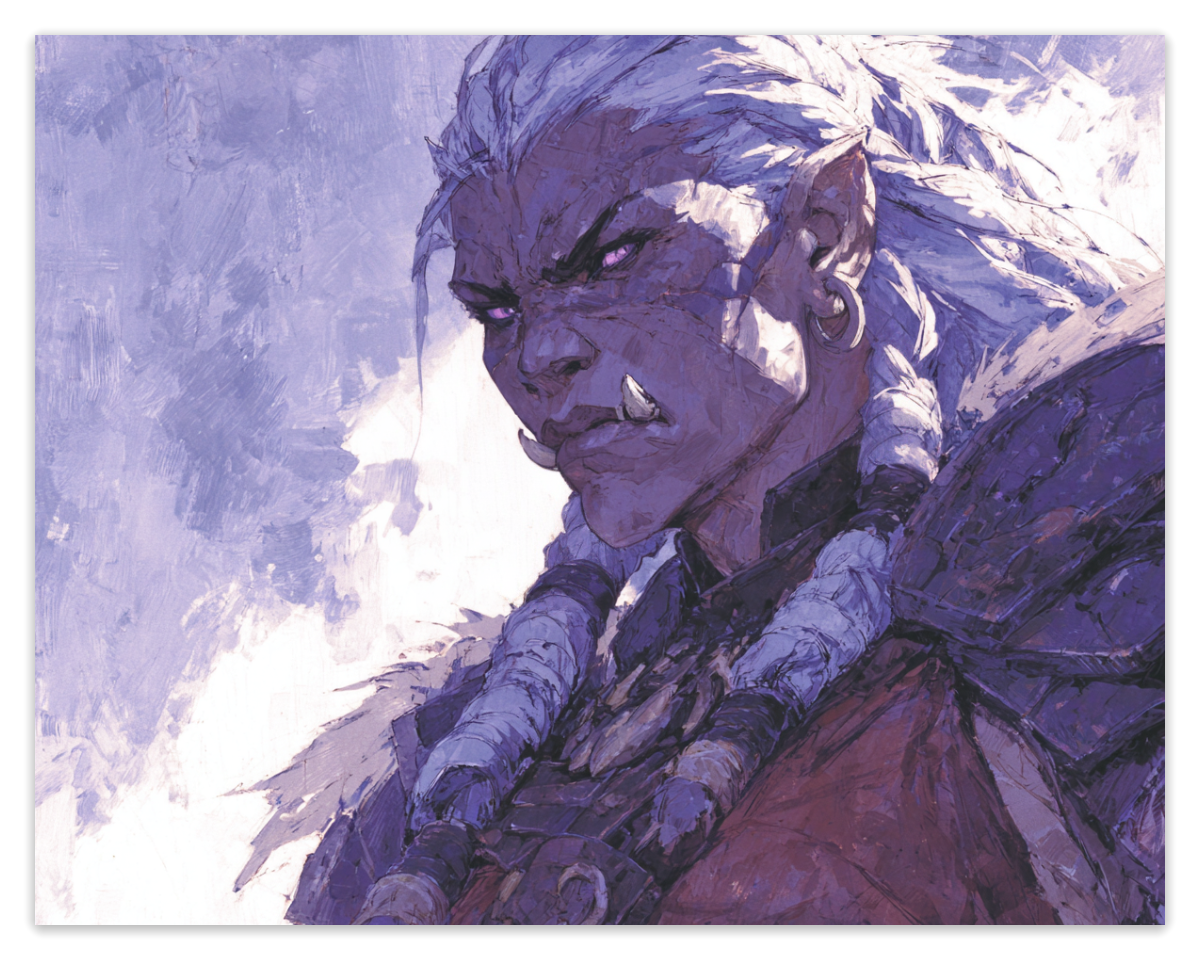
Ancestry · Iphexar · Xum / Kiriyan Steppes
Ork
“Orks are not a child of Midralis’s loam but of Xum’s gloam, hammered into shape by shadow and hunger. Their first footprints on Midralis were no timid scouts but iron-shod war-bands, still slick with the shadow-ink that stains their hides. I have watched gray Vaarkhúl matriarchs carve oaths into living rock with a single tusk, and green-skinned scions laugh beneath the ‘Helrune’ sun that slowly rewrites their very blood. Let it be known that they should be placed upon the Watch List, not for hidden malice, but because the next Nightfold Breach could disgorge a legion still untempered by the Solgeis.”
— Eonlogos, Celestian Archivist
Overview
Orks are shadow-forged nomads whose earliest mothers strode from Xum in the 2nd Age, approximately 1500 N.A., through Nightfold Breaches that tore open in the far south of Kyou. They are not children of Midralis. They are visitors who stayed, shaped by forces that have no equivalent in the settled world’s institutional frameworks. Gray-black Vaarkhúl bloodlines wear luminescent ink-tattoos called gloambrands that still echo their Xum origin, while long years beneath Midralis’s Helrune sun have mutated later generations into the familiar jade of today’s Gralshak.
They are matriarch-led war-clans who roam the Kiriyan Steppes of southern Kyou, locked in the centuries-old Forever Wars against Erdenezuun horse-lords and disciplined Hobgoblin forts. Outside the steppes, scattered packs sell bone-clad discipline and problem-solving prowess rather than conquest; every Ork carries the scent of Xum in their veins whether or not they have ever set foot in the realm that made them.
Their cultural dismissal of structured Prismaturgy — expressed as contempt for the weakness of those who need external frameworks to access internal force — is not ignorance. It is a position developed by a people who crossed from a realm where the Solgeis worldspell has no presence into a world where that same worldspell underpins most of what passes for civilizational safety. Orks are not afraid of the dark. They came from it.
Origin & History
Xum — The Shadow Cradle
Xum is the third world born from Auraprima’s shattering during the Divine War — shaped by the corrupted energy that pooled in the destruction’s shadow. Where Veraldié was formed from uncorrupted divine energy, Xum began in corruption and has remained what it was. Its relationship to Midralis is structural adjacency: they share an Auraprima origin, which is what makes passage between them possible under the right conditions.
In the cavernous region of Krakoroegar, lit only by bioluminescent quartz and ruled by proto-ork packs, scarcity and relentless predation by umbradrakes forged a creed of ruthless cooperation: the pack survives, or none survive. This is the baseline Xum instilled in every Ork before the crossing, not violence as personality, but violence as the least negotiable survival requirement, so thoroughly internalized that it became indistinguishable from character.
The void-iron monolith experiments that produced the first Nightfold Breaches were not spontaneous events. They were the result of sustained Vaarkhúl matriarch interest in what lay on the other side of the Xum boundary: an interest that bone-scribe records, in their oldest Orkish register, describe as beginning centuries before the first crossing. The matriarchs had been probing the boundary. What the monoliths achieved was stabilization of a crossing point long enough for coordinated movement.
The Nightfold Breaches — ~1500 N.A.
Around 1500 N.A., in the far south of Kyou, void-iron monoliths ripped stable fissures in the Xum boundary and entire clans crossed at dawn: the unfamiliar Helrune radiance scorching obsidian skin, the air too bright, too still, too suffused with the Solgeis presence that Xum-born biology had never encountered. What Kyou’s historical record calls the Gloomphase and what Ork bone-scribes record as the Vorruk-Tide — the moment of irreversible crossing — was not an invasion in the strategic sense. It was a migration that arrived prepared to fight for what it found.
The Concordiax’s files on Nightfold Breach locations are classified at the highest available level. Several Breach sites are known to exist in or near the Kiriyan Steppes. The void-iron monoliths that produced the original Breaches have not all been located or secured.
The Vorruk-Tide and the Gloomphase (~1500–1700 N.A.)
Emerging onto the Kiriyan Steppes, the Vaarkhúl found a sea of rolling grass, scattered Erdenezuun Myûr horse-lords, and disciplined Hobgoblin stone-forts. The Helrune sickness hit immediately: the Solgeis-saturated sun rewriting Xum-born hides in ways no Ork had survived long enough to fully anticipate. Those who endured it fought through it. Swift bonescythe-chariot raids pushed the Erdenezuun north, cracked Hobgoblin lines, and carved out territory in the far south of Kyou with the specific ruthlessness of beings who had crossed something irreversible and had nowhere to retreat to.
The Gloomphase lasted roughly two centuries of sustained conflict before exhaustion on all sides produced the armistice and the territorial grants that ended the open invasion phase. The Orks who chose integration were granted territorial claims in southern Kyou: formal recognition, writ in Hino Federation legal framework and in Orkish oath-carving on the boundary stones.
The Gralshak emerged not from a second crossing but from the Vorruk-Tide’s biological aftermath. Ork lineages that survived Helrune exposure long enough to reproduce on Midralis found subsequent generations shifting toward jade-green skin and altered humors, the Verdigris Flux, as Ork bone-scribes named the multi-generational adaptation process. The Gralshak who emerged were still fully Ork. They were Ork with the sun written into their cells.
The Tripartite Front and the Forever Wars
Alarmed city-states across Kyou quickly armed the steppes’ foes. Under the Three-Front Pact, an uneasy alliance formed — Erdenezuun sharpshooters, Hobgoblin stone-forts, and Hino bushi. After decades of attrition, exhaustion led the matriarchs to sign a truce, an armistice writ in stone and tusk. The truce that ended the Tripartite Front was not a defeat for the Orks. The matriarchs who signed it did so from a position of military stalemate: the Three-Front alliance had proven unable to drive the Orks from the Steppes, and the Orks had proven unable to crack the Hobgoblin fortification lines.
The Forever Wars are now in their fifteenth century and show no sign of structural resolution. The Hino Federation designates the ongoing violence as ‘local disputes’ — a classification that the Erdenezuun, Hobgoblin, and Ork communities involved find variously infuriating and useful depending on what they need from the Federation at any given moment. Within Ork communities, the Forever Wars mean different things: older Vaarkhúl lineages regard the territorial grants as insufficient and nurse old claims, while Gralshak clans that have occupied their southern Kyou territory for eight or ten generations regard the grants as the legal foundation of their actual home. They fight in the Forever Wars because the Erdenezuun encroach on that home, not because they are pursuing a Xum-origin agenda they never personally held.
Sub-Types
The Vaarkhúl and Gralshak are not simply physical variations — they represent genuinely different relationships to their cosmological origin and to Midralis itself. A Vaarkhúl is Xum made mobile, carrying the shadow-realm’s imprint at the cellular level. A Gralshak is what happens when Xum-origin biology encounters Midralis conditions across sufficient generations and the sun rewrites the inheritance. Both are unambiguously Ork.


Culture & Society
The Matriarchal Theology
Ork societies are matriarchal. The basis is theological rather than biological: matriarchs hold authority because they are believed to maintain the closest living connection to Xum through gloambrand density. The gloambrand is not merely a record — it is a sustained low-level working that keeps its bearer in partial Xum-adjacency, and the more dense the gloambrand, the more continuous that adjacency becomes. In a people whose origin realm is Xum, the individual most anchored to Xum is the individual whose judgment about the world is most cosmologically grounded. This theology produces a specific political structure: authority correlates with gloambrand density, which correlates with age and oath-history, which means older Vaarkhúl matriarchs hold more natural authority than younger warriors regardless of combat record.
The Bone-Scribe Caste
Bone-scribes are a formal caste, not a tradition anyone can pursue, but a structured lineage with its own hierarchy, training protocols, and political authority equal to combat leaders. Bone-scribes are never warriors. The distinction is categorical and enforced: a bone-scribe who takes up a weapon in anything other than immediate personal survival has made a statement about their priorities that the caste’s hierarchy will address formally.
The caste’s authority derives from their function: bone-scribes are the custodians of clan memory, the official readers and writers of gloambrands, the arbiters of oath-disputes, and the keepers of the bone-archives where the carved records of clan history are stored. A matriarch who wants to declare an oath fulfilllled must have a bone-scribe confirm the reading. Training is generational: a minimum of a decade of study before a bone-scribe is considered fully qualified. Senior bone-scribes are among the most politically significant Orks in any clan, and their relationships with each other across clan boundaries constitute an informal inter-clan network that functions independently of warrior politics.
Oath-Feasting
Oath-feasting is the primary non-martial cultural institution of Ork society: the ritual through which major oaths are sealed in a way that gloambrand-carving alone does not achieve. The shared consumption of specific foods in specific combinations communicates, in the archaic Orkish ritual register, the precise nature of what is being bound and at what depth. Different ingredients carry different binding connotations: certain meats signify blood-obligations that extend to the whole clan, certain preparations signify time-limited terms, certain combinations signify that the oath survives the death of one party and transfers to their designated successor. Non-Ork parties who attend oath-feasts without understanding the specific Orkish binding-register of what they consume are committing themselves to terms they may not have agreed to.
The Oath-Tusk and Its Loss
The tusk used for oath-carving — pressing Orkish glyph-register into stone, bone, or living rock — is called the oath-tusk and is never used in combat. An oath-tusk that draws blood in combat is considered compromised, and any oath carved by that tusk afterward requires re-verification by a senior bone-scribe. Orks who lose their oath-tusk to injury face a significant social crisis. The recovery process is called re-rooting: a public ceremony conducted by a bone-scribe in which the Ork’s full oath-record is re-established on treated bone harvested from the Ork’s own body for this purpose. The ceremony is humiliating not because it is explicitly degrading but because it is public — every clan member present witnesses the full inventory of the Ork’s current obligations, including those they might have preferred to maintain as private.
Physical Features
- Stature: 6’–7’ on average, broad-shouldered, tusked. Ork sexual dimorphism runs counter to most humanoid ancestries — Ork women consistently match or exceed men in build across both sub-types.
- Skin: Vaarkhúl are gray-black with violet (Khal-Vorg) or verdant-olive with amber eyes (Khal-Grin). Gralshak are jade to verdant-olive across the full range. Multi-generational hybrids show mottled slate and moss tones that map the generational distance from Xum with reasonable precision.
- Gloambrands: Vaarkhúl-specific; living shadow-sigils that glow indigo under astra-sight, encoding lineage and oath-chains in readable Orkish glyph-register. Absent in pure Gralshak bloodlines but occasionally present in attenuated form in hybrid individuals.
- Hair: Coarse manes, usually charcoal or deep brown. Matriarchs wear silver-streaked braids threaded with bone beads: the bead count and material encode rank in a secondary record-keeping tradition.
- Tusks: Single lower tusks of significant size. The oath-tusk, used for oath-carving, is never used in combat; the tusk used for oath-carving is considered sacred and its compromise a serious social crisis.
- Build: Dense muscle over heavy bone. Ork endurance: the capacity to sustain effort under conditions that would break shorter-lived or more delicately constructed beings — is the physical characteristic that most impresses non-Ork observers in extended field conditions.
Alignment
Orks prize oath-loyalty and debt-honor over abstract law. Most skew Chaotic Neutral to Chaotic Good within clan, but stray toward Neutral Evil under tyrant matriarchs. Martial prowess is celebrated, yet storytellers and bone-scribes hold equal status, tasked with keeping clan memory alive.
The specific quality that outside observers consistently misread is the primacy of the oath over the abstract principle. An Ork who has given an oath is bound by that oath regardless of what the law says about the situation the oath covers. An Ork who has not given an oath has no obligation that they did not choose. This produces behavior that looks, from outside, like either extraordinary reliability or complete unreliability depending entirely on whether an oath exists.
Affinity Disposition
Ork Spiritual Expression distribution reflects Xum’s cosmological conditions imposed on Midralis-resident biology. Darkness dominates at 12.0 — a direct inheritance from a realm whose language makes grammatical distinctions between different qualities of absence. Wind, Fire, Metal, Earth, and Thunder cluster tightly at 10.0 each — consistent with the specific combination of mobility, material toughness, territorial force, and decisive collective action that Ork pack culture has elevated as its core values across millennia of Steppes conflict. Light at 3.0 and Ice at 3.5 are the lowest expressions — revelation and stasis, both antithetical to the Ork’s fundamental relationship to the world.
| Spiritual Expression | Distribution (%) |
|---|---|
| Nature | 5.5 |
| Wind | 10.0 |
| Anima | 8.0 |
| Mind | 5.0 |
| Fire | 10.0 |
| Metal | 10.0 |
| Earth | 10.0 |
| Aqua | 4.5 |
| Electricity | 8.0 |
| Ice | 3.5 |
| Thunder | 10.0 |
| Darkness | 12.0 |
| Light | 3.0 |
| Empyreal | 0.5 |
Conflicts & Connections
With the Erdenezuun Myûr — Perpetual Wound
The Erdenezuun are the Myûr ethnic group of the Kiriyan Steppes — horse-lords whose relationship to their steppe territory predates the Ork arrival and whose displacement northward during the initial Kiriyan Surge is the founding wound of the inter-Steppes conflict. Day-to-day contact between Ork clans and Erdenezuun communities on the steppe margins is unavoidable and transactional — trade happens, information is exchanged, Gralshak mercenaries are occasionally hired for specific Erdenezuun operations. This contact does not resolve the underlying conflict. Every generation produces at least one incident significant enough to require armistice-interpretation by bone-scribe and Erdenezuun elder councils. None of these interpretations have resolved the underlying territorial question.
With the Hobgoblins — Martial Respect, Political Hostility
The Hobgoblin relationship to Ork clans is the most complicated of the three Steppes dynamics — characterized by genuine mutual recognition of martial competence that the Ork-Erdenezuun relationship does not produce. Hobgoblin military discipline and Ork shadow-combat capability represent genuinely different approaches to the same problem, and Hobgoblin commanders who have faced Ork war-bands have developed professional respect for what they are facing. This respect is entirely consistent with sustained political hostility. The bone-scribe records of the Steppes-Endless War’s Hobgoblin engagements are the most detailed military histories in the Ork oral archive — preserved with a specificity reflecting the bone-scribes’ recognition that the Hobgoblin tactical approach warrants detailed study.
With the Concordiax
The Concordiax’s relationship with Ork populations is structured by geography as much as policy. The Kiriyan Steppes concentration falls outside the Auridian Union’s primary administrative reach, where the Concordiax’s influence is indirect at best. Gralshak mercenary bands operating in Auridia occupy a different situation: most have received the Verbum, because Diplomata fluency is practically essential for mercenary work in mixed-ancestry markets. They accept it with the awareness that the process produces Spira-assessment data the Concordiax retains: a cost of doing business in Midralis’s institutional landscape, not an endorsement of the institution. The significant underestimation of their actual Prismal capacity that results from this assessment is, as noted, entirely satisfactory to the Gralshak.
Language Notes
Orkish (racial language) evolved by Ork communities across centuries of Kiriyan Steppes existence. Orkish carries precise gradations for concepts of debt, obligation, and earned respect that Diplomata does not model. The honor-code register encodes the specific weight of different oath categories, the degrees of obligation between parties of different status, and the formal vocabulary the bone-scribe caste uses in clan records. A Diplomata speaker engaging an Ork in a formal context receives a translation of what is being said: what the grammar means about who owes whom, what category of relationship is being invoked, and what has been deliberately left unnamed does not survive the translation.
The bone-scribe tradition operates primarily in Orkish. Bone-scribes are among the most fluent Orkish speakers alive and among the most culturally significant within their communities. Their records, carved in Orkish glyph-register on bone and stone, constitute an independent historical archive of Kiriyan Steppes events that no outside institution has accessed and that the bone-scribes themselves would not describe as accessible to outsiders in principle.
Systems & Campaigns
- Pathfinder 2e Orc › Ork
- D&D 5e+ Orc › Ork
- Draw Steel TBD
- Daggerheart TBD
- Realmfall Saga Active